

Hello, and welcome to the fourth and final part of my Lovers and Other Killers episode guide. If you haven’t already seen it, I recommend starting with Part 1.
There are four parts to this episode guide:
- Part 1 is a introduction, including the setting, characters, and context of the episode.
- Part 2 is a detailed timeline of the episode’s events.
- Part 3 is my analysis of the episode.
- This is Part 4, a collection of fun extras that I like to call Bonus Features.
Bonus Features
Gender Politics 101
This episode examines conventional gender roles, norms, and double standards, but with a critical eye, or a blind one?
The Bechdel Test
This is a murder mystery in which the sleuth, both murder victims, and the murderer are all women. However, this episode comes very close to failing the Bechdel test, because almost all the conversations between the female characters are about men. Allison Brevard dies without any dialogue. Lila has a single conversation, it’s with Jessica, and it’s about David. Except for a brief exchange about the secretarial job posting, Jessica and Amelia only talk about Edmund and David, until their final conversation about Lila’s murder.
Does it matter? This series is built on the appeal of a strong, intelligent, multifaceted woman who goes everywhere, knows everyone, and is good at just about everything. No one could accuse Murder, She Wrote of representing women in a limited way, right? Right?
Tale as Old as Time

Ok, maybe not tale as old as time, but certainly a trope as old as the workplace. Amelia, the secretary, is in unrequited love with her boss. Likewise, David, the other secretary, is also romantically interested in his boss. Neither of these relationships gets off the ground. However, Lila, the teaching assistant, is allegedly having affairs with at least two of her superiors at the university, with disastrous consequences.
Power-imbalanced workplace relationships like these are often portrayed as both prevalent and romantic, but they are potentially very destructive, and arguably non-consensual on the part of the subordinate. It’s frustrating to me that neither Professor Lowery nor Dean Gerard seem to fear any professional consequences after pursuing a (murdered) teaching assistant. And yes, while it’s possible for a woman in a position of power to exploit a subordinate in this way, the reverse is much more common.
Men and Women Can’t Be Friends?
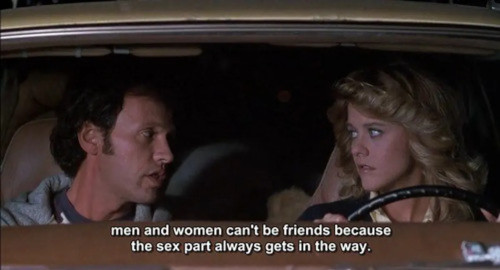
This episode seems to be of two minds when it comes to platonic relationships between men and women. Edmund and Jessica are old friends, but now that they are both widowed, shipping them seems almost unavoidable, from Edmund’s playful assertion that Jessica “picked the wrong one” to Amelia’s jealousy of Jessica as a perceived rival. On the other hand, Jack the jealous husband easily dismisses the exceptionally attractive David as simply a friend of his wife, and nothing more.
The Pick Up Artist
The most interesting and memorable dynamic of this episode is the relationship between David and Jessica. David’s interview is basically a pick up routine, and it’s calculated to leverage Jessica’s ideals about gender equality. It’s how he (literally) gets his foot in the door.
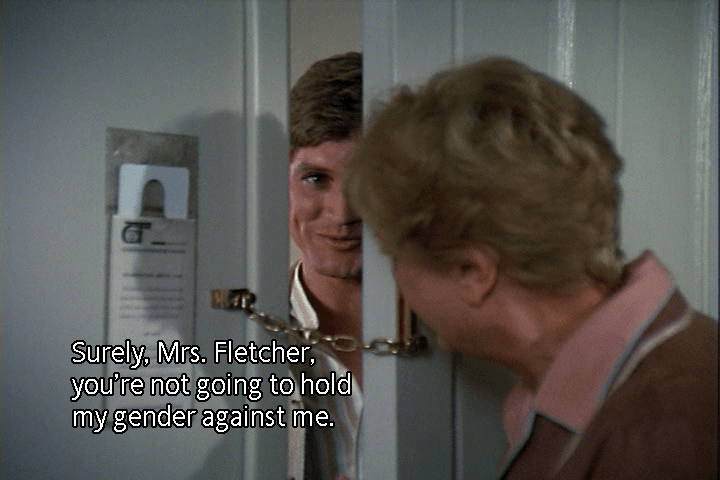
The rest of his interview plays out like a conventional pick up. David tricks and charms Jessica into letting down her guard.

And once he’s won her approval, he even has the audacity to neg her writing.
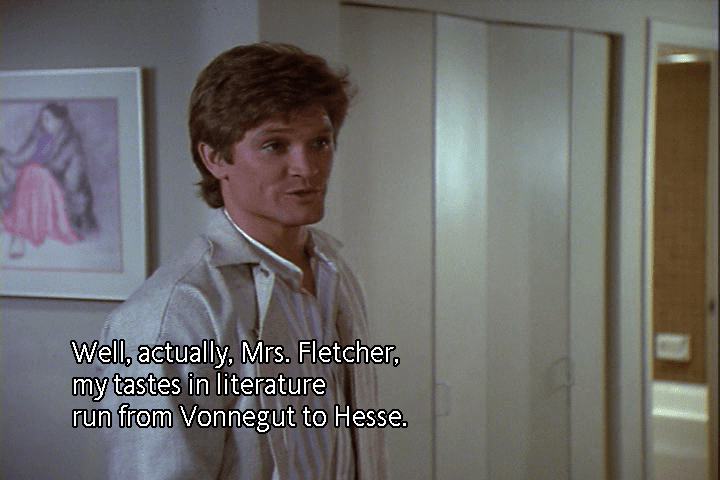
David would like Jessica to believe that all her misgivings about him are rooted in her own gender biases. And it works, for a while, at least. When her confidence in him does begin to flag, it rebounds seemingly as an indignant response to Andrews’ and Edmund’s sexist and ageist aspersions about their relationship.
In the end, David Tolliver is a flawed, but ultimately innocent, character who may sincerely care for Jessica. So, is he a modern young secretary whose genuine interest in a successful older woman upends 1980’s gender norms? Or, is he a creepy pick up artist whose manipulative behavior reinforces conventional narratives?
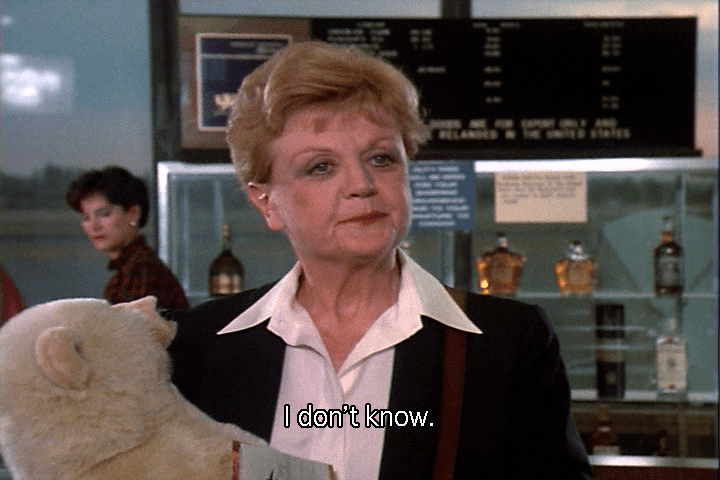
It’s OK to Say No to a Man. Here’s How.
The gender politics of this episode are pretty muddy. However, in a world where gender inequality and double standards still exist, Jessica demonstrates how to confidently communicate and enforce her personal boundaries with a man who would transgress them. This may not seem revolutionary or heroic, but it is quietly empowering to generations of women inured to accommodating men.
Do crimes.
First Murder!
- Victim: Allison Brevard
- Culprit: Anonymous criminal
- Motive: Burglary (Greed)
- Weapon: XL String of Pearls (Garrote)
- Before Our Eyes: Poor Allison is strangled on-screen
- Crime Scene: A posh townhouse
- Discovery: 4 minutes, or 8% through
Second Murder!
- Victim: Lila Schroeder
- Culprit: Amelia the Secretary
- Motive: Jealousy (Greed)
- Weapon: Longshoreman’s Hook (Pointy Object)
- Done Deed: The fatal blow is struck off-screen
- Crime Scene: An abandoned warehouse
- Discovery: 24:30, or 50% through
Other Crimes!
- Reckless driving: Amelia, for that night at the Lumberjack Inn
- Assault and battery: Amelia, for pushing Jessica down the stairs
- Obstruction of justice: David Tolliver, for lying to the police about his whereabouts the night of Allison Brevard’s death, and the nature of his relationship with Lila Schroeder.
- Trespass: Amelia, Lila Schroeder, and Jessica Fletcher, for their several encounters at an abandoned warehouse. David Tolliver, for inviting himself into Jessica’s hotel suite one too many times. And, while it might not have been trespassing, honorable mention to that time Jessica gained access to the Sequoia University men’s gym.
Psycho Killer
There is a theory that Jessica Fletcher is the most successful serial killer of all time. It’s pretty easy to see how she might have done it this time – instead of Amelia, it was Jessica who stuck a longshoreman’s hook into Lila. Why? I imagine Jessica might have found Lila’s phone etiquette a bit lacking, and she hates people when they’re not polite.
Tropes, Devices, and Other Conventions
Mystery Tropes
Love Triangle Hexagon
If you count Emily Lowery, a great gal who’s hard to fool, there are three men (Jack, Edmund, Todd) and three women (Lila, Amelia, Emily) in this episode’s proverbial love triangle, except that three and three makes six, which adds up to a love hexagon.
Oddly located corpse
Allison Brevard is killed in her own home, which is chillingly realistic, but Lila is murdered in a more unusual place, a spooky abandoned warehouse.
Suspicious Phone Call
It’s suspicious when we overhear only part of a character’s phone call, or we don’t know who’s on the other end. There are plenty of on-screen phone calls this episode, but each time we either know the identity of the other party, or we see both sides of the call.
There is one truly suspicious phone call this episode, the one that results in Jessica heading to Professor Lowery’s office on Wednesday night. It’s a crucial element of the plot, and yet no part of it is depicted on screen. In this way, it’s a doubly suspicious phone call, because it casts suspicion on both the person who allegedly placed the call, and the person who claimed to have received it.
Plot Devices
flashback
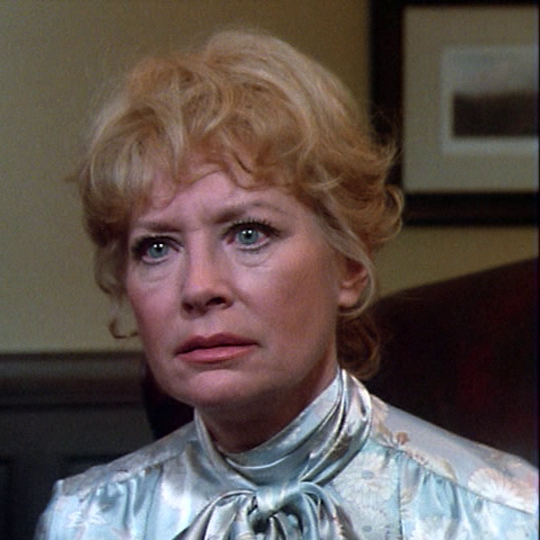
There is one brief flashback during the final conversation between Jessica and Amelia, showing Amelia managing Edmund’s bills, specifically the bill for the inflatable raft. I don’t think it’s necessary, especially because it only shows the audience something we’ve already seen, rather than some new detail. The popcorn-worthy flashback we really deserve is Amelia wielding a longshoreman’s hook during her encounter with Lila in the abandoned warehouse.

bookends
Jessica’s presence in this episode begins and ends symmetrically, with her arrival and departure at the Seattle airport, each time holding in her arms an impromptu totes adorbs travel buddy.

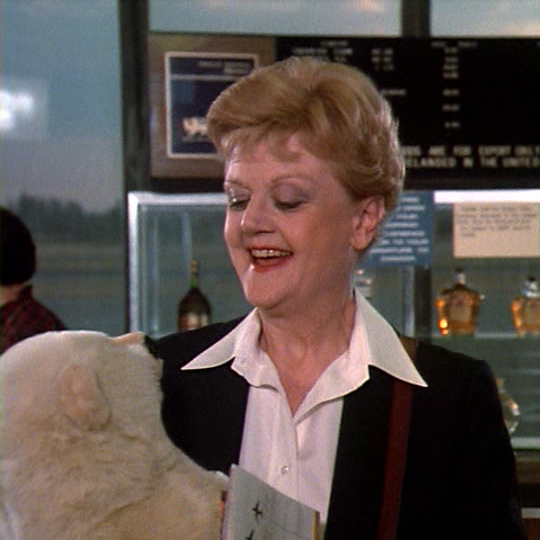
This was a really masterful, subtle choice by the writers. The episode itself actually opens and closes on two very dark scenes, Allison Brevard’s murder and David Tolliver’s intense stare. Jessica bookends her own presence in the episode by literally carrying in and carrying out the cozy.
MSW Tropes
Door of Truth
An offhand word from David – that a “person” called – is the last clue Jessica needs to solve the mystery.
Confess Thyself
In typical MSW fashion, Jessica confronts the killer alone and persuades her to confess.
Bait of Falsehood
Jessica lies to Amelia to trick her into confessing to Lila’s murder. Jessica tells Amelia that Edmund is about to be arrested for Lila’s murder, which is false. She also says Edmund doesn’t have an alibi, which is a teeny tiny plot hole, since the audience doesn’t know if that is true or false.
I Play the Villain
Often MSW will give us a character who I think of as The Jerk Who Isn’t The Murderer. I think that the writers intended Jack for this role; however, in my opinion, Edmund is the biggest AH this episode. He’s callously indifferent to Amelia’s feelings for him. Jessica tells him that Amelia is in love with him early on, so his final claim that he “had no idea” is BS. Worse, he takes advantage of a vulnerable subordinate, Lila, and after she’s dead, coldly dismisses the relationship as disposable, saying he “could have handled it.”
Smile and Smile

In order to finish on an up note, there’s almost always a cheesy freezeframe of Jessica laughing or otherwise mugging in response to the last, generally pretty lame, joke of the episode. By contrast, this episode is memorable for it’s unsettling final image of David Tolliver’s menacing stare after Jessica.
What She Wore
How to Wear a Scarf
We get one scarf from Jessica this episode, as part of her travel attire.
Jessica’s Best Look
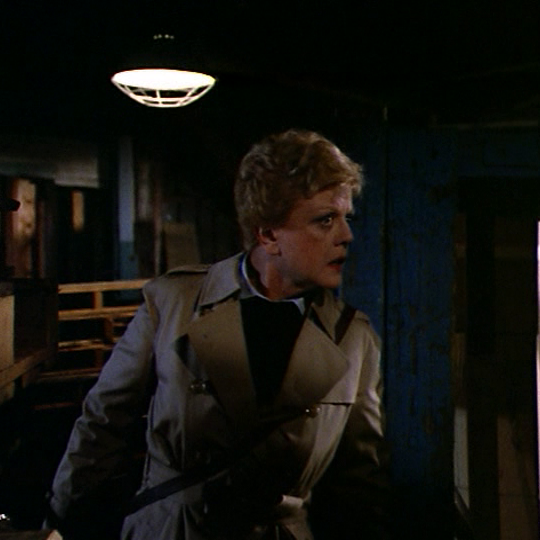
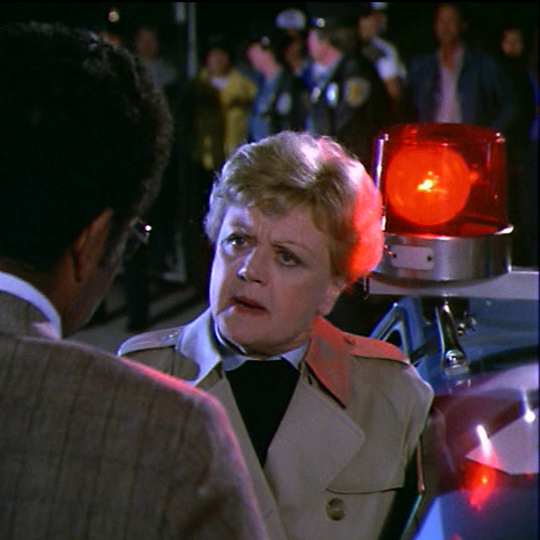
I didn’t find many noteworthy looks from Jessica this episode. My favorite is this navy blue sweater with a crisp collar and a classic trench- clean, timeless, and practical.
Jessica’s Least Best Look
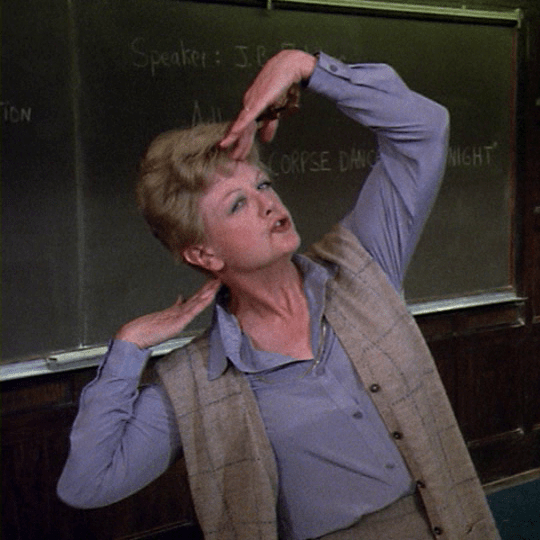
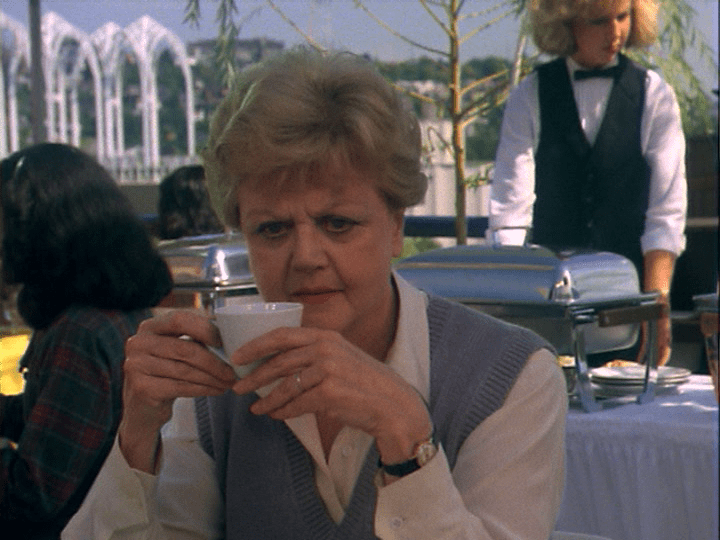
Dear Lord, lead us not into sweater vests.
Best Look Overall

This sweater, I guess. It really says 1984 and does a nice job of bringing out the blue of his eyes.
Least Best Look Overall
This sweater, again, because even though I kind of like it, I also really hate it.
The Rest of the Story
David Tolliver seems like a perfect character to reencounter in the MSW universe, but we never see him again. Here’s what happens instead.
Like any pick up artist, David doesn’t enjoy losing a quarry, but after Jessica gets on that plane back to Boston, he’s ready to move on, both figuratively and literally. As a person of interest in two recent murders, David finds Seattle a bit stifling, and decides to relocate. His taste for older, wealthy women takes him to Lake Tahoe and then to Las Vegas. He enjoys a life of romantic conquests, luxury, and leisure, until he becomes intimately involved with the wrong man’s mother. David disappears. He’s found decades later, when a severe drought causes the Lake Mead water level to drop dramatically.
Extra Credit
Similar works to this episode are difficult come by.
- The title “Lovers and Other Killers” was inspired by Lovers and Other Strangers but the likeness ends there.
- Depending on how you feel about David Tolliver, I recommend either Psycho, or Dirty Rotten Scoundrels, or Harold and Maude.
- While Dorothy Sayers’ Gaudy Night does not resemble this story, it is an excellent murder mystery that contends with gender politics and university life.
Discover more from Murder, She Wrote, She Wrote
Subscribe to get the latest posts sent to your email.

 Murder, She Wrote, She Wrote
Jessica also lied about the car accident on the blue car outside. She was able to get Prof Lowery to state he has a yellow car. And that leads to a question, why can’t a Seattle university professor also have another car, that is, say, blue or black?
Further, why would Jessica, upon receiving a menacing phone call demanding she meet a total stranger at a downtown warehouse at 10 PM, go to such a place, alone? Jessica was holding all of the cards. The stranger obviously had a need to express to her the alibi, so Jessica could have stated, “Sure, I’ll meet with you. But it must be in the daylight in a public place.”
That guy David is an absolute weirdo! A young man “attracted” to not just older women, but 70+ year old women? He barged into Jessica’s hotel room at night, demanding a job interview. Why would someone give him Jessica’s hotel room address? Why would he not call and set up an appointment? Why would Jessica not tell him to go away and tell him to meet her tomorrow at the university for an interview? How could get access to her hotel room multiple times without a key? he explained the first time the maid let him in. Why would jessica tolerate having a man break in to her hotel room multiple times? Why would the hotel tell him that Jessica left for the airport? Does this hotel not respect anyone’s privacy? Weird Weird Weird
Why did the episode not further pursue the investigation of the first murder? As was mentioned, I thought there would be a follow on episode where that crime was solved and David was found to be the murderer.
Thanks for your thoughts, GE. I see this episode really struck you as well! So many unanswered questions, for sure!
I just discovered your website and it’s both delightful and thorough. I hope you continue to update it! I recently started rewatching the series so it’s added an extra level of enjoyment.
Thanks, GG! I love writing about MSW, and plan to keep working on this over time. It’s a labor of love and I spend a lot of time on each episode- quality over quantity…. but if you have the patience, stay tuned for more…
love your content!
stumbled on your lovely website by trying to find out if David Tolliver ever makes a repeat appearance. Found my answer and soooo much more! Thank you.
I think there should be a series on David Tolliver. A Ripley/Dexter combo.
Thank you, I’m so glad you found what you were looking for! We here at MSWSW are huge David Tolliver fans!