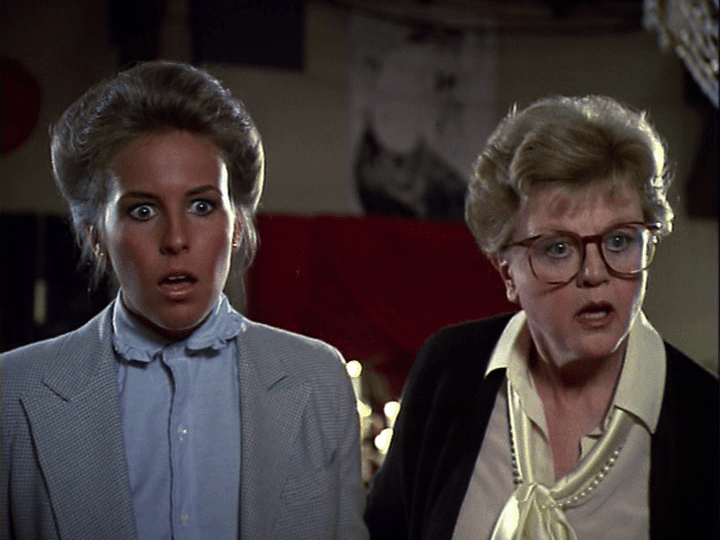
Don’t be afraid, my friends. Nothing frightening awaits you. Oh, perhaps a moment or two of panic, but we did warn you. Seat belts pulled tight? That’s good. And now, just sit back…
Welcome to Horatio’s House of Horrors!
This episode is a delightfully campy, deftly executed locked room mystery. If you want to make it dinner and a show, you can eat along with Jessica and the Donovans with this family-friendly menu. Guests who wish to avoid spoilers should watch the entirety of “We’re Off to Kill the Wizard” before proceeding. Thank you, and enjoy the ride!
This episode guide has four parts:
This is the first part, an introduction which includes the setting, characters, and context of the episode.
The second part is a detailed timeline of the episode’s events. (Coming Soon!)
The third part is an analysis of the episode’s mystery. (Watch this space!)
The fourth part is a collection of fun extras called Bonus Features. (ETA? TBD!)
Where in the World is Horatio’s House of Horrors?
The casual viewer could be forgiven if they came away thinking this episode takes place in Kansas City. (I’m looking at you, imdb.) Kansas City, the City of Fountains, is mentioned numerous times throughout the episode, but that’s because it’s Jessica’s next destination.
Aunt Jess is currently visiting one of her nieces, Carol, who lives somewhere that’s only a short flight away from Kansas City… you may have heard of it – Chicago! Check it out in the MSWSW Atlas.
This episode is low, low key set somewhere in Chicagoland. There are no glamorous on-location scenes with sightlines to Chicago landmarks. The name “Chicago” is never even spoken. The only direct reference to the Windy City is this fake newspaper.
When Are We?
The Original Airdate
In the absence of evidence to the contrary, the first guiding principal I use in my work on the MSWSW canon timeline is to place an episode’s events before, but as close as possible to, the initial airdate. This episode first aired on Sunday, December 9, 1984.
The Oeuvre of J.B. Fletcher
Dirge for a Dead Dachshund has been published! This means that Jessica’s visit to this episode’s House of Horrors takes place after S1 E2: “Deadly Lady”, when Dirge was still in pre-publication. The earliest “Deadly Lady” could have taken place is June 1984.
This gives us an initial, broad timeframe for “We’re Off to Kill the Wizard” of June – December 1984.
The seasons of the year
Little Billy rides his bicycle down a leafy street. The canopy is a full, lush green, with no hint of fall colors. Chicago’s fall foliage season is typically underway by early October.
All those green leaves allow us to narrow the timeframe further, to June – September 1984.
The Days of the Week
I’ll go through the episode’s timeline in more detail in Part 2, but for now, it will suffice that the episode begins on a Saturday. Two days later, on Monday, Lieutenant Donovan’s desk calendar tells us it’s the 23rd.
Let’s take a look at the 1984 calendar:
From June through September, there is one Monday the 23rd, and it’s in July. Could an argument be made that in the midst of an active murder investigation, Lt. Donovan didn’t find the time to flippy-flip his day calendar? Sure. However, unless and until we come across evidence to the contrary, the MSWSW timeframe for “We’re Off to Kill the Wizard” is Saturday, July 21 – Thursday, July 26, 1984.
We see two sides of Jessica this episode. Aunt Jess is in town for personal reasons, spending quality time with her niece’s family. A model guest, she can fix bicycles andburgers for dinner! However, it’s J.B. Fletcher, the sought-after novelist, who finds herself mixed up in yet another colorful murder.
Jessica’s niece of the week, Carol leads a picture perfect life in leafy suburb. Another leafy place you can find Carol is the MSWSW Fletcher Family Tree.
Jessica with her niece Carol and grand-niblings Cindy and Billy
The other security guard at the scene of the crime has several lines, yet remains noticeably, and somewhat inconveniently, nameless over the course of the episode. I’ve decided to call him Nemo.
Is the glamorous, jet-setting Mrs. Baldwin a femme fatale? Perhaps we’ll never know for sure.
Repeat Offenders
If you’re a MSW fan (and if you’ve read this far, you are) I’m sure you’ve recognized a few actors who appear multiple times throughout the series, but in different roles. Check out The Rogues’ Gallery for more details.
In this episode, nearly all the actors portraying supporting characters (even Nemo!) will return to the MSW universe in future episodes, except James Coco (Horatio Baldwin), Anne Kerry Ford (Carol Donovan), and siblings Joaquin and Summer Phoenix (Billy and Cindy).
What follows is a deep dive into a somewhat notorious episode of Murder, She Wrote, “It’s a Dog’s Life.” You know, the one where the dog did it. Sort of. There are more spoilers to come, so I recommend watching the entire episode first, ideally after a proper breakfast.
Ladies and Gentlemen, to Horse!
MSW’s very picturesque foxhunt
Welcome to rural Virginia and the world of traditional foxhunts. This American subculture is a romance of horses, hounds, time-honored traditions, and the appearance, if not the reality, of gentility and wealth. This is not a sport I knew much about going into this episode, so it was interesting to learn little bit about foxhunting as I prepared to write this post. Happily, a traditional foxhunt is all about the chase, rather than the killing, of a fox. However, this proletariat can’t help but reflect on the implicit classism, and, in the United States, the legacy of slavery, that made this type of leisure possible for the wealthy few. For this reason, I feel very conflicted about the continued celebration of this tradition. However, I cannot deny the beauty and romance of the extended horseback sequence that opens the episode.
The Players
All the king’s horses and all the king’s men, in the order we meet them:
Sawdust
Sawdust is a mild mannered old gray. I think we can safely assume he is not complicit in the unfortunate events that befall him.
If you’re a MSW fan (and if you’ve read this far, you are) I’m sure you’ve recognized a few actors who appear multiple times throughout the series, but in different roles. Check out The Rogues’ Gallery for more details. In addition to the actors playing some of the secondary characters already listed above, the following actors play supporting roles this episode, and will reappear in future episodes.
Greenville is small, rural community in Virginia’s Shenandoah Valley. So small, in fact, that one might wonder if the writers missed it on the map and had actually intended to create a fictional place. On the other hand, the real Greenville is a good fit for the storyline. The Langley estate is set in a rural area of Virginia. Real Greenville is also within a reasonable traveling distance of Washington, D.C., which is mentioned a few times in the episode.
When Are We?
Dear readers, it gives me so much pleasure to share with you my very specific estimated timeframe for this episode’s events:
Original Airdate
The first guiding principal I use in my work on the MSWSW canon timeline is to place an episode’s events before, but as close as possible to, the initial airdate. This episode first aired on November 4th, 1984.
The Oeuvre of J.B. Fletcher
At the beginning of the episode, Jessica is acknowledged as a famous author, so we know these events take place after April 1984. Unfortunately, we are not given any additional information about her oeuvre. We can, however, begin to establish a possible timeframe of April through early November 1984.
Foxhunting in Virginia
The episode opens with a scenic and catastrophic foxhunt. Foxhunting season in Virginia can run, broadly, from September through March. This narrows our timeframe to September through early November 1984.
Foliage in Maine
Jessica tells Abby that the maples are turning in Cabot Cove. Fall foliage season in Maine is late September through late October. This narrows our timeframe further, to the limits of leaf peeping season down east.
A Full Moon
Trish’s murder is on the night of a full(ish) moon. The only full moon to coincide with Cabot Cove’s 1984 fall foliage season is on Tuesday, October 9, 1984. Since to the naked eye a moon can appear full for about three days, the window for Trish’s murder is Monday, October 8 through Wednesday, October 10, 1984.
A bad moon rising over MSW S1 E5: “It’s a Dog’s Life”
The Days of the Week
I’ll break the timeline down further in the next section, but for the purposes of assigning dates to this episode’s events, I do want to cover a few of the details here.
Jessica states that both deaths (Denton, then Trish) happen within a week.
The inquest for Trish’s murder takes place on a Friday. The Friday following the window for Trish’s murder is Friday, October 12th, 1984.
During the inquest, Jessica states that she saw Marcus Boswell’s tire tracks two days ago (Wednesday, October 10th). Jessica had occasion to observe Marcus’ tire tracks the day after Trish’s murder, which must have then taken place on the Tuesday night, or more specifically, during the very early hours of Wednesday morning.
Allowing enough days for Sawdust to be lost and found, Denton’s will to be read, and Teddy to be framed as a ferocious little dog, my best estimate for this episode’s timeframe is Saturday, October 6th through Saturday, October 13th, 1984.
The Timeline
Saturday, October 6th, 1984
Morning
A mysterious figure clad in a black jacket dopes Sawdust the horse.
Denton shows Jessica his valuable collection of paintings, including a close up of a legit (reproduction, I’m sure) painting of American Eclipse by Edward Troye. (Fair warning, I use the inclusion of this very lovely, accurate detail to justify my ire at some of the lazy, but otherwise inane, continuity errors this episode.)
Everyone easts, drinks, and makes merry at a traditional hunt breakfast. In retrospect, Marcus Boswell is conspicuously absent given his close relationship with the Langley family.
Midday
A very scenic foxhunt ends in tragedy when Denton Langley is thrown from his horse, Sawdust, after a risky jump. Cousins Abby and Jess suggest foul play to the sheriff and veterinarian.
Evening
Off camera, Sawdust is found and tested for drugs.
Sunday, October 7th, 1984
Abby and Jessica learn that Sawdust’s drug tests were negative. Jessica stops packing and offers to stay with grief-stricken Abby a little longer, until after the will is read.
Monday, October 8th, 1984
Morning
The Langley family enjoys breakfast beverages. Boswell is four minutes late to the will reading.
The assembled party enjoys the “latest in will technology.” Denton gets the last word, and his estate goes to the dog.
Later
Off camera, the remains of Monday provide the window of time Spencer Langley would need to meet with Asa Potts and plot their ruse for the next day.
Digression
I feel the need to acknowledge that Monday, October 8th, 1984 was Columbus Day, a holiday that is federally recognized in the United States, but on which most markets and businesses remain open. (Indigenous Peoples’ Day did not gain widespread recognition in the U.S. until the 1990’s.) I feel comfortable in my assumption that both the Langley family and Marcus Boswell would choose to continue with the business at hand on this day, quasi-holiday or not.
Tuesday, October 9th, 1984
Morning
Jessica phones Ethan to explain that she will further extend her time in Virginia, since Abby is still suspicious about Denton’s death. (I can just picture Ethan, a bit downcast, watering Jessica’s houseplants, waiting for her to come home.)
Jessica had originally planned to leave after the will was read, I suppose because Abby had expected to be immediately dismissed by the heir(s).
Instead, Abby decides to stick it out a little longer in the service of her new employer, Teddy. Everyone decides the best thing to do would be to go riding and hurl insults and threats at one another.
Teddy is then caught in a very compromising position in the stable, and after the vet and sheriff return to the Langley estate, he gets sent to the dog house.
Afternoon
Boswell calls Abby with the good news that Teddy has been released on his own recognizance.
After retrieving the poor little pup, Jessica and Abby visit Boswell to discuss their concerns about trumped-up lawsuits against Teddy. Morgana Cramer and her big city lawyer pass by on their way out, and then it’s down to business.
They are briefly interrupted when Boswell takes a suspicious phone call.
Wednesday, October 10th, 1984
2:00 A.M.
The aforementioned full moon illuminates the night sky. “Just like clockwork” Teddy visits Barnes in the Langley security room.
Trish’s car approaches the front gates, which are closed. The driver stumbles out of the car to use the intercom, and after Barnes presses the gate button, falls between the opening gates. Barnes leaves Teddy in the security room while he goes to assist the driver, whom he believes to be Trish, “drunk again.”
Before Barnes reaches the gates, they close, and Trish meets a gruesome end.
clockWORK
There’s a clock in the security room that reads 10:50 just before Trish’s murder, but it’s easy to miss.
However, the same clock, reading 11:45, is definitely an intentional part of the frame in this scene after the murder.
Well, I guess we’ll let Jessica have the last word about the time of the murder.
before dawn
The authorities arrive to investigate Trish’s death. The remaining members of the household gather in the main house, and are soon joined by Boswell and Tom Cassidy. Numerous clues fuel competing theories about the identity of the murderer.
After sunrise
It rains.
The distinctive shield shape on this sign indicates it is for U.S. Route 202 South, which runs from Maine to Delaware, and does not pass through Virginia.
Abby and Teddy commiserate in lock up.
Jessica and Boswell try, unsuccessfully, to convince the Sheriff of Abby’s innocence.
Digression
Initially, I thought this episode made a case against the practice of electing sheriffs, since Jessica had some choice words about this one. However, after rewatching, it’s my opinion that the Greenville Sheriff was making an honest job of it. If an animal was trained to assist with a murder, Abby is the most likely suspect. And, he’s right, Abby did have a thing for Denton, and Jessica was kin.
Later Wednesday Morning
Boswell drives Jessica back to the Langley estate, and she asks to be dropped off about 1/2 mile from the gates.
She seeks two crucial pieces of evidence; one she finds immediately, and the other she only finds after some help from that cutie-patootie, Deputy Roxie, and one of those fancy new metal detectors.
Wednesday Afternoon
Off camera, I imagine this is the time Jessica, possibly with the assistance and support of Deputy Roxie, makes her case to the coroner and becomes a friend of the court.
Thursday, October 11th, 1984
A wardrobe change indicates a new day. Echo and Jessica wish each other good morning. Jessica goes to “see a man about a dog bite.”
Jessica interrupts Pott’s morning of mountain man multitasking (chew, chainsaw, moonshine, repeat…) when she attempts to abscond with his fake bandage. Don’t worry, there will be no repercussions for any of this – guns, fraud, trespassing, who cares.
Friday, October 12th, 1984
Are you tired? I’m tired. Friday is the inquest, and Jessica, with the help of an amenable coroner, a baby-faced deputy, and Teddy’s estimable training, exposes Trish’s murderer.
At the courthouse, the flag of the State of Ohio flies?Sons of Confederate Veterans vow one day to riseA portrait of Stonewall Jackson by Currier and IvesTeddy’s clever tricks reveal a murderer in disguise
Saturday, October 13th, 1984
Cousin Abby, happy to once again be a free woman, packs it in and heads home to Kent. Still-wealthy Teddy gets his dream job, lol.
The End.
Show Your Work
Fair Play Pause Point
In the early morning hours after Trish’s murder, we get to watch Jessica piece it all together. However, she does not feel she has conclusive proof of the murderer’s identity until later that day, after Boswell drops her a short distance from the Langley estate.
This episode gives us more than fair play, we the audience have all the information that Jessica does, plus one more important clue. It’s more than enough to solve the puzzle at the same point as Jessica, even if the murderer seems to have made some confounding choices.
Denton’s Murder
The opening scene gives us a piece of information that only the audience knows; Denton’s horse was drugged before the hunt, by a person wearing a black jacket.
The hunt party is formally dressed; all the men are wearing red jackets and all the women are wearing black ones, except Jessica, that gauche yankee.
We know that the family all hoped to benefit from Denton’s will, but we can eliminate Spencer as a suspect, because he is wearing red. Also, even though she is wearing black, we can eliminate Abby, because she has no motive to kill Denton. That leaves three possible suspects in Denton’s murder: Trish, Echo, and Morgana.
Trish’s Murder
After Trish’s murder, a number of clues are presented, including a couple of red herrings.
Teddy’s Pawprint
The forensics team lifts a pawprint from the gate button in the security room, indicating that Teddy was the last, erm, individual to use it.
Trish’s Coat
Jessica and Deputy Will Roxie discover that the lining of Trish’s new coat has been torn, indicating that it was donned in haste.
I’m going to posit that the wearer was also larger than Trish for the lining to tear like that. It’s a high quality coat, after all.
NightBird’s Call
Both Morgana and Barnes heard bird calls at the time of the murder.
Boswell’s Trousers
Boswell has a distinctive grease mark on his trousers. His explanation is a little bit fishy.
BoSwell’s Flat
When Jessica notices the stain on Boswell’s trousers, he says he had a flat tire on the way to the estate, and had stopped to change it about 1/2 a mile from the gate, for about 20 minutes.
Abby and Boswell agree that this means that the murderer could not have left the Langley estate without being seen by him, and therefore must be a member of the household.
Maybe it’s because it’s the middle of the night and everyone is shocked and exhausted, but this is completely illogical and/or incriminating on its face. It implies that there could have been no time between the 2 a.m. murder and Boswell’s drive to the Langley estate. But there must have been, because Boswell would have received notification of the accident via a 1984 landline telephone from Barnes, the police, or the family at least several minutes afterwards. Alternatively, he could have also been listening to his CB radio all night, like Tom Cassidy, but again, time enough at least for Barnes to alert the police would have elapsed. Further, the police were already onsite and investigating when Boswell arrived, making whatever he claimed to see or not see while changing his tire moot.
Morgana’s Vision
After learning about the pawprint on the gate button, the torn coat, and the bird call at the time of the murder, Jessica can provide a logical explanation for what Morgana saw from her window.
Abby’s Whistle
The police find Abby’s dog whistle near the gate. We never find out if this was an intentional misdirection from the murderer, or just a unfortunate coincidence. Probably the latter, since we later learn the murderer was trying to implicate Spencer, not Abby.
Boswell’s Treads
We’ve got some dirt on Boswell now. His tire treads seem to be evenly worn, indicating that his spare tire story is, well, flat.
The Bicycle Clip
At the inquest, Jessica confirms that a bicycle clip was found about 1/2 mile from the gates. Her theory is that the murderer fled the scene on foot and retrieved a bicycle hidden about 1/2 mile down the road, misplacing a bicycle clip at that point.
But why there? Jessica knows Boswell’s story about a flat tire is bogus, but believes the 1/2 mile distance holds some significance. Why? Perhaps, because Boswell’s flat tire story was off the cuff, it might contain some half truths? Unfortunately, her reason for linking the location of the fake flat to the location of the bicycle clip is never explained, and it’s a weak point.
J’accuse!
No one walks around in greasy trousers in front of Jessica and gets away with it. It was Boswell, because concocting this Rube-Goldberg-meets-Dr. Doolittle scheme was the only way to keep charging legal fees to the Langley estate.
Thanks, I hate it.
The writers chose a patently absurd premise – what if the dog did it? – and instead of making it perform clever tricks to delight us, just let it chew the upholstery and make a mess on the carpet.
There were so many simpler, equally effective ways to bump off that notorious drinker, Trish. A few stiff drinks and a blow to the head would have been perfectly sufficient to suggest a drunken accident. There was no need to gild the lily by elaborately beheading her in front of poor Barnes.
Our in-episode subject matter expert, Abby, says “endless repetition” is required to train a dog to perform tricks like pushing a specific button, or scratching at a specific door at 2 a.m. every night. This would have meant that Boswell spent hours and hours alone with Teddy at the Langley estate, long before either murder, without raising suspicions. Jessica simply says Boswell “had access” to Teddy, and that’s supposed to be a satisfactory explanation.
Framing Teddy to incriminate Spencer is an utterly unnecessary ploy to keep the legal fees flowing. As we saw during the episode’s rising action, Boswell could have relied on Spencer’s shady attempts on Teddy and Morgana’s more civilized lawsuits to provide continual reasons to draw money from the estate. Adding a murder on top would only invite unwanted scrutiny.
This could have been a very diverting episode, if the writers had given us a solution in which it was truly required, or, at least, convenient, for the murderer to use a trained dog. Instead, we are asked to believe that a seemingly intelligent, reasonable man decided that the best course of action was to commit a murder that was unnecessarily complicated, required a literally incredible amount of preparation, and was, at best, tangential to his interests.
Episode Rating
I give “It’s a Dog’s Life” two stars. A very strong cast is unfortunately let down by a weak story.
Bonus Features
Do Crimes.
If this kind of thing interests you, check out my MSW statistical analysis. Also, fun note, this episode, Trish Langley becomes the first character of the series to become both a murderer and a murder victim. Congrats, Trish!
What if Cousin Jess is really a serial killer? Pretty easy this time. She borrowed a black jacket from any one of the ladies at the hunt to dope Sawdust incognito. Jessica was also the mysterious figure at the gate the night Trish was murdered. She pinned it on Boswell by planting a bicycle clip. He really did have a flat that night, and his spare really did have a very worn tread, just like he claimed at the inquest. As for no one passing by for the 20 minutes he spent changing his tire, the police arrived before him, and Killer Jessica never left the estate.
Tropes, Devices, and Other Conventions
Mystery Tropes
Costume
My standard for this trope is that one or more costumes are used to obfuscate the identity of the murderer and/or the victim. So, this episode does technically use the costume trope when Boswell disguises himself with Trish’s coat. However, it just doesn’t have the same delightful bouquet of foreshadowing that a costume party or a stage performance would.
Despicable Victim
As I stated earlier, Denton Langley is the gold standard traditional wealthy patriarch cozy murder victim. However, some patriarchs are more sympathetic than others. Denton is tough to warm to; he seems to revel in being thought of as an old lech, and his last words to his children are just piss and vinegar.
Oddly located corpse
Both bodies conform to this cozy mystery trope; as intended, the novelty of the murder methods keeps the mood light.
Suspicious Phone Call
There are three on-screen phone calls this episode, but only one is suspicious. Why? What makes a murder mystery phone call suspicious? What makes one innocent?
Phone Call 1: Jessica and Ethan
Jessica calls Ethan to explain why she will be delaying her return home. This phone call is innocent because it’s intended to be expository, and because we know and trust the character on the other end of the line, even if we can’t see or hear him.
Phone Call 2: Abby and Boswell
Abby and Boswell discuss Teddy over the phone. This call is innocent because nothing is hidden; we see and hear both sides of the conversation. Also, note the open body language presented by both characters.
Phone Call 3: Boswell and Jim Boy
Boswell’s phone call with his broker is suspicious because we hear only his side of the conversation. Boswell seems to own up to an uncomfortable truth: financial losses from a bad investment. However, his side eye and closed body language indicate that he’s hiding something.
Plot Devices
flashback
We get a wavy flashback scene that explains Morgana’s perspective on Trish’s murder. It’s a little special because it waves out on Jessica and waves back in on Morgana.
MSW Tropes
Infinite Jest
One of the most endearing qualities of MSW is that, quite often, something laughably absurd happens as a plot device. When it succeeds, it adds levity that keeps the murder mystery from getting too dark. When it fails, as it unfortunately does this episode, it undermines the logic that’s needed to provide a satisfying solution.
As discussed earlier, a premise that is patently ridiculous, like “the dog did it!” requires a clear, concise case for why it was the best choice, or at least one among equally reasonable choices, for the murderer. Otherwise, the solution is just silly, and a big let down for the audience.
Nay, Tarry
Jessica extends her visit with Abby twice in order to unravel this episode’s strange events. Our lady is typically waylaid by a wrongful arrest; in an unusual sequence of events, Abby is not wrongfully arrested until after Jessica decides to remain longer in Greenville.
Smile and Smile
In the wake of two violent deaths, the surviving characters manage to have a final laugh about Teddy’s future prospects.
Le Mot Juste
This episode, Cousin Abby gets the best line: “Around here, some of the real beasts walk on two legs.”
What She Wore
This episode wasn’t a sartorial standout for me, but there were a couple of scarf variations to add to the collection, and I enjoyed the formal riding attire.
Best look goes to Morgana at the inquest. I love the beret.
Honorable mention goes to the well-coiffed Echo. As Jackie Kennedy said, “Pearls are always appropriate.”
Least Best Look
It’s a tie! Pun intended!
Interior Motives
Speaking of ties, Abby and Boswell are neck and neck in a competition to see who can collect the most house plants:
The Rest of the Story
After the inquest, the remaining members of the Langley family depart Greenville. Spencer resumes his work as a D.C. lobbyist. Morgana and Echo return to London, where Professor Cramer, husband to Morgana and father to Echo, recently accepted a prestigious fellowship in classic Greek literature.
Hm, what’s that? You had assumed that Morgana was divorced, widowed, or otherwise unhappily separated from her husband? Me, too. It turns out, the mild mannered Professor was just far too gentle a soul to endure much time in the company of his overbearing in-laws, so he stayed behind when Morgana and Echo traveled stateside for Denton’s birthday.
Once the Cramer family is happily reunited, Morgana, an accomplished neolithic anthropologist, returns to her work researching standing stones. Being able to throw herself back into work that is both intrinsically rewarding and closely aligned with her spiritual beliefs helps Morgana through her grieving process.
Like her mother, Echo feels unmoored and grief stricken after the Langley family tragedies. She rejoins the London music scene, and spends the next several months reflecting on her experiences and working on her music. During this period she also reconnects with an old flame, and unknowingly inspires his band’s next hit.
Extra Credit
Book Recommendation
For a more deftly handled “the dog did it” premise, I recommend Dumb Witness by Agatha Christie.
Film Reference
There is an in-episode reference to a Stephen King movie about a possessed dog. That movie is 1983’s Cujo, and it is a movie that exists and can be watched. Personally, I think there are better Stephen King movies out there. If Cujo you must have, read the 1981 novel instead.
The MSWSW It’s a Dog’s Life Playlist
For music lovers, this episode inspired the following playlist:
“King of the Road” by Roger Miller
“Cherry Bomb” by The Runaways
“Georgy Girl” by The Seekers
“Bring on the Dancing Horses” by Echo and the Bunnymen
What follows is a detailed discussion of Murder She Wrote S1 E3, “Birds of a Feather.” The plot will be spoiled, and the tea will be spilled. I recommend you watch the episode before reading further, and maybe make it dinner theater.
A Feathery Farce
MSW S1 E3 “Birds of a Feather” was inspired by the 1978 film La Cage aux Folles, which was also released as Birds of a Feather. Like the film, this episode concerns a drag club, although no one in 1984 San Francisco seems to know the colloquial term for “female impersonation.” More on that later. MSW’s “Birds” combines romantic farce and murder mystery. Will it lay an egg?
The Oeuvre of J.B. Fletcher
In this episode we learn that Jessica already has six best sellers and a movie deal, which is extremely impressive, since her first book was published only months prior.
Where in the World is…?
This episode takes us to San Francisco, California. Here’s a map.
When Are We?
This episode is, as far as I can tell, completely free from any information or clues as to what time of year it is. In the absence of in-episode information to the contrary, I assume that the events in question occur prior, but as close as possible to, the initial air date of the episode. The original air date was Sunday, October 14, 1984, so I initially estimated early October 1984.
However, the timeframe for S1 E5 “It’s a Dog’s Life” can be pinned down to Saturday, October 6, 1984 through Saturday, October 13, 1984. This pushes the “Birds” timeframe up into late September, for a number of reasons.
The Days of the Week
The events of “Birds” take place over four days. On the first night, Les Champignons, a nightclub, is open, which makes it unlikely that it’s a Monday, since this is the most common day for nightclubs to be closed.
However, because Jessica is making the morning chat show rounds on Day 1 and Day 2, we know these first two days are weekdays.
On Day 4, Howard and Victoria get married in a church. Christian churches almost universally discourage weddings on Sundays, to avoid scheduling conflicts with regular Sunday services.
With these limits in mind, we can narrow down the possible four day timeline as being either Tuesday – Friday or Wednesday – Saturday.
Travel Restrictions
With an airdate of October 14 and the events of S1 E5: “It’s a Dog’s Life” taking place October 6 – October 13, the latest possible timeframe for “Birds” is Tuesday, October 2 – Friday, October 5.
However, this would mean that, immediately following the wedding reception, Jessica flew from San Francisco to Washington DC (5 hours direct, plus 3 hours lost to the time difference), then traveled 2.5 hours by car into rural Virginia, and was fresh as a daisy for another murder on Saturday morning. Technically possible, but both unlikely and deeply unpleasant for our lady.
Conclusion
The next latest possible timeframe for “Birds” is Wednesday, September 26 – Saturday, September 29, 1984. This is my current best estimate. As well as giving Jessica some down time in Cabot Cove between trips, it has the added benefit of giving our lovebirds a Saturday wedding. Isn’t that nice?
The Players
All our delectable little champignons, in the order we meet them:
Howard is a nice kid who might be in over his head at a local nightclub. He’s an aspiring actor who recently worked as a NYC cab driver. I usually try not to wade too far into IMDb waters, but this is a very direct reference to Jeff Conaway’s role in Taxi.
(L-R) Taxi, Jeff Conaway, Tony Danza
(L-R) John Travolta, Jeff Conaway, Greased Lightning
Al Drake is a disagreeable man who likes jogging. He owns a successful nightclub named Les Champignons, even though the name of the episode is “Birds of a Feather.” I guess the eponym Drake will have to suffice. Quack.
Actually, no, I’m putting Howard the Duck in here, too. The movie came out a few years after this episode, but the comics predate them both. Quack, quack.
Fritz
Is Fritz the German Shepherd a good boy or a bad dog? Only time will tell.
Victoria is the first we’ll meet of Jessica’s many nieces. Her maiden name is Brandon, a fact which, as far as I can tell, is never alluded to in-episode. It is the last IMDb factoid I will include here. I just really needed it for the family tree. Jessica says, “We’ve only had one killer in our family…” which I think implies that Victoria belongs to her side of the family rather than Frank’s. As a plot vehicle, Victoria is allergic to flowers. We’ll see her again in future episodes, and I’m curious as to whether the allergy bit will carry forward.
What is Jessica’s primary role in San Francisco? Is it Aunt Jess, lending familial legitimacy to Victoria’s hurry-up-already wedding? Or is it J.B. Fletcher, promoting her sixth bestseller on morning chat shows and meeting the mayor (Dianne Feinstein)?
Bill is a television talent agent, so we know right away that he’s an acquisitive asshole. He also happens to be the most enjoyable secondary character this episode. Bill hustles and does his homework. He specifies that J.B. has six paperbacks and one movie sale, and if you think the distinction between bestseller and paperback is kind of a small detail, why are you here?
Freddy York (L) and Bill Patterson (R) face off with Jessica
Freddy York is a comedian. He’s technically not a stand-up comedian since he also plays the drums. This character/performance felt very uncomfortable, and just… off, which was surprising to me, since the actor is a successful comedian.
Lady Drake is the third eponymous bird. Duck, duck, goose duck. Candice plays golf, which I think is meant to demonstrate her merry widowhood, but seems both unnecessary to the plot and incongruous with her character.
Novack is the first of many officers of the law who will feel beleaguered and exasperated by the unasked-for assistance of Jessica Fletcher.
The Cockatoo
The only actual avian in “Birds of a Feather,” the cockatoo serves feathery realness. Both a ready bird and a red herring, the cockatoo’s range is unexpectedly expansive, portraying both fish and fowl.
George
George the marmalade cat is Floyd’s flatmate. Fun fact: Marmalade cats are usually male. I bet Lillian Jackson Braun would’ve know this. Unfortunately, it seems cat facts fall outside of Jessica’s otherwise estimable expertise.
Angela may enjoy working with animals, but in this instance, the feeling is not mutual.
Repeat Offenders
If you’re a MSW fan (and if you’ve read this far, you are) I’m sure you’ve recognized a few actors who appear multiple times throughout the series, but in different roles. Check out The Rogues’ Gallery for more details. The following supporting characters are played by actors who we’ll see again, in future episodes:
As far as I can tell, the events of “Birds of a Feather” take place over four days.
Day One
Morning
Jessica arrives in San Francisco and appears on the local television show Bay City Breakfast.
Afternoon
Al goes jogging with Fritz and has two unpleasant scenes; first with Howard, about financial matters, and then with Mike, also about financial matters. This is probably why Howard can’t get himself to the church on time. Once he arrives for the wedding rehearsal, Victoria is piqued because he can’t join her and Aunt Jess for dinner. She says she wouldn’t want to drag Howard away from a client, and that’s the only use of that four-letter word we’re going to get all episode.
Evening
Jessica and Victoria have dinner at what appears to be a British pub themed restaurant. Jessica seems unable to go 24 hours without Maine lobster, no matter how lethargic.
Victoria confides in Jessica about Howard’s odd behavior, and they decide to investigate. However, the truth is right in front of us. Howard fell in love with acting when he played the lead in Charley’s Aunt. Whatever might that mean, Victoria?
Later that night, at Les Champignons, Al and Barbara have an unprofessionally cozy conversation. Al then has his third and final unpleasant scene about financial matters, this time with Bill. Victoria leverages Jessica’s celebrity to get a table. It is the last time we see Al Drake alive.
Shortly before 9:50 pm, the maître d’ seats Jessica and Victoria. The opening act, a mysterious figure in pink, concludes, and Freddy York takes the stage.
During Freddy’s act, the lovely Mrs. Drake arrives. Backstage, Barbara intercedes when Felix is sent to tell her husband.
Just after 10:05 pm, Michelle Dupont begins her opening number, “Someone to Watch Over Me”. Barbara screams bloody murder from backstage. Howard, on the run and in full drag female impersonation clothing, is prevented from escaping.
Our young lovebirds are reunited. Boy, what a pickle!
Jessica meets the cockatoo and begins to beleaguer Lieutenant Novack.
Day Two
Morning
Everyone at the police station is understandably tired and grumpy after having been up all night. It’s Jessica’s turn to leverage her celebrity, and it looks like Dana Burns and Dianne Feinstein will have to wait, because the only person she wants to talk to is Howard. Like a fairy godmother waving a magic wand, Jessica grants Howard a nitric acid test, a lawyer, and a pair of pants.
Afternoon
Unsatisfied by Lt. Novack’s theory that Freddy’s drums obscured the sound of the gunshot, Jessica returns to Les Champignons in search of Barbara. Bill shoots his shot, Mike and Candice make a scene, Jessica makes the acquaintance of Freddy, and enjoys the view of Alcatraz from his dressing room.
After Barbara gets fired, Jessica takes her for a ride and gets valuable gossip in exchange for the cab fare.
Just wanted you to marvel at the similarity of their hairstyles
Mike and Candice meet on location at the Aquatic Park Pier to discuss the fortuitous turn of events and protest their respective innocence.
It must have been a roundtrip cab ride, because Jessica is back to Les Champignons to learn that Howard’s nitric acid test was negative. She gets to rock out while testing Lt. Novack’s drum vs. gunshot theory. Freddy enters stage left only to be knocked into the first row by falling stage lights.
I wanna rock
Day Three
Morning
Jessica takes a streetcar, and joins Floyd and George for coffee.
How does he open the cabinet behind the fridge?
Jessica and Floyd discuss motives and the intentional sabotage of the stage lights.
Midday
Jessica bails out Howard and tells him to take Vicky to lunch. Did he see Candice at the stage door the night of the murder? Maybe? That’s all the reason Jessica needs for another cab ride.
It appears Jessica is holding a bag of actual food… poor hungry hungry doggo.
Jessica takes a bagged lunch to the driving range to find Candice, who’s wearing, according to Jessica, very attractive golf togs. “I’ve never seen it done in black” is definitely a low-key burn. The only thing gained from this scene is the knowledge that Freddy is receiving visitors at the hospital. I hope Jessica told the cab to wait.
Cocktail Hour
It’s time for a glass of champagne with Freddy and Bill at the hospital.
Freddy’s ring, so big and shiny!
Freddy’s gown, so short and tiny!
Bill is obstreperous, and delightfully so, imho. They discuss the suspicious incident of the falling stage lights and all the possible targets.
Back to Jessica’s hotel with Howard and Vicky in tow, and Jessica is very, very tired. I’ll admit, I might be losing the threads of the timeline here, because I feel like due to the wardrobe changes, everyone had time for a full night’s sleep between the falling stage lights scene and coffee at Floyd’s apartment.
But anyway, Jessica is tired and it’s noisy next door, so she has occasion to use a pillow to muffle the sound… and, eureka!
Cut for time, Jessica returns to the police station to acquire crime scene photos from Charlie, and then it’s back again to Floyd’s apartment, and finally to Les Champignons for some pillow talk and an onstage reenactment that amounts to reckless endangerment. Floyd could have been killed, Jessica, wtf.
Jessica names the killer, who then conveniently walks onstage to confess.
Day 4
Victoria and Howard get married! All our remaining little mushrooms are there, except Felix and the MC, whom I assume are dog sitting Fritz and bird sitting the cockatoo. Everyone is so G-D blissful, even the freshly unemployed Barbara. Nothing erases the horror of violent death quite like a wedding, apparently.
Show Your Work
Fair Play Pause Point
Jessica’s eureka moment happens at her hotel, but she does seek confirmation of her suspicions via the crime scene photos and a follow up onsite visit. Lt. Novack serves as a stand in for the audience, and Jessica walks him through the final clues, as follows:
The pillow from Al’s settee was used as a silencer for the gun.
The damaged pillow was later replaced with a pillow from another dressing room.
Floyd heard the falling stage lights above him in time to step out of the way.
Once Lt. Novack successfully avoids the falling stage lights, Jessica expects him to be able to put all the pieces together. So, let’s see if we can.
The Pillows
There are five people with motives to kill Al: Howard, Mike, Bill, Freddy, and Candice.
Originally, the police concluded that only the sound of the drums during Freddy’s act could have obscured the sound of the gunshot. Once Jessica establishes that a pillow was used as a silencer, the possible timeframe for the murder expands to include any time after which Al is last seen until the murder is discovered. This includes the final minutes of Howard’s act, all of Freddy’s act, and the beginning of Michelle’s act.
Crucially, this means that Freddy no longer has an alibi for the murder.
If we pay close attention to the appearance of the replacement pillow, we can see that it is sun faded, and can be connected to the window in Freddy’s dressing room. However, MSW is generous to its casual viewers, and drops one more big clue on us.
The Stage Lights
Once we learn about the pillows, things start to look bad, but not conclusively so, for Freddy. Once Jessica stages her reenactment (pun intended), he is the only possible suspect. Jessica proves that a person with normal hearing and physical response times would be able to dodge the lights. Therefore, Freddy faked his fall and injuries in an attempt to misdirect the investigation, and possibly, also clobber Jessica. Two birds with one stone. Birds. This episode is purportedly about birds, so I have to get my birds idiom in somewhere.
J’accuse!
This mystery is pretty simple, and the writers play fair with us in terms of evidence. The tone of the episode is light, especially with the attempt at romantic farce. Neither aspect of this episode really worked for me, I think there’s just simply not enough time to do both things well in 45-ish minutes.
This episode Jessica seemed to ricochet from suspect to suspect with only the slightest hint of reason or driving force. Similarly, the denouement, Freddy’s confession, also seemed to lack impetus. He quickly abandons his claim of innocence, but why? He’s correct in saying that the stage lights prank doesn’t prove he murdered Al, and any one of the other suspects could have framed him by taking his dressing room pillow. He certainly isn’t remorseful. In fact, Freddy’s deadpan manner and his matter-of-fact suggestion that he should have also killed Jessica make him seem like a complete psychopath. And yet, the writers seem to think they have created a sympathetic character, because Jessica tries to console him, assuring him that she’s sure he would have been a success in Las Vegas.
There’s a couple of missed opportunities this episode. First, there’s an interesting theme that runs through almost all the important evidence this episode – sound: the sound of the gunshot, the sound of the drums, the sound of the falling stage lights, and it might have been interesting to pursue that further. Second, another key element to the plot was Freddy’s dressing room window, the light from which caused the upholstery to fade, but which also had a great view. And yet, the writers did not explore the idea of a man who feels desperately trapped, gazing out of his window every day at Alcatraz.
As for Howard and Victoria’s happily ever after? It’s fine, I guess. Thankfully, many of the happy couple’s ideas about marriage and gender roles are now laughably dated. The one thing “I do” wish would come back in style is small, simple weddings. A relief all around, I imagine.
Episode Rating
I give “Birds” three stars… it was nearly just a two star episode, but the cast was good, and the camp hit all the right notes for me.
Bonus Features
Do crimes.
Murder!
Motive: To escape a contract (greed)
Weapon: Gun
Done Deed: Murder happens offscreen
Crime Scene: Body comfortably seated behind a desk
Discovery: 15 minutes, 30% through
Murderer(s): Freddy York
Other Crimes!
Possession of a stolen firearm: Freddy York
Assault: Freddy York, for dropping the stage lights first
Reckless endangerment: Jessica Fletcher, for dropping the stage lights second
What if Jessica Fletcher is the world’s most successful serial killer?
After being seated by the maître d’, Jessica briefly excuses herself during Freddy York’s act, ostensibly to freshen up. She goes backstage and shoots Al. Why? For the Moët et Chandon he keeps in a pretty cabinet.
That’s why Freddy’s confession felt so unnatural. He was innocent, but because of his dark sense of humor, and, like many comedians, a tendency to self-sabotage, he decided it would be fun to do a bit where he’s the killer.
Tropes, Devices, and Other Conventions
Mystery Tropes
“Birds of a Feather” features one of the most common mystery tropes, a victim whom almost everyone wants to kill.
Plot Devices
Flashback
We’re treated to a classic wavy flashback effect at 22:50, when Howard recounts how he found the body. It seems like the writers are leaning into the camp, since Howard is definitely channeling his inner Dee Snider.
April 1984: We’re Not Gonna Take It
September 1984: No, We Ain’t Gonna Take It
Wedding Finale
The final scene is a wedding, because despite the murder, this episode is essentially a comedy, and nothing says happily ever after like “I do.”
MSW Tropes
Door of Truth
As often happens, an ordinary and unrelated event helps Jessica solve the murder. This time, it’s a pretty literal connection. When she puts a pillow over her ears to muffle the sound of nearby construction, she realizes a pillow could have been used as a silencer.
Infinite Jest
One of the best things about Murder, She Wrote is that often something completely absurd happens as a plot vehicle. In the spirit of farce that inspired this episode, Jessica and Victoria discover that Howard is secretly a drag performer in the same moment as he discovers a murder. What are the odds?
Law Enforcement
Lt. Floyd Novack is the first of many officers of the law who is truly antagonistic towards Jessica. Of course, as she almost always does, she wins him over in the end.
Le Mot Juste
In my opinion, the best lines this episode took place during Jessica’s cab ride with Barbara.
Barbara calls Candice “Lucretia Borgia in furs.” 80’s ladies like Candice still wore furs. One might imagine that Lucretia Borgia also had both the means and occasion to wear furs, making Barbara’s turn of phrase seem superfluous. However, the intricacies of sumptuary laws in Renaissance Italy may have meant Lucretia Borgia did not wear furs. So, points to Barbara for style and plausible historical accuracy.
After a nice juicy gossip with Barbara, Jessica says adieu and “It is so nice to talk to someone who knows how to be discrete.”
Don’t Say Gay
If you thought it was strange that there were no gay people at a drag club in 1984 San Francisco, you aren’t alone.
What She Wore
Scarves
We’re starting to see Jessica’s style develop a bit more. We get a repeat of the ivory blouse and pearls combo we saw in “The Murder of Sherlock Holmes,” which I actually don’t mind at all. I think it makes a character seem more authentic if we see her wear a piece of clothing more than once, like an actual person would do. We also get a couple of scarf variations, which I always enjoy.
Best Look
Mrs. Drake in white
Least Best Look
Mrs. Drake in black
Interior Motives
Les Champignons is a treasure trove of over-the-top interior design choices. My favorite piece is the pop art painting in the room with Howard before he’s arrested.
By contrast, the gag painting of Michelle Dupont can not be unseen. Sorry.
Honorable mention goes to Floyd and George’s apartment. It’s lovely.
The Rest of the Story
We’ll see Victoria and Howard again later in the series. It looks like Mike, Candice, and all the champignons will live happily ever after at their very straight drag club. But, what about Barbara, newly unattached and unemployed?
After a couple of glasses of champagne at the wedding reception, Barbara and Candice bury the hatchet. As it turns out, Candice found it incredibly difficult to run the club without Barbara, who was a very effective administrator. Still, both agree sharing a work space would be difficult. Instead, Mike and Candice offer Barbara a new position as manager of Les Nouveaux Champignons, their expansion location in Lake Tahoe. And who does Barbara take along as the premiere act? It’s Felix, lucky Felix, who launches a promising career as Lake Tahoe’s Sweetheart, Felicity.
Extra Credit
Want more birds? I recommend the original La Cage Aux Folles (1978) or the remake The Birdcage (1996).
Want more backstage murder? I recommend Vintage Murder by Ngiao Marsh, the master of theater whodunits.
Finally, it’s clear that “Birds of a Feather” is not representative of American drag culture in the 1980’s. For some 80’s drag realness, I recommend the documentary Paris is Burning (1990).
Move over, Sherlock. We’re in Jessica’s world now.
Fair Warning
This is a discussion of a murder mystery. It will contain many, many spoilers. If you have not yet had the pleasure of watching the entire episode, I suggest you make an evening of itand then return here to pick over the bones with me.
Hello and Welcome
“The Murder of Sherlock Holmes” is the premiere episode of the Murder, She Wrote series. It is double length, which allows time to introduce Jessica Fletcher as she embarks on a new and unexpected chapter in her life.
We first meet Jessica as she innocently unravels the plot of a new murder mystery play, Something Terrible (indeed), just before its’ pre-Broadway premiere. The director is flummoxed. How could a PTA cookie lady outwit a New York playwright?
Because it’s the series premiere, we are treated to an extended opening sequence dedicated to picturesque scenes of Jessica’s hometown, Cabot Cove, Maine, and all of Jessica’s bracing outdoor exercise (Bicycling! Fishing! Jogging! Wind-swept cliff walks with young people!). This is punctuated with lots of presumably murder-writing on a typewriter that was already ancient in 1984.
We meet Grady! I love Grady and all his failed romances and revolving-door career decisions. I love the way Grady loves Jessica. He is the affable, loyal, slightly dim man of action. He is a Captain Hastings to our Miss Marple. He is generally prone to mishap, but his first act is a success. Grady discovers Jessica’s first book,The Corpse Danced at Midnight, and gets it published to wide acclaim.
We then watch Jessica transition from a small-town substitute English teacher to a bestselling novelist, by way of a very tried and true plot device, montage! In fact, montages, plural. There’s a quintessential (and tired) makeover montage, which proves both literally and figuratively ineffectual. Next, there’s a NYC book promotion montage, which I thought was clever and a lot of fun to watch.
The Game is Afoot!
The main plot of this episode gets rolling about fifteen minutes in, when Jessica is invited to spend a weekend at a luxurious estate in upstate New York.
Surprise! There’s going to be a fancy costume party! Since we’re watching a murder mystery, you know at least one of the costumed is coming to an untimely end. Or, more specifically, getting pushed over the Reichenbach Falls, because remember, it’s “The Murder of Sherlock Holmes.”
Don’t you admire the writers’ chutzpah? With their very first murder, they symbolically kill the world’s most famous fictional amateur detective. No sh*ts given for Sherlock, we’re in Jessica’s world now.
Until recently, Jessica was a substitute English teacher at Cabot Cove High School and a core member of the PTA refreshment committee. She’s still all that, but now she’s also Coventry House’s newest bestselling mystery writer.
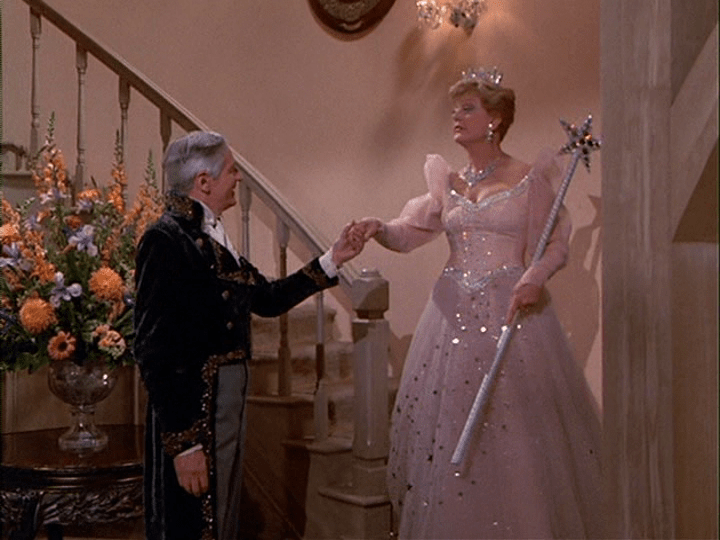
Jessica’s Costume: Cinderella’s Fairy Godmother, but with definite Glinda vibes. Also, Preston Giles, dressed as the Count of Monte Cristo.
It’s very early in the series, and so, unsurprisingly, Jessica’s character and personality are still evolving. In this first episode, she’s a very folksy “widow woman,” and has a home remedy for everything. A lot of time is dedicated to demonstrating her overwhelm and naivete about The Big City. While this Jessica is still whip-smart, energetic, warm, and caring, she is not yet the self-possessed and elegant woman of the world she becomes in later episodes.
Kitt is Grady’s fiancée, and it was she who helped get Jessica’s book published by Coventry House. But how did Kitt and Grady meet? It’s too much of a coincidence that their respective bosses also happen to be friends and neighbors, unless Kitt and Grady met through the Giles/McCallum connection at some other social event.
Kitt (left), costume not stated, but my guess is Scheherazade. Grady (right), costume also not stated, looks like an Errol Flynn/Douglas Fairbanks inspired Robin Hood (he lost his hat apprehending Baxendale). Dexter Baxendale (center), no costume… yet.
Giles is the erudite and genteel head of a successful publishing company, Coventry House. He is the gracious host of a very eventful costume party. Giles develops a romantic interest in Jessica.
McCallum is a successful businessman. He owns of a chain of seafood restaurants, Cap’n Caleb’s Chowder Houses. Both wealthy and easy to dislike, McCallum is the conventional victim of a cozy murder mystery. When he joins the party dressed as the titular Sherlock Holmes, the case seems to be solved almost before it’s begun.
Peter is a pompous, pretentious, down on his luck theater producer. He is also a talented piano man, and deserves points for being a good sport and playing all night to entertain a detestable Peter Pan.
Ashley is an executive at the Chowder Houses. She “has a slinky walk” and is Caleb’s former lover.
There is one very subtly done misdirect concerning Ashley. When Louise suggests that Caleb has invited Ashley to the party, Giles simply says that inviting her was not his (Giles’) idea. This allows both Louise and the audience to believe Caleb invited Ashley. However, later we learn that it must have been Peter Brill who invited Ashley, a fact that would have given too much away if disclosed early in the story.
Peter Brill dressed as Ebenezer Scrooge, and Ashley Vickers as, according to Brill, “The Queen of Office Sweethearts.”
Roy is the New Holvang Chief of Police. He is a church goer, a football watcher, and dislikes working on Sundays. Roy initially negs Jessica on her book, but he quickly warms up to her assistance with the case. Their subsequent rapport is such that he later accepts her offer of lobster stew if ever he’s in Cabot Cove.
Jessica’s first ever murder investigation collaboration is with Chief of Police Gunderson.
If you’re a MSW fan (and if you’ve read this far, you are) I’m sure you’ve recognized a few actors who appear multiple times throughout the series, but in different roles. Check out The Rogues’ Gallery for more details. The following actors play supporting roles this episode. We’ll see them again, as part of the main cast of future episodes:
New Holvang is a completely fictional upstate enclave for wealthy New Yorkers. However, if you wanted to place it on a map, the sonic booms from the “airport a few miles down the road” are likely coming from the Stewart Air National Guard Base in Newburgh, NY.
Wait? What’s that? You DO want to place it on a map? Me too!
As someone who grew up in upstate New York, I loved the extremely realistic State of New York sign.
When Are We?
“The Murder of Sherlock Holmes” first aired in September 1984. At the costume party, Ashley Vickers says that it’s April. In the absence of in-episode information to the contrary, I assume that the events in question occur prior, but as close as possible to, the initial air date of the episode. Why? To establish a canon MSW timeline, that’s why. So, I place “The Murder of Sherlock Holmes” in April 1984.
A fun little easter egg can be found in the scene where Jessica, Kitt, and Grady are combing newspapers for information about Peter Brill’s new show. At 1:06:42 (or 19:50 in part 2) of the episode, Jessica holds open an issue of the ILGWU (International Ladies’ Garment Workers Union) Publication Justice with a back page ad for an upcoming ABC television broadcast of the 1979 film Norma Rae. Norma Rae was featured as the ABC Sunday Night Movie on Easter Sunday, April 22, 1984. This prop detail was not meant to be noticed by the audience, or be meaningful to the plot of the episode, but it certainly places filming in or around April 1984.
In a pre-internet world, Jessica combs the trades.
At the end of the episode, Jessica tells Grady she’s not coming back to New York, not next month (May 1984), not next year (1985). Will this hold true? Stay tuned!
The Timeline
At her final, successful departure from the NYC railway station, Jessica describes “the past seven days” as “the most miserable week of my entire life.” Here’s my breakdown of Jessica’s no good, very bad week:
Wednesday
Morning: Jessica arrives in NYC via Amtrak. She is greeted by Grady and meets Kitt. After being kept waiting, she has a brief encounter with Preston Giles at his office.
Afternoon: Jessica begins her book promotion appearances with a television interview that is “dedicated to the beatification of the trivial and the canonization of the mundane.”
Evening: Book signing:
Thursday
Morning: Radio interview
Afternoon: Her second TV interview (spoiler alert!)
Evening: Recovering from a cold in her hotel suite
Friday
Morning: More autographs and book signings, plus a subpoena from Agnes Peabody
Afternoon: Jessica’s first attempt to depart NYC is foiled by a dozen red roses
Evening: Not explicit, but I infer that Giles takes Jessica to the dinner he promised her on Wednesday
Saturday
Morning: Giles drives Jessica to New Holvang
Afternoon: Caleb does some poolside skeet shooting, foreshadowing later events. Not explicit, but I imagine Jessica goes to the McCallums’ home so she can borrow a costume. Since Kitt and Grady were included with Jessica in the last-minute invitation to Giles’ weekend party, did they need to borrow their costumes from Louise as well? Otherwise, why didn’t they do a couples’ costume?
Saturday Night: The Costume Party
The house is full of costumed guests, most notably, Caleb McCallum as Sherlock Holmes. McCallum engages in what my grandmother would call “hanky-panky” with a woman dressed as Little Red Riding Hood.
Just after 8:15pm, Baxendale is discovered in Preston Giles’ home. Grady and Jessica apprehend him. He discloses to Giles that someone in attendance is under his private investigation.
After Baxendale is escorted from the premises, Louise has a disagreement with Caleb and decides to leave the party early. A very intoxicated Louise manages to fight off Grady and drive herself, against his better judgement. Don’t drink and drive, kids.
A clock reads 10:35. Ashley, Peter, Kitt, Humpty Dumpty, and Jessica all note that Caleb has not been seen for some time. (We will later learn that Caleb registered at a local inn just before 10:30 pm.) Ashley states that her affair with Caleb has been over for months, and then spills her martini on herself.
Jessica and Ashley head to the kitchen to concoct Jessica’s absurd stain removal home remedy that includes milk, eggs, lemons, and soda to remove the noxious stain of…. a martini? Just let it evaporate. Or rewrite the scene and have Ashley dump a mudslide on herself, that would leave a mark.
In the kitchen, we overhear the tail end of Preston Giles’ Suspicious Phone Call. Giles says “Yes, I understand. I’ll see what I can work out.” After ending the call, Giles tells Jessica that the call was from an overeager NYT columnist, and that he told him Jessica was “in Pago Pago” and was unavailable for an interview that weekend. Jessica and Ashley retire to an upstairs bedroom for stain removal. The kitchen clock reads 10:53.
At his host’s request, Peter Brill plays the piano for an insufferable Peter Pan and a room of party guests. He says he can only stay until 4, which I think is meant to imply he plans to play for a while. The clock near the piano says 10:55.
We later learn that Baxendale is shot at 11:15.
Sunday
Morning: Midway through her early morning run, Jessica encounters Louise on the drive, looking for Caleb. Considering she spent the night sleeping it off in her car, Louise looks fantastic. They both hear Kitt scream bloody murder from the pool. An April morning in upstate New York is typically a bit chilly for outdoor swimming, but someone has to find the body… Gunderson arrives to investigate, and soon after, so does Caleb, which means the Sherlock in the pool was Baxendale. We learn that Caleb hired Baxendale to investigate a pattern of employee thefts from his business.
Afternoon: Giles sends Jessica back to NYC via limo, and Gunderson climbs in to compare notes. Which man was the intended target? McCallum or Baxendale?
Monday
Morning: Jessica makes her second attempt to Amtrak it home to Maine, but has to remain in New York, because Grady is arrested! Gunderson and the NYC police suspect Grady of killing Baxendale to prevent Baxendale from revealing that Grady was stealing from Caleb. Soon out on bail, Grady joins Jessica, Giles, and Kitt at a nearby diner where they drink coffee out of those little Styrofoam cups I haven’t seen since the 80’s. Ashley is spotted at the diner, replacing the handset of a pay phone (I count this as half a Suspicious Phone Call). Ashley says she is safe from suspicion of murder because Giles’ neighbors heard the gunshot at 11:15 pm, and Ashley and Jessica were washing out Ashley’s dress at that time.
Afternoon: Jessica visits Cap’n Caleb aboard the Chowder King. Caleb insists the shot was fired at too close a range to for it to have been a case of mistaken identity. Additionally, he’s confident Louise would not want to kill him, because a prenup prevents her from benefitting from his death. He also calls Jessica a “shrewd cookie,” because he’s gross.
Evening: At 7pm Jessica and Grady rendezvous to search Chowder Houses HQ for evidence of the thefts. While Jessica hides in a supply closet, Ashley has a full-blown Suspicious Phone Call and leaves the office for a rendezvous of her own. Hot in pursuit, Jessica plays in traffic, rides the bus with George and the scary lady from Goonies, gets off at 3rd Ave and E 17th St. (Gramercy), and, in my least, least favorite scene this episode, is promptly assaulted by a young Andy Garcia.
Late Night: At 11:30 pm, after being rescued from the mean streets of 1980’s Gramercy by an anonymous bookworm vigilante, Jessica returns to her hotel. She places a 12:15 am call to Gunderson to insist that Baxendale was the intended target, and that Baxendale’s files should be reviewed in the morning. With the help of Grady, Kitt, and Giles, Jessica finds a newspaper ad for Peter Brill’s new show. We later learn that Vickers and Brill spend all night at a NJ nightclub, and that Caleb McCallum is killed before 2:30 am.
Tuesday
Morning: Jessica confronts Brill and Vickers at the 17th St. theater. They confess to stealing from Caleb, but insist they are innocent of Baxendale’s murder, for which they both have alibis. Pursuing an anonymous tip, Gunderson and the local police discover Caleb’s body aboard the Chowder King.
Afternoon: At 1pm Louise arrives at the Hudson St. station for questioning about Caleb’s death. The police reluctantly accept the mistaken identity theory for Baxendale’s murder. Because Ashley Vickers and Peter Brill confessed to the thefts, Grady is exonerated, and Jessica can head home. A lovelorn Giles lists the lux details of his empty, effete existence, including automated banking, automated security systems, and automated lights. No mention of the labor-saving butler, Davis, though. The 4:30 pm train is Jessica’s 3rd attempt to leave New York. But wait! We see the NYT book review column, and a photo of the writer, Chris Landon. Jessica solves the case! She gets off the train and goes to New Holvang.
Night: Later that evening, Giles receives a call from a disappointed Yalie telling him Jessica went to New Holvang. Giles orders a charter flight from Teterboro to be ready and waiting for him. He follows Jessica to his home in New Holvang and sends her cab away. Jessica is poolside, waiting… for what? The automated lights come on at 8 pm! That means Baxendale was the intended target in the first place! Oh, no! Giles is the murderer!!!
Wednesday, Again
After her miserable seven days in New York, Jessica finally leaves for good on Wednesday morning. But not before Kitt tries to waylay her with another puzzling murder, lol!
Drowned!?
Show Your Work
A crucial consideration for any cozy mystery is whether it is “fair play.” Are there enough clues for the audience to solve it? Does the evidence eliminate everyone but the guilty party? Does our sleuth know something we don’t?
One rule that always applies to cozy mysteries: The culprit must always have means, motive, and opportunity.
Another rule: The murderer is one of the main characters of the piece. As you watch “The Murder of Sherlock Holmes,” you know that the murderer will not be Humpty Dumpty, or Peter Pan, or even the good doctor. However, narrators, detectives, and law enforcement are all fair game.
So, for my own, and perhaps, dear reader, your enjoyment, here is my proof for “The Murder of Sherlock Holmes.” All main characters will be assessed as suspects. Those who do not have means, motive, or opportunity, will be eliminated. By the time Jessica has solved it, can we?
Fair Play Pause Point
This is the point in the plot or narrative when our sleuth has all the clues necessary to solve the crime. It is the point at which Ellery Queen might break the fourth wall and issue a “Challenge to the Reader.” In this episode, Jessica solves the crime just before 4:30 pm on Tuesday, when she sees Book Beat columnist Chris Landon’s photo in the paper. We can use all the information presented up until this point to determine fair play.
Suspects
Jessica Fletcher
Grady Fletcher
Kitt Donovan
Preston Giles
Caleb McCallum
Louise McCallum
Peter Brill
Ashley Vickers
Roy Gunderson
Means
The means for both murders are too widely available to eliminate anyone. Anyone and everyone had access to the unlocked gun cabinet by the pool where Baxendale was found. The gun that was used to shoot McCallum is never described in detail, so to our knowledge, all the suspects also had the means to murder McCallum.
Motive
Because of the relationship between Baxendale and McCallum, the motives are very similar for both murders.
We can eliminate:
Jessica: No motive for either crime.
Caleb McCallum: No motive to kill Baxendale. Also, a man who very much enjoyed his own life, so no motive for suicide.
Grady and Kitt: By the time Jessica solved the case, Grady had already been cleared of the thefts, and therefore had no motive for either murder. Kitt, possibly implicated by her relationship with Grady, is also absolved.
Roy Gunderson: McCallum has been trying to get Gunderson fired. However, Gunderson had no motive to kill Baxendale. Nor did he attend the costume party, so he would not assume the identity of anyone based on a costume. If we assume the same person killed both men, we must eliminate Gunderson.
That leaves four suspects with possible motives:
Ashley Vickers and Peter Brill: Fear that Baxendale and/or McCallum will expose them as guilty of theft.
Louise McCallum: First, mistook Baxendale for her philandering husband, Caleb, and then got it right the second time.
Preston Giles: No explicit motive, but he lied about a phone call, admits to having automated lights, and is very insistent about the mistaken identity theory for Baxendale’s murder.
Opportunity
Of the four suspects with motives, Vickers and Brill have alibis for both murders. Louise does not have an alibi for the first murder, and it is not stated whether she has an alibi for the second murder. No alibi is given for Giles for either murder.
Conclusion
Jessica’s last clue is the gender of the NYT “Book Beat” columnist, Chris Landon. When she sees Chris’ photo in the paper, Jessica knows Giles lied about the phone call on Saturday night. While this makes Giles look very suspicious, it does not do anything to dispel the mistaken identity theory for the first murder.
Jessica has connected the idea of Giles’ automated lights to a well-lit murder scene, eliminating the possibility of mistaken identity, but she doesn’t share that with the audience until later, when she’s face to face with the murderer.
So, at the fair play pause point, based on the evidence presented to the audience, either Louise McCallum or Preston Giles is the murderer. It depends on whether the intended victim was Baxendale or McCallum.
J’Accuse!
Overall, I give this episode 2 out of 3 stars in terms of fair play. The plot is logically presented, and most of the other main characters are eliminated, but the evidence against Giles is very light. The audience really only knows to suspect him because of the conventions of the genre.
As the audience, if we have been very, very observant, once Jessica sees that the NYT journalist is a “she” and not a “he,” we know that Giles was lying his beribboned pants off about the Suspicious Phone Call he had during the costume party. However, in the actual “Pago Pago” exchange, the use of pronouns is very, very subtle. I wonder if the writers initially intended to make use of the gender-neutral name, “Chris”, as part of the misdirection earlier in the plot. As it is, the name of the journalist is not mentioned until just before Jessica sees her photo.
To wander a bit into the weeds, I find it difficult to believe that the shrewd, prosperous head of a New York publishing house would not know his business well enough to know exactly whom from The New York Times was scheduled to interview his newest bestselling author. (He knew all about the litigious Agnes Peabody.) Even if he hadn’t met Landon in person, as a publisher, he would have certainly read her column, and seen her picture, regularly. The clue of the phony phone call would have been more palatable to me if the journalist in question was from a more obscure publication (The Yale Daily News, for instance), or if we learned that the journalist herself couldn’t have made that call because she was in the South Pacific for the weekend.
Telling Jessica that automated lights were a part of his effete lifestyle was Giles’ other misstep, because those lights made it impossible to mistake Baxendale for Caleb at 11:15 pm. However, I’m willing to believe that, at least until the night of the party, Giles had only a dim awareness (pun intended) of the automated lighting on the premises of his weekend house. I think it’s plausible that an innocent Giles could have thought it dark enough by the pool at nighttime to mistake someone’s identity.
If the audience suspects Giles, it’s because of the conventions of the genre. If a main character has a Suspicious Phone Call, they are guilty of something. Ashley had one (and a half), and she is guilty of the thefts. Giles’ phone call during the party is suspicious, even if you didn’t notice the pronouns, and, up until the fair play pause point, remains unexplained. Also, when Baxendale sees the statue of blind justice and identifies Giles’ costume as the Count of Monte Cristo, we know that it’s more than just idle party chat, because we are watching the murder mystery costume party trope play out. Further, we know that Giles and Jessica’s relationship is going to be doomed somehow, because it’s the series premiere and Jessica is our protagonist, and it’s going to be better for the series if she’s single and has a romantic intrigue every so often.
The final scene between Jessica and Preston Giles is my favorite of the entire episode, and quite possibly, the entire series. This is the first time Jessica encounters and solves a real-life murder. It is the first time she confronts a murderer. Later in the series, most episodes will end in a pattern so predictable, it becomes cliché: Jessica will confront her suspect alone, elicit a confession, be threatened, and then be saved by law enforcement waiting in the wings. However, in this first episode, Jessica did not plan to meet Giles at the pool, and there’s no indication that she wanted to. Instead of the safety of police hiding nearby, Jessica is very alone, and in very real danger of her life. There’s also a brilliant, very theatrical visual element to the resolution of this episode. Jessica, standing in the dark with Giles, isn’t truly sure of his guilt until the lights literally come on. But the thing that really elevates this scene for me is that we don’t know what Giles will decide to do. He has isolated Jessica, and he has a plan for a quick escape. In the final moments of the scene, Giles stands behind Jessica with his hands on her shoulders. We can see both their faces. It’s clear that she doesn’t know what he’s going to do, and, for a moment, he doesn’t know either. It’s suspense worthy of Hitchcock.
Jessica regrets agreeing to a couples’ costume.
Episode Rating
I give this episode four stars, it’s one of my favorites.
Bonus Features
Do Crimes.
Ever watch so much MSW that you start wondering what percentage of episodes feature multiple murders? Yes? Oh, thank goodness you’re here. I thought I was the only one.
Double Murder!
First
Motive: Blackmail (fear)
Weapon: 12 gauge shot gun
Done Deed: Murder happens off screen.
Body: Costumed pool float
Discovery: 28 minutes, or 30% through
Murderer(s): Preston Giles
Second
Motive: Obfuscate real motive for first murder (fear)
Dear readers, there are those among us who are certain that Jessica Fletcher is the world’s most successful serial killer. It’s not a pet theory of mine, but if you are interested, here is an excellent explanation as to how she did it this time.
Tropes, Plot Devices, and Other Conventions
Like other types of genre fiction, murder mysteries often rely on tropes and other conventions to set the desired tone or convey the story more effectively. Over its 12-season run, I think MSW probably makes use of almost every cozy mystery convention. The series is also well known for its own set of tropes and clichés.
Mystery Tropes
I’ve discussed most of these earlier in the post, so I’ll be brief.
Costume
One or more costumes are used to obfuscate the identity of the murderer and/or the victim.
Oddly Located Corpse
In cozy murder mysteries, the corpse is often found somewhere unusual. This helps keep the tone of the story light, and lets the audience focus on the puzzle, rather than on the disturbing and grim realities of violent death.
Suspicious Phone Call
We overhear only part of a main character’s phone call, and what we do hear is usually either vague, suggestive, or both.
Wrongful Arrest
An innocent person – Grady – is wrongfully arrested. This is a favorite MSW trope/plot device, but it’s also ubiquitous to the genre. This plot twist can be used simply to keep the audience guessing, or to trick the culprit into giving himself away. It can also be used to illustrate the ineptitude of law enforcement, and thus the necessary involvement of our amateur detective.
Montage!
Who doesn’t love a good montage, or love to hate a bad one? I’ve already discussed the two montages included in this episode, the makeover (meh) and the book promotion (enjoyable). However, I feel like there was a missed opportunity for a third montage, wherein our hero tries on all of Louise McCallum’s costumes before borrowing one. In fact, my theory is that Kitt and Grady probably also had to borrow costumes from Louise, so it could have been a really fun montage of all three of them playing dress up.
MSW Tropes
This is the first episode, so all the MSW tropes and conventions still seem fresh and new, even the ones that will quickly become cliché. I’ve given them all names, and I’ll tag the ones that aren’t so ubiquitous as to happen almost every episode.
Nay, Tarry
Jessica tries to leave, but an innocent person is suspected, so she has to stay and solve the case. Often this involves getting off a train or missing a flight. This time, it’s Grady who’s arrested, foiling Jessica’s second attempt to leave town.
Brave New World
The characters are confounded or undone by some newfangled technology. This time, potentially incriminating real estate reports are “in the computer.” Poor Grady must have hit the wrong button, because “Instead of the real estate reports, it started spitting out last year’s wholesale fish prices!”
Confess Thyself
Jessica confronts the killer alone and persuades them to confess. I cannot think of an episode of MSW that doesn’t use this plot device, so it’s in cliché territory, but it’s also one of the things that made the series so beloved.
Smile and Smile
To end the episode on an up note, there’s almost always a cheesy freezeframe of Jessica laughing or otherwise mugging in response to the last, generally pretty lame, joke of the episode. Again, it’s used so much it’s cliché, but also something that made the show. Yes, of course I have a final freezeframe page.
Le Mot Juste
Jessica Fletcher has the most satisfying ability to tell odious people where they get off without ever being discourteous or vulgar. She has a couple good repartees this episode:
To the snooty TV book critic: “Television is your business, not mine.”
To Cap’n Caleb, regarding her disappointing meal at his Chowder House: “It was an experience I’ll never forget.”
I often find myself wishing I had Jessica’s knack for saying exactly the right thing. Of course, I don’t have a team of writers creating my dialogue… at least, I’m pretty sure I don’t. Free will is a topic for another day…
Returning to our muttons, the exchange with the book critic was probably the wittiest scene of the episode, but the man set himself up in a very specific way, and so Jessica’s response doesn’t lend itself to reuse. However, I can imagine many occasions where “It was an experience I’ll never forget” would come in handy.
The Railway Stations
About halfway through the episode, Preston Giles refers to what I always call “the train station” as “the railway station.” Initially, I thought it must be an old-fashioned gentleman using an old-fashioned term, how quaint, or maybe vaguely transatlantic, of him. But readers, I was wrong. According to the Google Books Ngram Viewer, in 1984 it was actually more common to say railway station than train station, although it sounds very old fashioned to me now.
The New York railway station is an important element of this episode. There are five scenes that take place there:
Jessica arrives in New York, not dressed as a barber pole, thank you very much.
Jessica tries to leave once, after she’s served a subpoena by Agnes Peabody, and is persuaded to stay with a dozen red roses.
Jessica tries to leave twice, after Baxendale’s murder, and must remain because Grady is arrested.
Jessica tries to leave thrice, but solves the murder and instead takes a local train to New Holvang. She tells Daniel to check her luggage through to Boston (South Station), which is as close as she can get to Maine on Amtrak from New York. Once in Boston, I’m guessing her plan was possibly to taxi to North Station for a train to Portland, or more likely, take a bus home from South Station.
Jessica’s fourth attempt to leave, after a very dreadful week in New York, is finally successful. Points for continuity here, because she boards without her luggage. At this point she must be absolutely exhausted, up all night at the police station with Giles, and then getting on an early train without even a toothbrush or a fresh change of clothes. Adieu, dear lady.
Solving the case by way of train schedules is a common murder mystery trope. One that isn’t used in this episode. However, the plot would have benefited from a quick glance at the Amtrak schedules. Why does the Yalie who wants to interview Jessica get on at New London, when Yale is in New Haven? On his way back from Mystic Pizza?
Does it matter? Yes. New York to New Haven by train is about 1.5 or 1.75 hours, putting the 4:30 pm New York train in New Haven by about 6:00 or 6:15. That same train would not reach New London until about 7:00 pm. The Yalie then needs at least a few minutes to discover Jessica is not on the train, talk to Daniel about where she is, and place a call (remember, no cell phones) to Giles’ New York office. Giles then has to make very good, probably impossible, time to meet Jessica poolside in New Holvang before the 8:00 pm lights come on. It’s about a 1.5-hour drive from Manhattan to the sonic booms of Stewart Air Base. So, what have we learned? Fictional facts matter. Also, 10:1 there were no Yalies in the MSW writers’ room that day.
Is there still something stuck in your craw? I got you. Why does Daniel the conductor tell this Yalie where Jessica went anyway, rather than just telling him she’s not on the train? My theory: Remember Daniel’s son’s university scholarship? It’s to Yale, so he’s partial.
Am I splitting hairs? Maybe. However, let the record show that Daniel’s son starts school “next September 4th.” Tuesday, September 4th, 1984, was the day after Labor Day, an extremely plausible first day of school. If we can be precise about dates, we can be precise about Connecticut railway stations.
What She Wore
Unlike future episodes, this one wasn’t a sartorial standout for me. While Louise McCallum and Ashley Vickers have some varied and chic ensembles throughout the episode, everyone else wears a lot of tweed and trench coats, which is accurate to 1984 New York, but isn’t especially interesting to look at.
The very significant exception to this is, of course, the costumes in the party scenes, which were far and away the most remarkable and memorable looks this episode.
Jessica’s best look is meant to be, and is, the fairy godmother costume, which foreshadows the camp and glamour, but not necessarily the elegance, we’ll see later in the series. Jessica’s worst look is, and is meant to be, the makeover montage visual gag dress that Jessica refers to as a “barber pole” on her arrival in New York.
The highs and lows of campy glam this episode.
Interior Motives
And the award for worst dressed/best visual gag goes to Cap’n Caleb’s Chowder Houses HQ.
If only office spaces could attend costume parties.
The Rest of the Story
Before Jessica’s penultimate attempt to depart New York by train, Kitt discloses that The Corpse Danced at Midnight is being considered for a movie deal, foreshadowing a later MSW episode, “Hooray for Homicide.”
As the series unfolds, we will learn more about the future of a few characters. Sadly, there will be no doing of deeds in Jessica’s parlor – Grady and Kitt are not meant to be. Though we bid adieu to the lovely Kitt, we will see Preston Giles again, after he is released from prison.
But what becomes of, IMHO, the most underserved character of this episode, the warm, glamorous, costume-sharing mensch, Louise? As we know, Preston Giles chooses to do the right thing and confess to the murders of Baxendale and McCallum. Because of their prenup, Louise inherits “next to nothing” from the Chowder King’s estate. However, as Caleb’s widow, Louise would have had grounds to sue Giles in civil court for the wrongful death of her husband.
Fortunately, it doesn’t come to that. Giles, inspired by his deep and abiding love for Jessica, chooses to be noble, and settles with Louise out of court, generously. With her newfound wealth, Louise decides to make a fresh start, leaves New Holvang behind, and pursues her dream of opening a bespoke costume boutique for New York City’s elite. Her motto: “No Duplicates!” She becomes a lauded and beloved fixture in NYC fashion circles. When Iris Apfel declares “More is more,” it’s her good friend Louise who adds “and less is a bore.” In the 90’s, it’s Louise who convinces a young SJP to embrace feathers as a daytime look. …Or is it a young Carrie Bradshaw? Do MSW and SATC exist in the same fictional universe? Yes. Let’s make it yes.
Extra Credit
Loved this episode so much you’re craving more? Here are my recommendations:
Agatha Christie’s The Affair at the Victory Ball: An unpremeditated murder takes place during a glamorous masquerade ball, and the costumes in play are used to obfuscate the crime.
Edgar Allen Poe’s The Cask of Amontillado: A carefully planned murder takes advantage of the revelry, costumery, and chaos of carnival.