The Murder of Sherlock Holmes

Move over, Sherlock. We’re in Jessica’s world now.

Fair Warning

This is a discussion of a murder mystery. It will contain many, many spoilers. If you have not yet had the pleasure of watching the entire episode, I suggest you make an evening of it and then return here to pick over the bones with me.

Hello and Welcome

“The Murder of Sherlock Holmes” is the premiere episode of the Murder, She Wrote series.  It is double length, which allows time to introduce Jessica Fletcher as she embarks on a new and unexpected chapter in her life.

We first meet Jessica as she innocently unravels the plot of a new murder mystery play, Something Terrible (indeed), just before its’ pre-Broadway premiere.   The director is flummoxed.  How could a PTA cookie lady outwit a New York playwright? 

Because it’s the series premiere, we are treated to an extended opening sequence dedicated to picturesque scenes of Jessica’s hometown, Cabot Cove, Maine, and all of Jessica’s bracing outdoor exercise (Bicycling! Fishing! Jogging! Wind-swept cliff walks with young people!).  This is punctuated with lots of presumably murder-writing on a typewriter that was already ancient in 1984.

We meet Grady! I love Grady and all his failed romances and revolving-door career decisions. I love the way Grady loves Jessica.  He is the affable, loyal, slightly dim man of action.  He is a Captain Hastings to our Miss Marple.  He is generally prone to mishap, but his first act is a success.  Grady discovers Jessica’s first book, The Corpse Danced at Midnight, and gets it published to wide acclaim.

We then watch Jessica transition from a small-town substitute English teacher to a bestselling novelist, by way of a very tried and true plot device, montage!  In fact, montages, plural.  There’s a quintessential (and tired) makeover montage, which proves both literally and figuratively ineffectual.  Next, there’s a NYC book promotion montage, which I thought was clever and a lot of fun to watch.

The Game is Afoot!

The main plot of this episode gets rolling about fifteen minutes in, when Jessica is invited to spend a weekend at a luxurious estate in upstate New York. 

Surprise! There’s going to be a fancy costume party! Since we’re watching a murder mystery, you know at least one of the costumed is coming to an untimely end.  Or, more specifically, getting pushed over the Reichenbach Falls, because remember, it’s “The Murder of Sherlock Holmes.” 

Don’t you admire the writers’ chutzpah?  With their very first murder, they symbolically kill the world’s most famous fictional amateur detective. No sh*ts given for Sherlock, we’re in Jessica’s world now.

The Characters

In the order we meet them:

Jessica fletcher

Until recently, Jessica was a substitute English teacher at Cabot Cove High School and a core member of the PTA refreshment committee.  She’s still all that, but now she’s also Coventry House’s newest bestselling mystery writer.

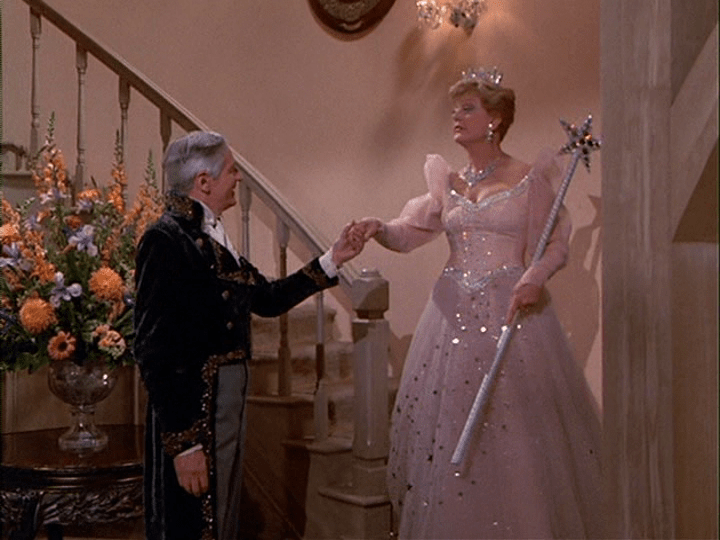
Jessica’s Costume: Cinderella’s Fairy Godmother, but with definite Glinda vibes.  Also, Preston Giles, dressed as the Count of Monte Cristo.

It’s very early in the series, and so, unsurprisingly, Jessica’s character and personality are still evolving.  In this first episode, she’s a very folksy “widow woman,” and has a home remedy for everything.  A lot of time is dedicated to demonstrating her overwhelm and naivete about The Big City.  While this Jessica is still whip-smart, energetic, warm, and caring, she is not yet the self-possessed and elegant woman of the world she becomes in later episodes.

Grady Fletcher

Grady is Jessica’s devoted nephew, and, at least for the time being, employed as an accountant for Cap’n Caleb’s Chowder Houses.

Kitt Donovan

Kitt is Grady’s fiancée, and it was she who helped get Jessica’s book published by Coventry House.  But how did Kitt and Grady meet?  It’s too much of a coincidence that their respective bosses also happen to be friends and neighbors, unless Kitt and Grady met through the Giles/McCallum connection at some other social event.

Kitt (left), costume not stated, but my guess is Scheherazade.  Grady (right), costume also not stated, looks like an Errol Flynn/Douglas Fairbanks inspired Robin Hood (he lost his hat apprehending Baxendale).  Dexter Baxendale (center), no costume… yet.

Preston Giles

Giles is the erudite and genteel head of a successful publishing company, Coventry House.  He is the gracious host of a very eventful costume party.  Giles develops a romantic interest in Jessica.

Cap’n Caleb McCallum

McCallum is a successful businessman.  He owns of a chain of seafood restaurants, Cap’n Caleb’s Chowder Houses.  Both wealthy and easy to dislike, McCallum is the conventional victim of a cozy murder mystery.  When he joins the party dressed as the titular Sherlock Holmes, the case seems to be solved almost before it’s begun.

Louise McCallum

The glamorous Louise does not care for skeet shooting and is a bit of a day (and night) drinker.  She is tired of her husband Caleb’s philandering.

Louise (left), costume not stated, Caleb (right), dressed as Sherlock Holmes, Ashley Vickers (center).

Peter Brill

Peter is a pompous, pretentious, down on his luck theater producer.  He is also a talented piano man, and deserves points for being a good sport and playing all night to entertain a detestable Peter Pan.

Ashley Vickers

Ashley is an executive at the Chowder Houses.  She “has a slinky walk” and is Caleb’s former lover.

There is one very subtly done misdirect concerning Ashley.  When Louise suggests that Caleb has invited Ashley to the party, Giles simply says that inviting her was not his (Giles’) idea.  This allows both Louise and the audience to believe Caleb invited Ashley.  However, later we learn that it must have been Peter Brill who invited Ashley, a fact that would have given too much away if disclosed early in the story.

Peter Brill dressed as Ebenezer Scrooge, and Ashley Vickers as, according to Brill, “The Queen of Office Sweethearts.”

Dexter Baxendale

A gentleman PI, Baxendale nevertheless lends truth to the moniker “gumshoe.”  He is an uninvited party guest who ends up as a fancy dress pool float.

Roy Gunderson

Roy is the New Holvang Chief of Police.  He is a church goer, a football watcher, and dislikes working on Sundays.   Roy initially negs Jessica on her book, but he quickly warms up to her assistance with the case.  Their subsequent rapport is such that he later accepts her offer of lobster stew if ever he’s in Cabot Cove.

Jessica’s first ever murder investigation collaboration is with Chief of Police Gunderson.

Repeat Offenders

If you’re a MSW fan (and if you’ve read this far, you are) I’m sure you’ve recognized a few actors who appear multiple times throughout the series, but in different roles.  Check out The Rogues’ Gallery for more details.  The following actors play supporting roles this episode. We’ll see them again, as part of the main cast of future episodes:

Where in the World is…New Holvang?

New Holvang is a completely fictional upstate enclave for wealthy New Yorkers. However, if you wanted to place it on a map, the sonic booms from the “airport a few miles down the road” are likely coming from the Stewart Air National Guard Base in Newburgh, NY. 

Wait?  What’s that?  You DO want to place it on a map?  Me too! 

As someone who grew up in upstate New York, I loved the extremely realistic State of New York sign.

When Are We?

“The Murder of Sherlock Holmes” first aired in September 1984.  At the costume party, Ashley Vickers says that it’s April.  In the absence of in-episode information to the contrary, I assume that the events in question occur prior, but as close as possible to, the initial air date of the episode.  Why?  To establish a canon MSW timeline, that’s why.  So, I place “The Murder of Sherlock Holmes” in April 1984.  

A fun little easter egg can be found in the scene where Jessica, Kitt, and Grady are combing newspapers for information about Peter Brill’s new show. At 1:06:42 (or 19:50 in part 2) of the episode, Jessica holds open an issue of the ILGWU (International Ladies’ Garment Workers Union) Publication Justice with a back page ad for an upcoming ABC television broadcast of the 1979 film Norma Rae.  Norma Rae was featured as the ABC Sunday Night Movie on Easter Sunday, April 22, 1984.  This prop detail was not meant to be noticed by the audience, or be meaningful to the plot of the episode, but it certainly places filming in or around April 1984.

In a pre-internet world, Jessica combs the trades.

At the end of the episode, Jessica tells Grady she’s not coming back to New York, not next month (May 1984), not next year (1985).  Will this hold true?  Stay tuned!

The Timeline

At her final, successful departure from the NYC railway station, Jessica describes “the past seven days” as “the most miserable week of my entire life.”  Here’s my breakdown of Jessica’s no good, very bad week:

Wednesday

  • Morning: Jessica arrives in NYC via Amtrak.  She is greeted by Grady and meets Kitt.  After being kept waiting, she has a brief encounter with Preston Giles at his office.
  • Afternoon: Jessica begins her book promotion appearances with a television interview that is “dedicated to the beatification of the trivial and the canonization of the mundane.”
  • Evening: Book signing:

Thursday

  • Morning: Radio interview
  • Afternoon: Her second TV interview (spoiler alert!)
  • Evening: Recovering from a cold in her hotel suite

Friday

  • Morning: More autographs and book signings, plus a subpoena from Agnes Peabody
  • Afternoon: Jessica’s first attempt to depart NYC is foiled by a dozen red roses
  • Evening: Not explicit, but I infer that Giles takes Jessica to the dinner he promised her on Wednesday

Saturday

  • Morning: Giles drives Jessica to New Holvang
  • Afternoon: Caleb does some poolside skeet shooting, foreshadowing later events.  Not explicit, but I imagine Jessica goes to the McCallums’ home so she can borrow a costume.  Since Kitt and Grady were included with Jessica in the last-minute invitation to Giles’ weekend party, did they need to borrow their costumes from Louise as well?  Otherwise, why didn’t they do a couples’ costume?

Saturday Night: The Costume Party

  • The house is full of costumed guests, most notably, Caleb McCallum as Sherlock Holmes.  McCallum engages in what my grandmother would call “hanky-panky” with a woman dressed as Little Red Riding Hood.
  • Just after 8:15pm, Baxendale is discovered in Preston Giles’ home.  Grady and Jessica apprehend him.  He discloses to Giles that someone in attendance is under his private investigation.
  • After Baxendale is escorted from the premises, Louise has a disagreement with Caleb and decides to leave the party early.  A very intoxicated Louise manages to fight off Grady and drive herself, against his better judgement.  Don’t drink and drive, kids.
  • A clock reads 10:35.  Ashley, Peter, Kitt, Humpty Dumpty, and Jessica all note that Caleb has not been seen for some time. (We will later learn that Caleb registered at a local inn just before 10:30 pm.) Ashley states that her affair with Caleb has been over for months, and then spills her martini on herself.
  • Jessica and Ashley head to the kitchen to concoct Jessica’s absurd stain removal home remedy that includes milk, eggs, lemons, and soda to remove the noxious stain of…. a martini?  Just let it evaporate.  Or rewrite the scene and have Ashley dump a mudslide on herself, that would leave a mark.  
  • In the kitchen, we overhear the tail end of Preston Giles’ Suspicious Phone Call.  Giles says “Yes, I understand.  I’ll see what I can work out.”  After ending the call, Giles tells Jessica that the call was from an overeager NYT columnist, and that he told him Jessica was “in Pago Pago” and was unavailable for an interview that weekend.  Jessica and Ashley retire to an upstairs bedroom for stain removal.  The kitchen clock reads 10:53.
  • At his host’s request, Peter Brill plays the piano for an insufferable Peter Pan and a room of party guests.  He says he can only stay until 4, which I think is meant to imply he plans to play for a while.  The clock near the piano says 10:55. 
  • We later learn that Baxendale is shot at 11:15.

Sunday

  • Morning: Midway through her early morning run, Jessica encounters Louise on the drive, looking for Caleb.  Considering she spent the night sleeping it off in her car, Louise looks fantastic.  They both hear Kitt scream bloody murder from the pool.  An April morning in upstate New York is typically a bit chilly for outdoor swimming, but someone has to find the body… Gunderson arrives to investigate, and soon after, so does Caleb, which means the Sherlock in the pool was Baxendale.  We learn that Caleb hired Baxendale to investigate a pattern of employee thefts from his business.
  • Afternoon: Giles sends Jessica back to NYC via limo, and Gunderson climbs in to compare notes.  Which man was the intended target?  McCallum or Baxendale?

Monday

  • Morning: Jessica makes her second attempt to Amtrak it home to Maine, but has to remain in New York, because Grady is arrested!  Gunderson and the NYC police suspect Grady of killing Baxendale to prevent Baxendale from revealing that Grady was stealing from Caleb.  Soon out on bail, Grady joins Jessica, Giles, and Kitt at a nearby diner where they drink coffee out of those little Styrofoam cups I haven’t seen since the 80’s.  Ashley is spotted at the diner, replacing the handset of a pay phone (I count this as half a Suspicious Phone Call).  Ashley says she is safe from suspicion of murder because Giles’ neighbors heard the gunshot at 11:15 pm, and Ashley and Jessica were washing out Ashley’s dress at that time.
  • Afternoon:  Jessica visits Cap’n Caleb aboard the Chowder King.  Caleb insists the shot was fired at too close a range to for it to have been a case of mistaken identity.  Additionally, he’s confident Louise would not want to kill him, because a prenup prevents her from benefitting from his death. He also calls Jessica a “shrewd cookie,” because he’s gross.
  • Evening: At 7pm Jessica and Grady rendezvous to search Chowder Houses HQ for evidence of the thefts.  While Jessica hides in a supply closet, Ashley has a full-blown Suspicious Phone Call and leaves the office for a rendezvous of her own.  Hot in pursuit, Jessica plays in traffic, rides the bus with George and the scary lady from Goonies, gets off at 3rd Ave and E 17th St. (Gramercy), and, in my least, least favorite scene this episode, is promptly assaulted by a young Andy Garcia. 
  • Late Night: At 11:30 pm, after being rescued from the mean streets of 1980’s Gramercy by an anonymous bookworm vigilante, Jessica returns to her hotel.  She places a 12:15 am call to Gunderson to insist that Baxendale was the intended target, and that Baxendale’s files should be reviewed in the morning.  With the help of Grady, Kitt, and Giles, Jessica finds a newspaper ad for Peter Brill’s new show.  We later learn that Vickers and Brill spend all night at a NJ nightclub, and that Caleb McCallum is killed before 2:30 am.

Tuesday

  • Morning: Jessica confronts Brill and Vickers at the 17th St. theater. They confess to stealing from Caleb, but insist they are innocent of Baxendale’s murder, for which they both have alibis.  Pursuing an anonymous tip, Gunderson and the local police discover Caleb’s body aboard the Chowder King.
  • Afternoon: At 1pm Louise arrives at the Hudson St. station for questioning about Caleb’s death. The police reluctantly accept the mistaken identity theory for Baxendale’s murder.  Because Ashley Vickers and Peter Brill confessed to the thefts, Grady is exonerated, and Jessica can head home.  A lovelorn Giles lists the lux details of his empty, effete existence, including automated banking, automated security systems, and automated lights.  No mention of the labor-saving butler, Davis, though.  The 4:30 pm train is Jessica’s 3rd attempt to leave New York.  But wait! We see the NYT book review column, and a photo of the writer, Chris Landon.  Jessica solves the case!  She gets off the train and goes to New Holvang.
  • Night: Later that evening, Giles receives a call from a disappointed Yalie telling him Jessica went to New Holvang.  Giles orders a charter flight from Teterboro to be ready and waiting for him.  He follows Jessica to his home in New Holvang and sends her cab away.  Jessica is poolside, waiting… for what?  The automated lights come on at 8 pm! That means Baxendale was the intended target in the first place! Oh, no!  Giles is the murderer!!!

Wednesday, Again

After her miserable seven days in New York, Jessica finally leaves for good on Wednesday morning.  But not before Kitt tries to waylay her with another puzzling murder, lol!

Drowned!?

Show Your Work

A crucial consideration for any cozy mystery is whether it is “fair play.”  Are there enough clues for the audience to solve it? Does the evidence eliminate everyone but the guilty party?  Does our sleuth know something we don’t?

One rule that always applies to cozy mysteries: The culprit must always have means, motive, and opportunity.

Another rule: The murderer is one of the main characters of the piece.  As you watch “The Murder of Sherlock Holmes,” you know that the murderer will not be Humpty Dumpty, or Peter Pan, or even the good doctor.  However, narrators, detectives, and law enforcement are all fair game.

So, for my own, and perhaps, dear reader, your enjoyment, here is my proof for “The Murder of Sherlock Holmes.”  All main characters will be assessed as suspects.  Those who do not have means, motive, or opportunity, will be eliminated.  By the time Jessica has solved it, can we? 

Fair Play Pause Point

This is the point in the plot or narrative when our sleuth has all the clues necessary to solve the crime.  It is the point at which Ellery Queen might break the fourth wall and issue a “Challenge to the Reader.”   In this episode, Jessica solves the crime just before 4:30 pm on Tuesday, when she sees Book Beat columnist Chris Landon’s photo in the paper.  We can use all the information presented up until this point to determine fair play.

Suspects

  • Jessica Fletcher
  • Grady Fletcher
  • Kitt Donovan
  • Preston Giles
  • Caleb McCallum
  • Louise McCallum
  • Peter Brill
  • Ashley Vickers
  • Roy Gunderson

Means

The means for both murders are too widely available to eliminate anyone.  Anyone and everyone had access to the unlocked gun cabinet by the pool where Baxendale was found.  The gun that was used to shoot McCallum is never described in detail, so to our knowledge, all the suspects also had the means to murder McCallum.

Motive

Because of the relationship between Baxendale and McCallum, the motives are very similar for both murders. 

We can eliminate:

  • Jessica: No motive for either crime.
  • Caleb McCallum: No motive to kill Baxendale.  Also, a man who very much enjoyed his own life, so no motive for suicide.
  • Grady and Kitt: By the time Jessica solved the case, Grady had already been cleared of the thefts, and therefore had no motive for either murder.  Kitt, possibly implicated by her relationship with Grady, is also absolved.
  • Roy Gunderson: McCallum has been trying to get Gunderson fired.  However, Gunderson had no motive to kill Baxendale.  Nor did he attend the costume party, so he would not assume the identity of anyone based on a costume.  If we assume the same person killed both men, we must eliminate Gunderson.

That leaves four suspects with possible motives:

  • Ashley Vickers and Peter Brill: Fear that Baxendale and/or McCallum will expose them as guilty of theft.
  • Louise McCallum: First, mistook Baxendale for her philandering husband, Caleb, and then got it right the second time.
  • Preston Giles: No explicit motive, but he lied about a phone call, admits to having automated lights, and is very insistent about the mistaken identity theory for Baxendale’s murder.

Opportunity

Of the four suspects with motives, Vickers and Brill have alibis for both murders.  Louise does not have an alibi for the first murder, and it is not stated whether she has an alibi for the second murder.  No alibi is given for Giles for either murder.

Conclusion

Jessica’s last clue is the gender of the NYT “Book Beat” columnist, Chris Landon.  When she sees Chris’ photo in the paper, Jessica knows Giles lied about the phone call on Saturday night.  While this makes Giles look very suspicious, it does not do anything to dispel the mistaken identity theory for the first murder.

Jessica has connected the idea of Giles’ automated lights to a well-lit murder scene, eliminating the possibility of mistaken identity, but she doesn’t share that with the audience until later, when she’s face to face with the murderer.

So, at the fair play pause point, based on the evidence presented to the audience, either Louise McCallum or Preston Giles is the murderer.  It depends on whether the intended victim was Baxendale or McCallum.

J’Accuse!

Overall, I give this episode 2 out of 3 stars in terms of fair play.  The plot is logically presented, and most of the other main characters are eliminated, but the evidence against Giles is very light.  The audience really only knows to suspect him because of the conventions of the genre.

As the audience, if we have been very, very observant, once Jessica sees that the NYT journalist is a “she” and not a “he,” we know that Giles was lying his beribboned pants off about the Suspicious Phone Call he had during the costume party. However, in the actual “Pago Pago” exchange, the use of pronouns is very, very subtle.  I wonder if the writers initially intended to make use of the gender-neutral name, “Chris”, as part of the misdirection earlier in the plot.  As it is, the name of the journalist is not mentioned until just before Jessica sees her photo.

To wander a bit into the weeds, I find it difficult to believe that the shrewd, prosperous head of a New York publishing house would not know his business well enough to know exactly whom from The New York Times was scheduled to interview his newest bestselling author.  (He knew all about the litigious Agnes Peabody.)  Even if he hadn’t met Landon in person, as a publisher, he would have certainly read her column, and seen her picture, regularly.  The clue of the phony phone call would have been more palatable to me if the journalist in question was from a more obscure publication (The Yale Daily News, for instance), or if we learned that the journalist herself couldn’t have made that call because she was in the South Pacific for the weekend.

Telling Jessica that automated lights were a part of his effete lifestyle was Giles’ other misstep, because those lights made it impossible to mistake Baxendale for Caleb at 11:15 pm. However, I’m willing to believe that, at least until the night of the party, Giles had only a dim awareness (pun intended) of the automated lighting on the premises of his weekend house.  I think it’s plausible that an innocent Giles could have thought it dark enough by the pool at nighttime to mistake someone’s identity.

If the audience suspects Giles, it’s because of the conventions of the genre.  If a main character has a Suspicious Phone Call, they are guilty of something.  Ashley had one (and a half), and she is guilty of the thefts.  Giles’ phone call during the party is suspicious, even if you didn’t notice the pronouns, and, up until the fair play pause point, remains unexplained.  Also, when Baxendale sees the statue of blind justice and identifies Giles’ costume as the Count of Monte Cristo, we know that it’s more than just idle party chat, because we are watching the murder mystery costume party trope play out.  Further, we know that Giles and Jessica’s relationship is going to be doomed somehow, because it’s the series premiere and Jessica is our protagonist, and it’s going to be better for the series if she’s single and has a romantic intrigue every so often.

The final scene between Jessica and Preston Giles is my favorite of the entire episode, and quite possibly, the entire series. This is the first time Jessica encounters and solves a real-life murder. It is the first time she confronts a murderer. Later in the series, most episodes will end in a pattern so predictable, it becomes cliché:  Jessica will confront her suspect alone, elicit a confession, be threatened, and then be saved by law enforcement waiting in the wings.  However, in this first episode, Jessica did not plan to meet Giles at the pool, and there’s no indication that she wanted to.  Instead of the safety of police hiding nearby, Jessica is very alone, and in very real danger of her life.  There’s also a brilliant, very theatrical visual element to the resolution of this episode.  Jessica, standing in the dark with Giles, isn’t truly sure of his guilt until the lights literally come on.  But the thing that really elevates this scene for me is that we don’t know what Giles will decide to do.  He has isolated Jessica, and he has a plan for a quick escape.  In the final moments of the scene, Giles stands behind Jessica with his hands on her shoulders.  We can see both their faces.  It’s clear that she doesn’t know what he’s going to do, and, for a moment, he doesn’t know either. It’s suspense worthy of Hitchcock.

Jessica regrets agreeing to a couples’ costume.

Episode Rating

I give this episode four stars, it’s one of my favorites.

Bonus Features

Do Crimes.

Ever watch so much MSW that you start wondering what percentage of episodes feature multiple murders?  Yes? Oh, thank goodness you’re here.  I thought I was the only one.

Double Murder!

First
  • Motive: Blackmail (fear)
  • Weapon: 12 gauge shot gun
  • Done Deed: Murder happens off screen.
  • Body: Costumed pool float
  • Discovery: 28 minutes, or 30% through
  • Murderer(s): Preston Giles
Second
  • Motive: Obfuscate real motive for first murder (fear)
  • Gun (not specified)
  • Done Deed: Murder happens off screen.
  • Body: Furled in a sail aboard the Chowder King
  • Discovery: 74 minutes, or 79% through
  • Murderer(s): Preston Giles

Other Crimes!

  • DUI: Louise McCallum
  • Theft:  Ashley Vickers and Peter Brill
  • Trespass: Dexter Baxendale, Jessica Fletcher, Grady Fletcher

Psycho Killer

Dear readers, there are those among us who are certain that Jessica Fletcher is the world’s most successful serial killer.  It’s not a pet theory of mine, but if you are interested, here is an excellent explanation as to how she did it this time. 

Tropes, Plot Devices, and Other Conventions

Like other types of genre fiction, murder mysteries often rely on tropes and other conventions to set the desired tone or convey the story more effectively.  Over its 12-season run, I think MSW probably makes use of almost every cozy mystery convention.  The series is also well known for its own set of tropes and clichés.

Mystery Tropes

I’ve discussed most of these earlier in the post, so I’ll be brief.

Costume

One or more costumes are used to obfuscate the identity of the murderer and/or the victim. 

Oddly Located Corpse

In cozy murder mysteries, the corpse is often found somewhere unusual.  This helps keep the tone of the story light, and lets the audience focus on the puzzle, rather than on the disturbing and grim realities of violent death.

Suspicious Phone Call

We overhear only part of a main character’s phone call, and what we do hear is usually either vague, suggestive, or both.

Wrongful Arrest

An innocent person – Grady – is wrongfully arrested. This is a favorite MSW trope/plot device, but it’s also ubiquitous to the genre. This plot twist can be used simply to keep the audience guessing, or to trick the culprit into giving himself away. It can also be used to illustrate the ineptitude of law enforcement, and thus the necessary involvement of our amateur detective.

Montage!

Who doesn’t love a good montage, or love to hate a bad one?  I’ve already discussed the two montages included in this episode, the makeover (meh) and the book promotion (enjoyable).  However, I feel like there was a missed opportunity for a third montage, wherein our hero tries on all of Louise McCallum’s costumes before borrowing one.  In fact, my theory is that Kitt and Grady probably also had to borrow costumes from Louise, so it could have been a really fun montage of all three of them playing dress up.

MSW Tropes

This is the first episode, so all the MSW tropes and conventions still seem fresh and new, even the ones that will quickly become cliché.  I’ve given them all names, and I’ll tag the ones that aren’t so ubiquitous as to happen almost every episode.

Nay, Tarry

Jessica tries to leave, but an innocent person is suspected, so she has to stay and solve the case. Often this involves getting off a train or missing a flight.  This time, it’s Grady who’s arrested, foiling Jessica’s second attempt to leave town.

Brave New World

The characters are confounded or undone by some newfangled technology.  This time, potentially incriminating real estate reports are “in the computer.”  Poor Grady must have hit the wrong button, because “Instead of the real estate reports, it started spitting out last year’s wholesale fish prices!”

Confess Thyself

Jessica confronts the killer alone and persuades them to confess.  I cannot think of an episode of MSW that doesn’t use this plot device, so it’s in cliché territory, but it’s also one of the things that made the series so beloved.

Smile and Smile

To end the episode on an up note, there’s almost always a cheesy freezeframe of Jessica laughing or otherwise mugging in response to the last, generally pretty lame, joke of the episode.  Again, it’s used so much it’s cliché, but also something that made the show.  Yes, of course I have a final freezeframe page.

Le Mot Juste

Jessica Fletcher has the most satisfying ability to tell odious people where they get off without ever being discourteous or vulgar.  She has a couple good repartees this episode:

  • To the snooty TV book critic: “Television is your business, not mine.”
  • To Cap’n Caleb, regarding her disappointing meal at his Chowder House: “It was an experience I’ll never forget.”

I often find myself wishing I had Jessica’s knack for saying exactly the right thing.  Of course, I don’t have a team of writers creating my dialogue… at least, I’m pretty sure I don’t.  Free will is a topic for another day… 

Returning to our muttons, the exchange with the book critic was probably the wittiest scene of the episode, but the man set himself up in a very specific way, and so Jessica’s response doesn’t lend itself to reuse.  However, I can imagine many occasions where “It was an experience I’ll never forget” would come in handy.

The Railway Stations

About halfway through the episode, Preston Giles refers to what I always call “the train station” as “the railway station.”  Initially, I thought it must be an old-fashioned gentleman using an old-fashioned term, how quaint, or maybe vaguely transatlantic, of him.  But readers, I was wrong.  According to the Google Books Ngram Viewer, in 1984 it was actually more common to say railway station than train station, although it sounds very old fashioned to me now.

The New York railway station is an important element of this episode.  There are five scenes that take place there:

  1. Jessica arrives in New York, not dressed as a barber pole, thank you very much.
  2. Jessica tries to leave once, after she’s served a subpoena by Agnes Peabody, and is persuaded to stay with a dozen red roses.
  3. Jessica tries to leave twice, after Baxendale’s murder, and must remain because Grady is arrested.
  4. Jessica tries to leave thrice, but solves the murder and instead takes a local train to New Holvang.  She tells Daniel to check her luggage through to Boston (South Station), which is as close as she can get to Maine on Amtrak from New York.  Once in Boston, I’m guessing her plan was possibly to taxi to North Station for a train to Portland, or more likely, take a bus home from South Station.
  5. Jessica’s fourth attempt to leave, after a very dreadful week in New York, is finally successful. Points for continuity here, because she boards without her luggage.  At this point she must be absolutely exhausted, up all night at the police station with Giles, and then getting on an early train without even a toothbrush or a fresh change of clothes.  Adieu, dear lady.

Solving the case by way of train schedules is a common murder mystery trope.  One that isn’t used in this episode.  However, the plot would have benefited from a quick glance at the Amtrak schedules.  Why does the Yalie who wants to interview Jessica get on at New London, when Yale is in New Haven?  On his way back from Mystic Pizza?

Does it matter?  Yes.  New York to New Haven by train is about 1.5 or 1.75 hours, putting the 4:30 pm New York train in New Haven by about 6:00 or 6:15.  That same train would not reach New London until about 7:00 pm.  The Yalie then needs at least a few minutes to discover Jessica is not on the train, talk to Daniel about where she is, and place a call (remember, no cell phones) to Giles’ New York office.  Giles then has to make very good, probably impossible, time to meet Jessica poolside in New Holvang before the 8:00 pm lights come on.  It’s about a 1.5-hour drive from Manhattan to the sonic booms of Stewart Air Base.  So, what have we learned?  Fictional facts matter.  Also, 10:1 there were no Yalies in the MSW writers’ room that day.

Is there still something stuck in your craw?  I got you.  Why does Daniel the conductor tell this Yalie where Jessica went anyway, rather than just telling him she’s not on the train?  My theory: Remember Daniel’s son’s university scholarship?  It’s to Yale, so he’s partial.

Am I splitting hairs?  Maybe.  However, let the record show that Daniel’s son starts school “next September 4th.”  Tuesday, September 4th, 1984, was the day after Labor Day, an extremely plausible first day of school.  If we can be precise about dates, we can be precise about Connecticut railway stations.

What She Wore

Unlike future episodes, this one wasn’t a sartorial standout for me.  While Louise McCallum and Ashley Vickers have some varied and chic ensembles throughout the episode, everyone else wears a lot of tweed and trench coats, which is accurate to 1984 New York, but isn’t especially interesting to look at. 

The very significant exception to this is, of course, the costumes in the party scenes, which were far and away the most remarkable and memorable looks this episode.

Jessica’s best look is meant to be, and is, the fairy godmother costume, which foreshadows the camp and glamour, but not necessarily the elegance, we’ll see later in the series.  Jessica’s worst look is, and is meant to be, the makeover montage visual gag dress that Jessica refers to as a “barber pole” on her arrival in New York.

The highs and lows of campy glam this episode.

Interior Motives

And the award for worst dressed/best visual gag goes to Cap’n Caleb’s Chowder Houses HQ.

If only office spaces could attend costume parties.

The Rest of the Story

Before Jessica’s penultimate attempt to depart New York by train, Kitt discloses that The Corpse Danced at Midnight is being considered for a movie deal, foreshadowing a later MSW episode, “Hooray for Homicide.”

As the series unfolds, we will learn more about the future of a few characters.  Sadly, there will be no doing of deeds in Jessica’s parlor – Grady and Kitt are not meant to be.  Though we bid adieu to the lovely Kitt, we will see Preston Giles again, after he is released from prison.

But what becomes of, IMHO, the most underserved character of this episode, the warm, glamorous, costume-sharing mensch, Louise?  As we know, Preston Giles chooses to do the right thing and confess to the murders of Baxendale and McCallum.  Because of their prenup, Louise inherits “next to nothing” from the Chowder King’s estate.  However, as Caleb’s widow, Louise would have had grounds to sue Giles in civil court for the wrongful death of her husband. 

Fortunately, it doesn’t come to that.  Giles, inspired by his deep and abiding love for Jessica, chooses to be noble, and settles with Louise out of court, generously.  With her newfound wealth, Louise decides to make a fresh start, leaves New Holvang behind, and pursues her dream of opening a bespoke costume boutique for New York City’s elite.  Her motto: “No Duplicates!”  She becomes a lauded and beloved fixture in NYC fashion circles.  When Iris Apfel declares “More is more,” it’s her good friend Louise who adds “and less is a bore.”  In the 90’s, it’s Louise who convinces a young SJP to embrace feathers as a daytime look.  …Or is it a young Carrie Bradshaw?  Do MSW and SATC exist in the same fictional universe?  Yes.  Let’s make it yes.

Extra Credit

Loved this episode so much you’re craving more?  Here are my recommendations:

  • Agatha Christie’s The Affair at the Victory Ball: An unpremeditated murder takes place during a glamorous masquerade ball, and the costumes in play are used to obfuscate the crime.
  • Edgar Allen Poe’s The Cask of Amontillado: A carefully planned murder takes advantage of the revelry, costumery, and chaos of carnival.