

Eleanor is a member of the Cabot Cove PTA refreshment committee. Her specialties are brownies and macaroons.

Eleanor is a member of the Cabot Cove PTA refreshment committee. Her specialties are brownies and macaroons.
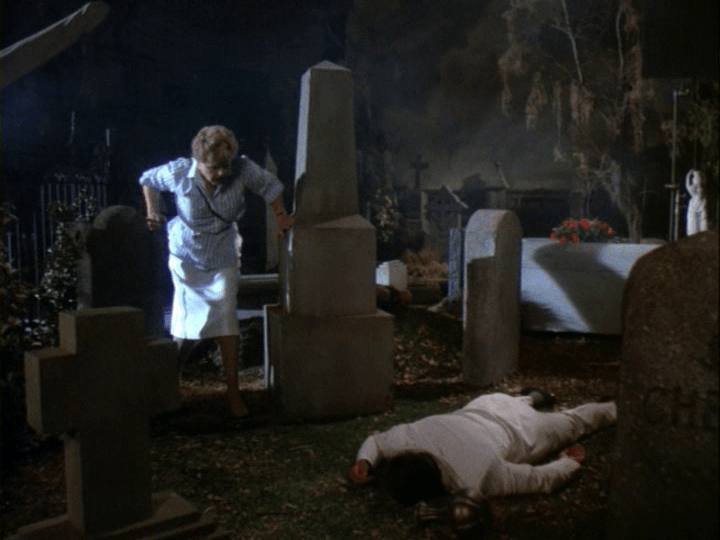
Hello, and welcome to this installment of MSWSW. What follows is a detailed, somewhat meandering look at “Hooray for Homicide.” There will be spoilers. I recommend watching the entire episode first, possibly with a light beverage and nosh, before proceeding.
This episode appears to have everything one could want in a great episode of MSW: a glamorous locale, plenty of camp, the oeuvre of J.B. Fletcher… and yet, perhaps much like Tinseltown itself, the allure quickly fades.
Well, we’re here, so let’s do this thing.
Oh no! The Corpse Danced at Midnight is being turned into a cheap horror flick with pearl-clutching amounts of sex and gore! Jessica flies to LA, determined to defend the integrity of her work.
Hollywood! Here’s a map.
This is another episode that seems to be completely free of clues as to what time of year it is, especially since it’s warm and sunny year-round in southern California. However, we know the events of this episode take place after Jessica’s “Birds of a Feather” trip to San Francisco, because at that time, the Corpse movie deal was still intact. The initial air date of this episode was October 28, 1984, so I place these events in late October 1984.
In order of appearance:
A mystery writer of great renown, J.B. is prepared to do whatever is required to rein in the film version of The Corpse Danced at Midnight.
Ethan makes a brief, but notable, appearance in the opening scene, set in Cabot Cove. He is the first gentleman, but not the last, to try to tackle Jessica’s plumbing. Freud did say “Sometimes, a cigar is just a cigar.” But that’s not the case here, friends.
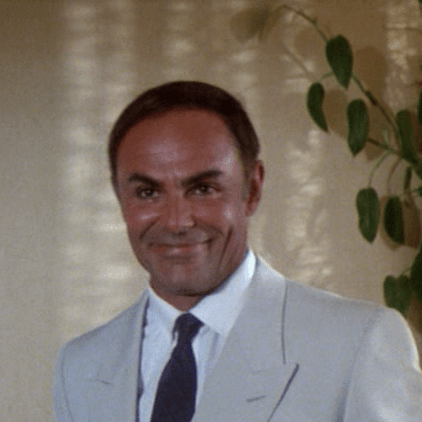
John Saxon is delightfully detestable as a vulgar and avaricious film producer.
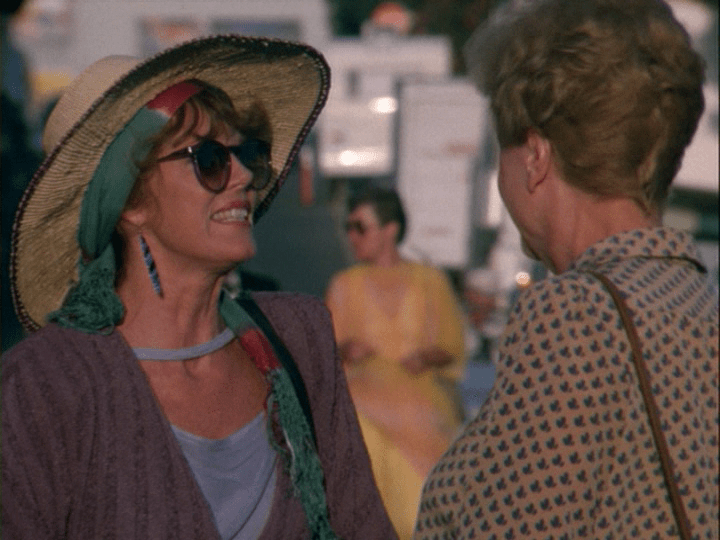
Glamorous Marta, the film’s costume designer, quickly befriends Jessica.

Melissa Sue Anderson is a very demure choice for a slasher starlet.
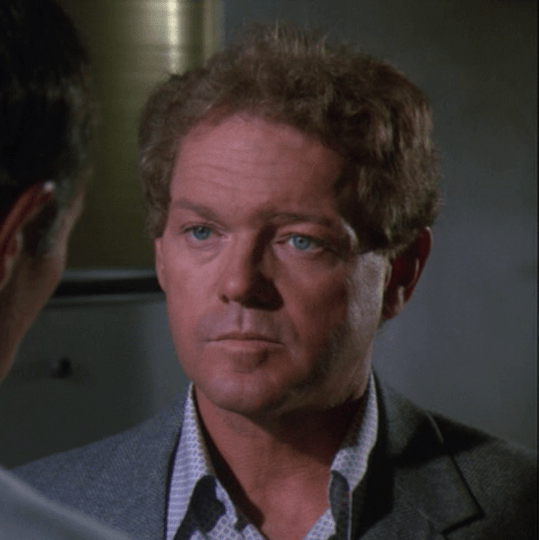
Allan is a screenwriter who must save all his best stuff for the page.
An earnest and seemingly competent director.
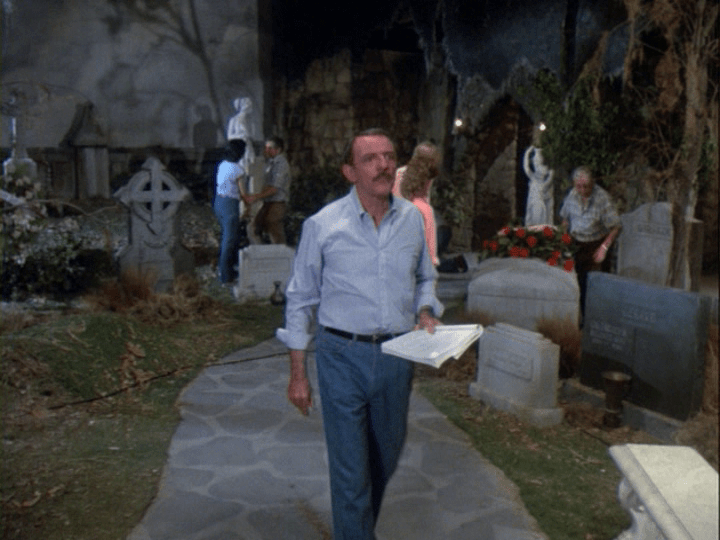

A man with a tan.

A puppyish junior attorney.
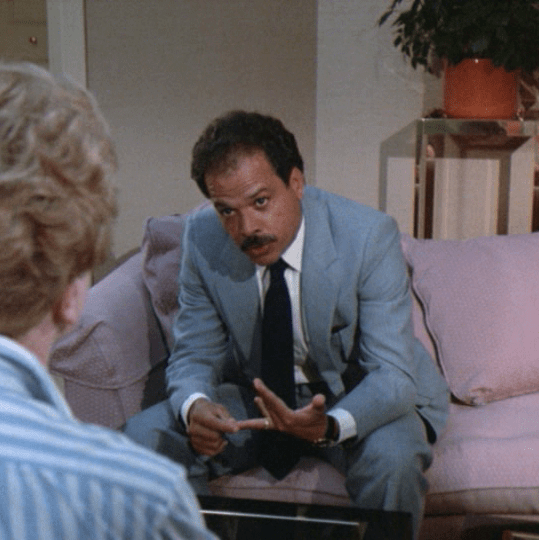
A man who’s a fan.
If you’re a MSW fan (and if you’ve read this far, you are) I’m sure you’ve recognized a few actors who appear multiple times throughout the series, but in different roles. Check out The Rogues’ Gallery for more details. In this episode, one supporting character, Marty Strindberg, is played by an actor who we’ll see again in a future MSW, Lyle Waggoner.
At home in Cabot Cove, Jessica sees a television interview with Jerry Lydecker about the slasher film he’s producing, J.B. Fletcher’s The Corpse Danced at Midnight. Oh, the horror!

Jessica flies out to Hollywood and meets with her attorney, Marty Strindberg. He can’t, or won’t, intervene in the Corpse project, and instead suggests that Jessica should go:
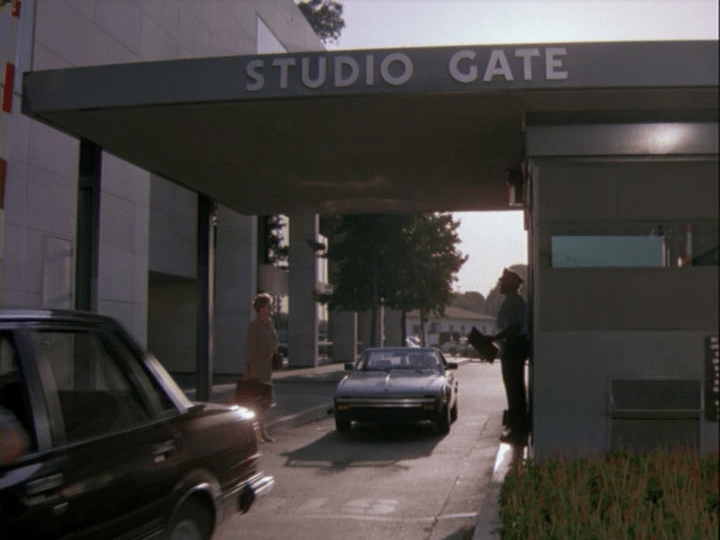
But she’s a woman on a mission, so Jessica crashes the studio gates with the aid of the film’s costume designer, the glamorous Marta Quintessa.
Meanwhile, in her trailer, Eve is confronted by Jerry about his suspicions that there’s another man.
On the way to the set, Jerry and Allan argue about financial matters. Marta, Allan, and Jessica all lament the quality of the screenplay. Jerry and Marta discuss costume challenges.
Ross, Eve, and Scott meet on set to shoot the “nude scene.” Jessica is discomposed.
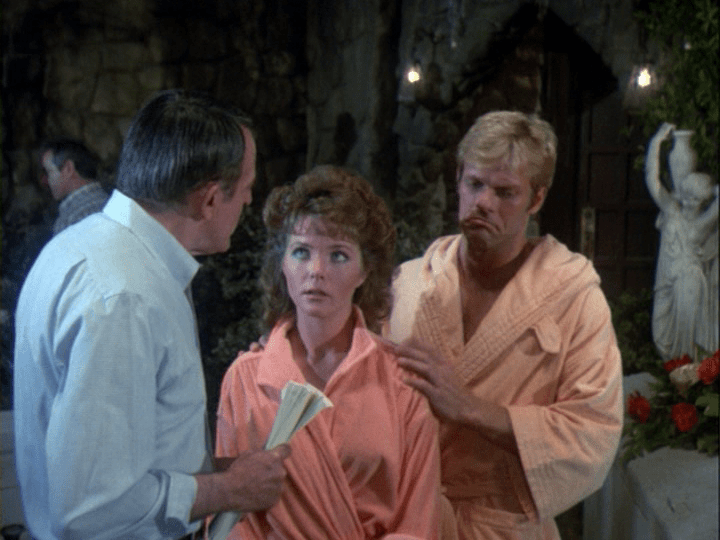
Jerry and Jessica face off. Jerry stands his ground, and our lady says, “Just because the Almighty gave people a taste for lobsters doesn’t mean that He gave lobsters a taste for being boiled alive.” I think this line is a little too over the top to include in my Le Mot Juste, but it recalls David Foster Wallace’s excellent essay Consider the Lobster, which I highly recommend.
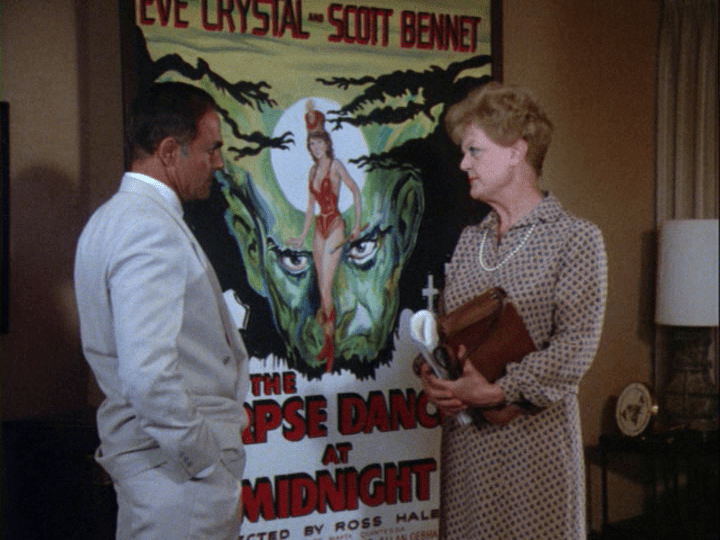
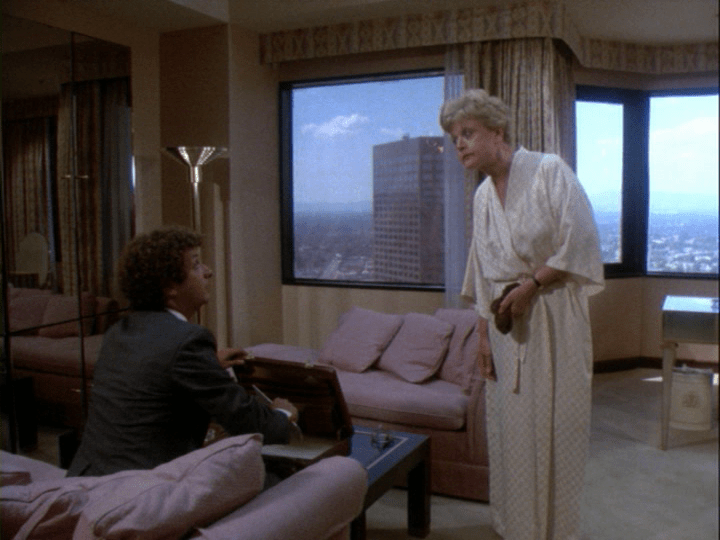
Norman, a junior attorney from Carr, Strindberg and Roth, brings the Corpse contract to Jessica’s hotel suite. Legal eagle-eyed Jessica discovers that she is in the wrong and resolves to see Jerry to make amends.
Off camera, Jerry views rushes in the screening room, and then goes to the set.
After pressing his secretary, Ms. Finch, Jessica follows Jerry to the set to apologize. Instead, she finds his real body in his fake cemetery. Plus, a gold button! It’s a clue!

After being aided/detained by security, Jessica meets Lieutenant Hernandez. He’s a big fan of J.B. Fletcher, and we learn that the “B” is for Beatrice.
Ross and Marta arrive and voice their weak alibis and some even weaker lines. Jessica is sent to Jerry’s beach house to break the news to Eve.
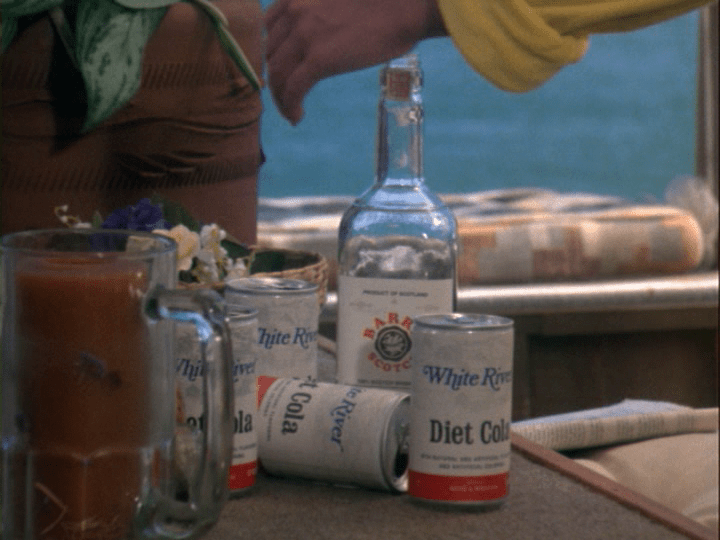
At the beach house, Eve offers Jessica some scotch and (diet) soda.

Here, the viewer might pause to contemplate the difference between purposeful bad acting and unintentional bad acting, and whether we should evaluate a play within a play by the same standards as the play itself. Please leave your thoughts in the comments.
Jessica and Eve decide a cold shower plus a cup of tea is a recipe for sobriety, and then they have an important chat.
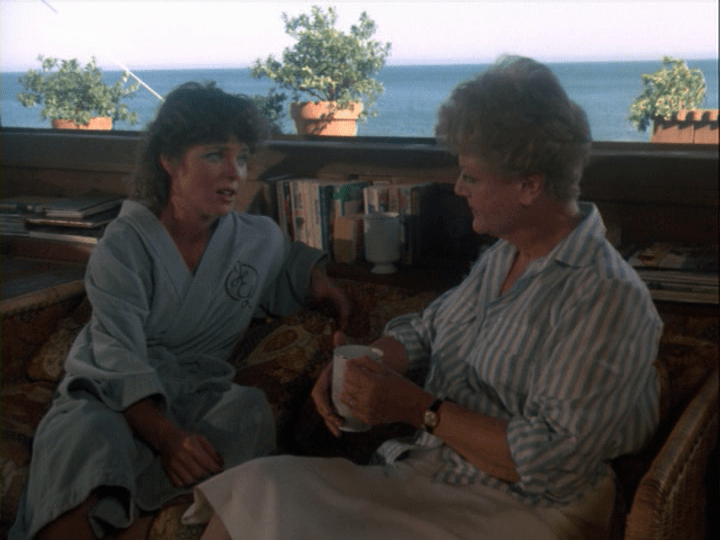
Jessica returns to her hotel with Lt. Hernandez, who tells her she can’t fly home yet, because she’s a suspect.
On the way to the set with Jessica, Allan explains how he, Ross, Marta, et al stand to benefit from Jerry’s death.
On set, we finally get to see Jerry’s vision for the film, and there’s a lot of… choices.

In another tête-à-tête with Jessica, Marta divulges the nature of her past relationship with Jerry, and alludes to a possible allergy or medical condition that Eve has when she drinks alcohol.
Lt. Hernandez halts production to publicly arrest Jessica as prime suspect. Back at the precinct, instead of booking her, he leans on Jessica to solve the case for him.
I deduce it’s morning, as Jessica’s wearing another bathrobe. Does she travel with multiple robes? Is one of them the hotel’s robe? I need to know why there’s more than one. Also, I’ll note that Jessica does all her robe wearing with Norman. However, Jessica and younger men is a subject for a later episode.
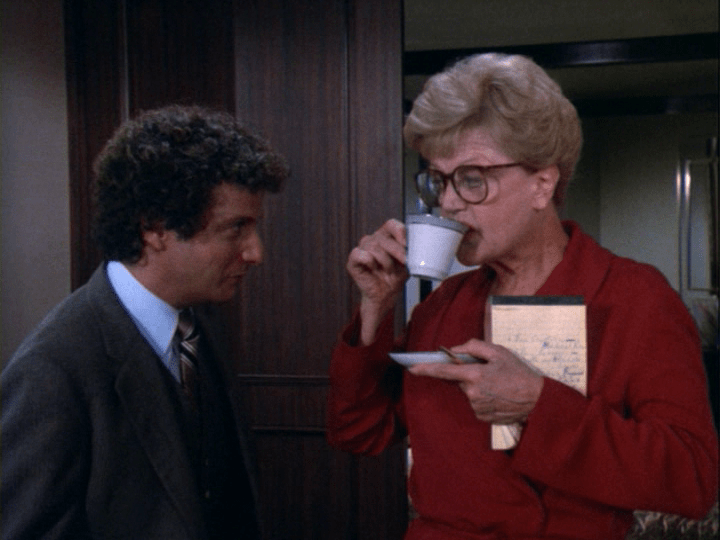
Norman agrees to help Jessica solve the murder. This includes researching the other four suspects and calling in a favor at the studio.
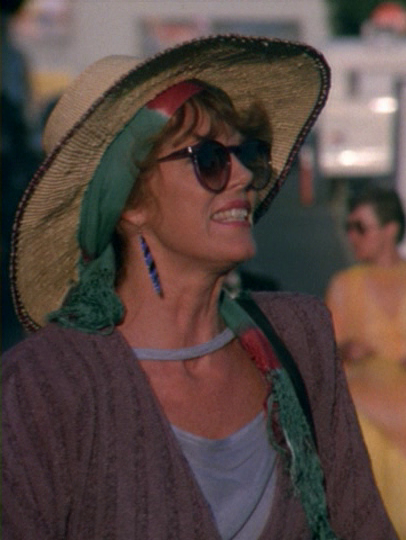
Since she’s been banned from the set, Jessica returns to the studio undercover as a tourist.

She completes a studio tour of her own design:
Egads, it’s Ross! And he has the gold button! It’s a clue!
Due to an irksome plot hole, Hernandez is immediately, inexplicably on the spot to arrest Ross. As they watch the paddy wagon pull away, Norman provides Jessica with the final clues to the mystery:
It’s a party at Jerry’s beach house and Jessica, Marta, Allan, Scott, and Eve are there. Norman is not in attendance; I imagine he’s having a long overdue dinner at his uncle’s house.
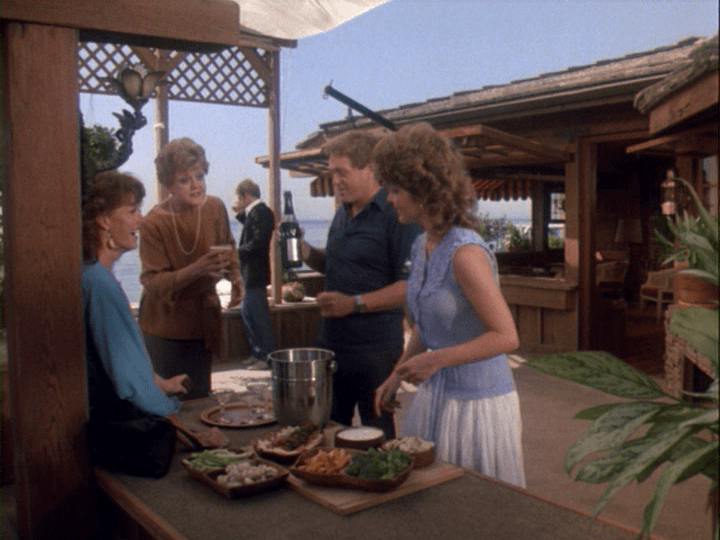
The champagne and diet soda flow. After Jessica’s toast to the wrongfully accused Ross, each party goer takes their leave, until only the murderer remains.
Once Norman gives Jessica his report on all the other suspects, she has enough information to know who the killer is, and so do we.
All the main characters should be considered as potential suspects, the one exception being Ethan, who only makes a brief appearance in the opening scene set in Cabot Cove. The rest, in order of appearance:
Five suspects have motives to kill Jerry:
As for the rest of the main characters:
I’m on the fence about whether Scott had a motive. Neither Jessica nor Lt. Hernandez consider him a serious suspect, but he didn’t like Jerry and was interested in Eve, which seems to me very nearly as much motive as Marta had.
In this case, means and opportunity are inseparable. All five main suspects had access to the set where Jerry was killed, and the weapon was a prop urn on that set. None of the suspects have a particularly strong alibi for the time of the murder. Eve was alone, as was Jessica. Ross and Marta left separately from the costume department during the time of the murder, so they were alone, as well. No alibi is given for Allan. Or Scott, if you care to include him.
Solving the murder comes down to a couple of clues that are presented to us during the scene in which Ross is arrested.

The gold button, first glimpsed beside Jerry’s body when Jessica discovers the murder, is missing for most of the episode. When the button is found in Ross’s possession, Jessica suggests to Lt. Hernandez that it belonged to a costume. The only costume of import throughout the episode is Eve’s original majorette costume. Eve didn’t like it, and Jerry wanted Marta to redesign it. It’s also missing from the costume department.
The gold button beside the body indicates that the majorette costume was present at the time of the murder. Of the five suspects with motives, only Marta, the costume designer, Eve, the costume wearer, and Ross, the director, would have had reason to interact with Jerry in the vicinity of the majorette costume. Neither Allan nor Jessica (nor Scott) were concerned with the majorette costume. Additionally, that Ross is found in possession of the gold button means that he was at the murder scene before the police arrived, and that he understood the significance of the button as evidence.
At Jessica’s request, Norman confirms that Eve takes oral medication for diabetes. If you’re fuzzy or even completely ignorant about the different kinds of medication available for diabetes, don’t worry, so am I. We can still sort this out, because we know Jessica would not have asked Norman for this information unless it potentially pertained to the murder.
We can tie it back to Marta’s remark about Eve’s reaction to vodka, which, in addition to the scotch and diet soda at the beach house, really should have been plenty for us to question Eve’s “I’m drunk” alibi for the murder.
This was another fair play episode, there was plenty of evidence that Eve was lying about her alibi. The gold button was relevant, but also injected just enough chaos and uncertainty to keep the plot moving.
This was another early episode where the final scene felt a little clunky. All the remaining suspects are called together, but instead of a Hercule Poiret-style dramatic denouement including the entire group, each character leaves one at a time, and just like a party breaking up, the final scene loses all its steam. You can kind of see how the later episodes fell into the classic MSW end scene where Jessica confronts the killer alone, often at the risk of some sort of threat or violence. It becomes a cliché, but at least it’s a reliable way of sustaining tension and energy until the conclusion.

I give this episode two stars. It had potential, and I loved the campy b-movie premise, but the cast was undermined by too many terrible lines, and the ending did not work for me.
This is an easy one. This is the first time in the series that law enforcement considers Jessica a suspect, and for good reason. I award a gold button star to this episode for how deftly Jessica is framed, and how concisely Lt. Hernandez and Ms. Finch make a case against her. If Jessica’s the killer, it went down just the way they said.
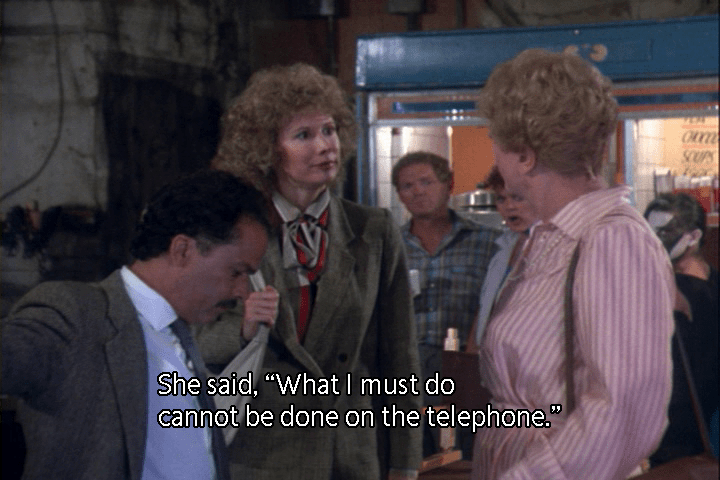
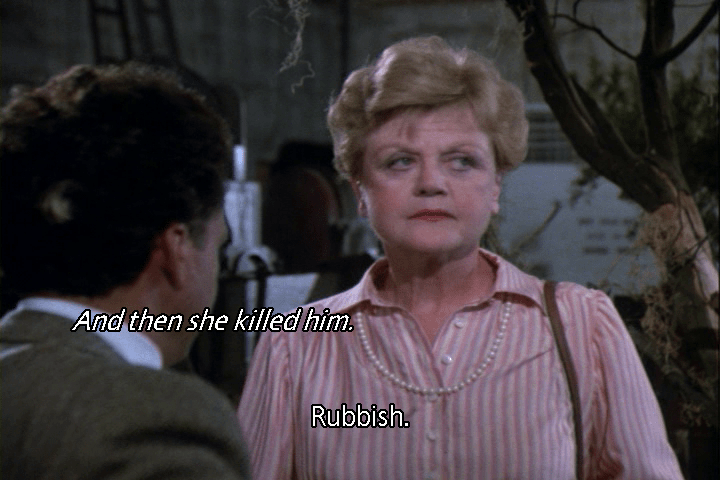
As often happens, this episode’s victim is so dastardly that almost everyone has a reason to kill him.
This is the series’ first, but not last, love triangle that includes the murderer and the victim.
Jessica finds a real body in a fake cemetery, which is clever. Incidentally, it is the first time in the series that Jessica discovers the body.
We see a flashback during Eve’s confession, and it’s the first time in the series that the murder is portrayed on screen.
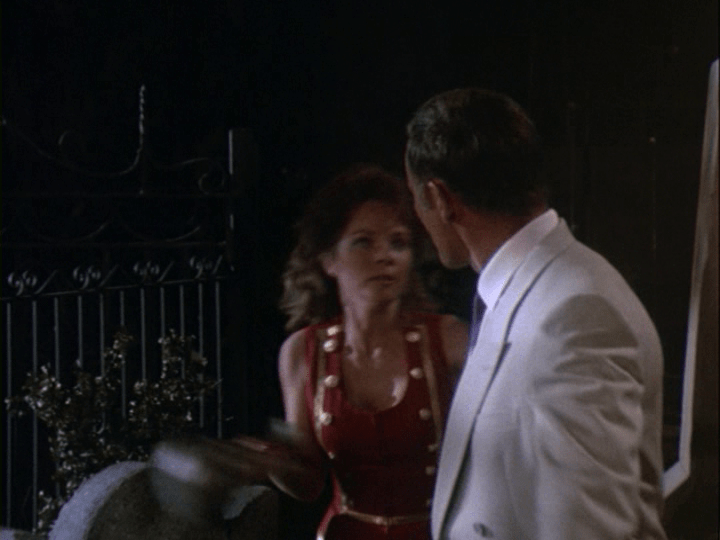
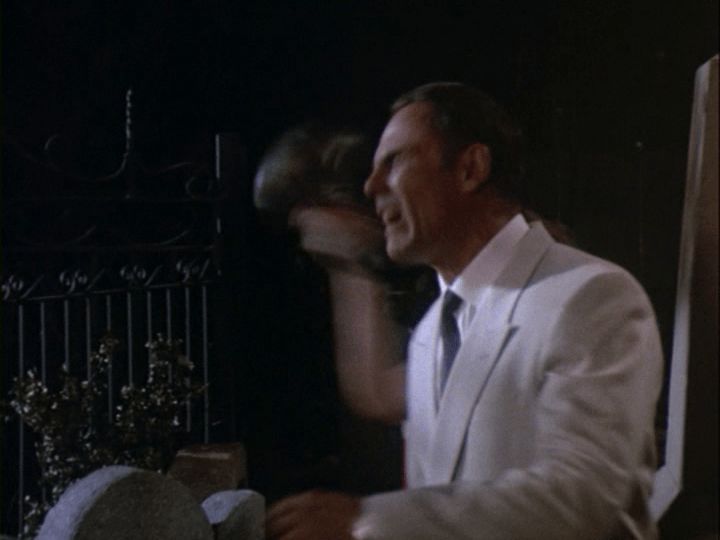
This time, Jessica has to miss her flight home because she’s the prime suspect.
Jessica uses her superlative powers of persuasion to convince the killer to confess.
Lt. Mike Hernandez is the first law enforcement officer who is an unabashed fan of J.B. Fletcher, but he won’t be the last.
This episode is riddled with terrible lines. So many, I should have called this section Le Mot Injuste. Here are the top three stinkers:
To her credit, my favorite line this episode is also from Marta, regarding the majorette costume: “Darling, if I cut it any higher, there will be nothing left but a belt.”
Since the events of this episode come seemingly on the heels of Vicky and Howard’s wedding and their new start in Hollywood, why didn’t Jessica visit them while she was in LA?
My favorite look from Jessica this episode is the blue striped blouse and white straight skirt she’s wearing when she finds the body. It’s so timeless it could be worn today, maybe with an updated belt and shoes. Plus, it could look great on a woman of any age.

My favorite look this episode is Eve’s beach house casual. It’s colorful, but well composed. It looks like it belongs in an 80’s Esprit ad. It also looks super comfy.



This is the second episode in a row I’ve had to come down hard on a jumpsuit.
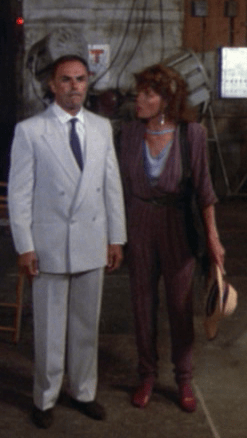
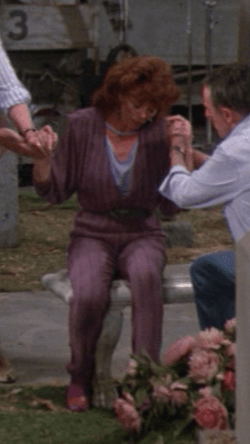
The world of MSW is one in which Eve Crystal is a very good, perhaps excellent, actor. She was able to deceive Jessica the day of the murder. It follows, then, that she was also able to deceive Jessica when she seemingly confessed all and agreed to turn herself in to the police.
While the facts of the case were undeniable, Eve, with the help of the best criminal defense team her studio could buy, was able to convince judge and jury that she acted in self-defense. Only Ross Haley, the lone eye witness to the murder, knew the truth, and it was in his personal and professional best interest to keep quiet.
In addition to the best legal defense, Eve’s studio also invested in a stellar PR campaign. Consequently, the publicity of her trial and acquittal actually boosted Eve’s career. She went on to become a solid B-list actress, and, for a time in the late 80’s, a household name. Whenever possible, she worked on Ross’s projects, helping him to quietly rebuild his career as a respected director and producer. Though they worked closely together for many years, they never, ever discussed the circumstances of Jerry’s death.
Eve purchased Jerry’s beach house from his estate. She led a solitary life there until her death thirty years later.
Looking for some more movie magic, plus a little murder? Here are my recommendations:
A stormy Shakespearean tragedy blows through Cabot Cove.
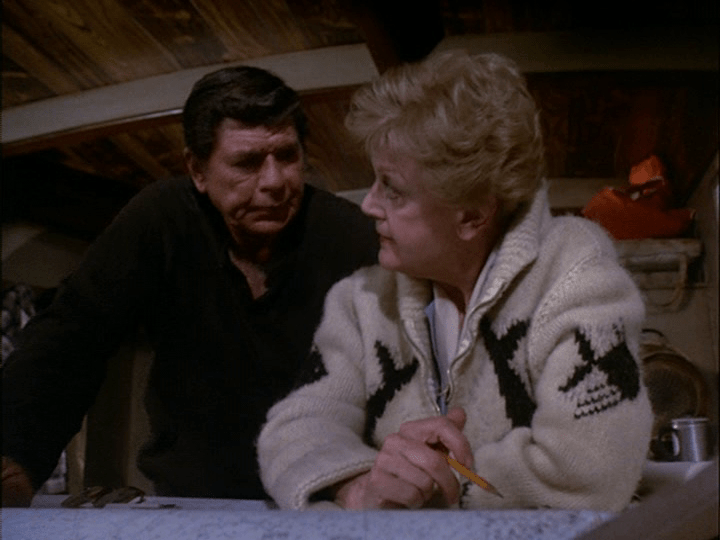
This episode guide is a deep dive into the details of Murder She Wrote S1 E2, “Deadly Lady.” There will be spoilers. There will be what passes for comparative literature here at MSWSW. I recommend you grab a bite and watch the episode before continuing.
Welcome to the first Cabot Cove episode of MSW! It opens dramatically, on a dark and stormy night. The MSW writers are still fresh and full of ambition. After taking on Sir Conan Doyle in the series premiere, they move right on to Shakespeare in the second episode. “Deadly Lady” doesn’t quite merit being called a modern retelling of King Lear; it’s a very standard MSW episode with a heaping measure of Lear flavor in the mix. The very first notable Lear element is the hurricane, which Ethan calls a “deadly lady.”
We get a few indirect clues about Cabot Cove’s geographic location in this episode. Check out this post for more details. Or, take a stroll around town.
My work on a canon MSW timeline continues this episode.
In the absence of in-episode information to the contrary, I assume that the events in question occur prior, but as close as possible to, the initial air date of the episode. “Deadly Lady” first aired on October 7, 1984.
The episode opens with a hurricane. Atlantic hurricane season is June 1st – November 30th.
After dinner with Ralph on the evening of the murder, Jessica’s kitchen clock reads 7:10, and there’s still enough daylight left for Jessica to make it to Ethan’s boat before dark. Using sunset times for Portland, Maine, this narrows the possible time period further, to June – August.
Terry Jones states that Nan was with him in Portland until 4 a.m., just before dawn. This piece of information doesn’t help us any further, however, as the earliest the sun rises in Portland is 4:58 a.m., in mid-June. How long before dawn is “just before dawn”? I don’t know, but someone should tell poor Nan that’s when it’s always darkest.
In this episode, we learn that one of Jessica’s novels, Dirge for a Dead Dachshund, is in pre-publication. In S1 E8 – “We’re Off to Kill the Wizard,” Dirge has been published. The MSWSW timeframe for “We’re Off to Kill the Wizard” is July 21 – 26, 1984, so “Deadly Lady” must have taken place before then.
We’ll do a deep dive into the timeline shortly, but for our purposes here, it suffices that the events of “Deadly Lady” begin on a Wednesday and end on a Sunday. This gives us a window beginning with the first Wednesday of hurricane season, June 6th, 1984, and ending with July 15th, 1984, the last Sunday before the events of “We’re Off to Kill the Wizard.”
In the order we meet them:
The local celebrity and an unofficial police consultant, Jessica is at home and hard at work on her next bestseller.
A local man with a boat, and a good friend to have in a storm. Is he a fisherman by profession? Or does he make a living engaging in other boating endeavors? Perhaps time will tell.
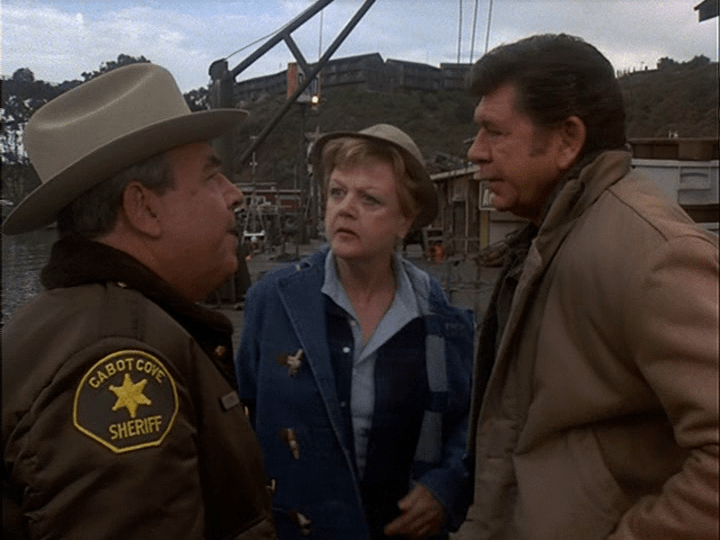
Taking another page from Lear, the Stephen Earl assumes the guise of an ordinary drifter, “Ralph,” to avoid being recognized. His true name, Earl, is, of course, an anagram of Lear. Also, the name Stephen means “crown.” If only it had been Steven rather than Stephen; we could have anagrammed Lear Events. Stephen is the patriarch of the Earl family and has strained relationships with most of his daughters. He is lately, and possibly regretfully, retired from his cosmetics empire.
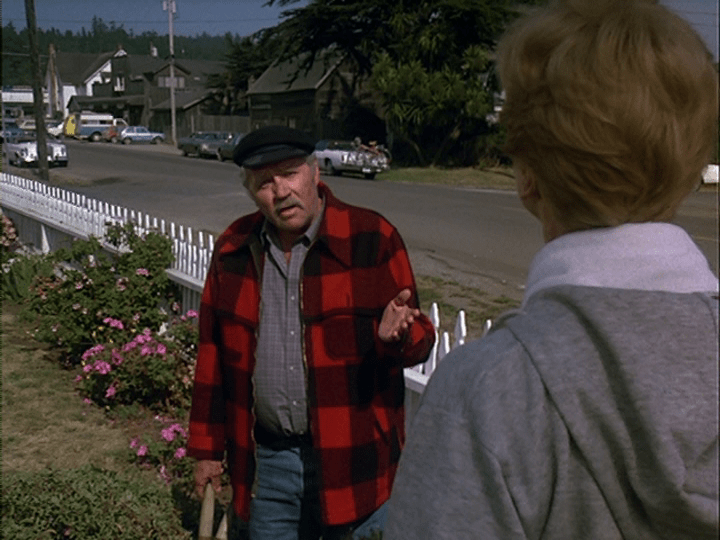
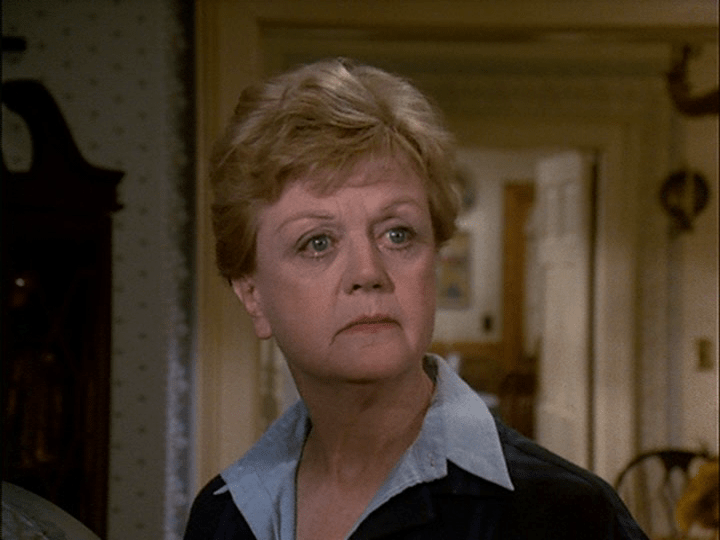
Amos is the lawman of Cabot Cove. He begrudgingly accepts Jessica’s assistance when the case becomes more complicated than he’d like it to be.
Nan is the youngest Earl sister and an aspiring fashion designer.
Maggie has read and enjoyed Jessica’s latest book. She’s described as a frumpy hausfrau, but the actor (Marilyn Hassett) is so young and beautiful that it’s a hard sell.
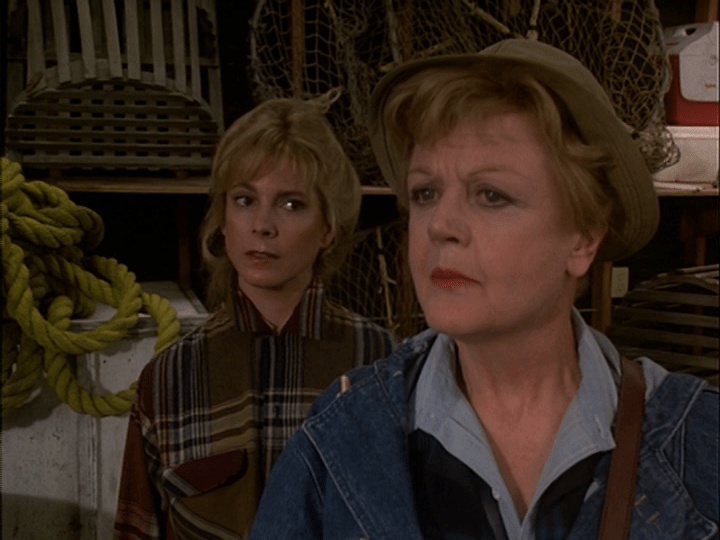
Loyal to her sisters, Lisa is also quite brusque, and nearly deserves her husband, Brian.
Sad Grace will not stop talking about her long-gone husband, so much so that one begins to wonder if he’ll appear with a smoking gun. Spoiler, he does not.
Dack Rambo has a lot of fun baring his teeth as the ruthlessly ambitious Mr. Shelby.
Nan’s former fiancé is just as self-interested as Brian, but more spineless than ruthless.
If you’re a MSW fan (and if you’ve read this far, you are) I’m sure you’ve recognized a few actors who appear multiple times throughout the series, but in different roles. Check out The Rogues’ Gallery for more details. In addition to several of the secondary characters, above, the following supporting characters are played by actors who we’ll see again, in future episodes:
The events of “Deadly Lady” take place over the course of a five-day period.
Aboard the Earl family yacht, Stephen and Maggie stage Stephen’s fake death. Stephen Earl goes to shore on a raft.
A hurricane blows through Cabot Cove. Nearby, the Earls’ yacht sends distress signals to the Coast Guard.
On her early morning run, Jessica learns that Ethan is out rescuing the distressed yacht. Hobo Ralph does yardwork and has eggs with Jessica.
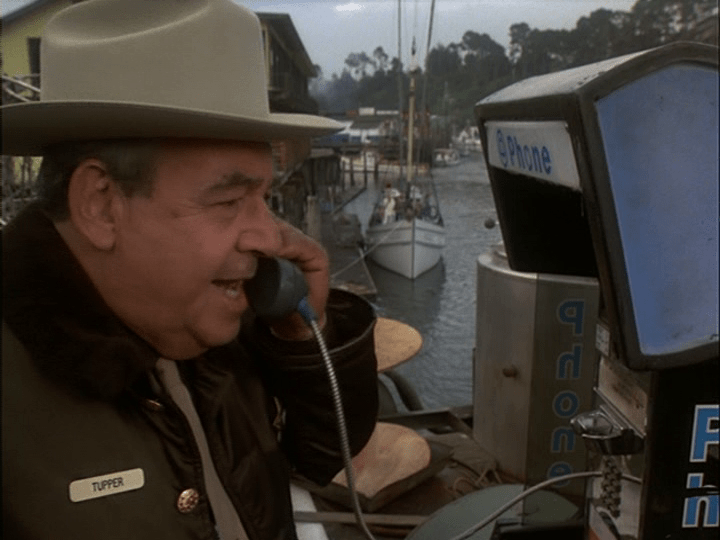
At 8:15 a.m., Jessica and Ralph’s breakfast is interrupted by a phone call. Amos summons Jessica with the best line of the episode.
Jessica meets the Earl sisters. They claim that shortly after midnight, three miles due east of Monhegan Island, their father was swept overboard by the hurricane.
Around noon, Ralph uses Jessica’s line to make a phone call to Terry Jones in Paris, Kentucky. The charge is $9.97, which would be $27.22 in 2022.
Ralph and Jessica discuss classical music, long distance phone calls, and home repairs. Jessica’s grief over the loss of Frank is palpable as she gifts Ralph his pipe.
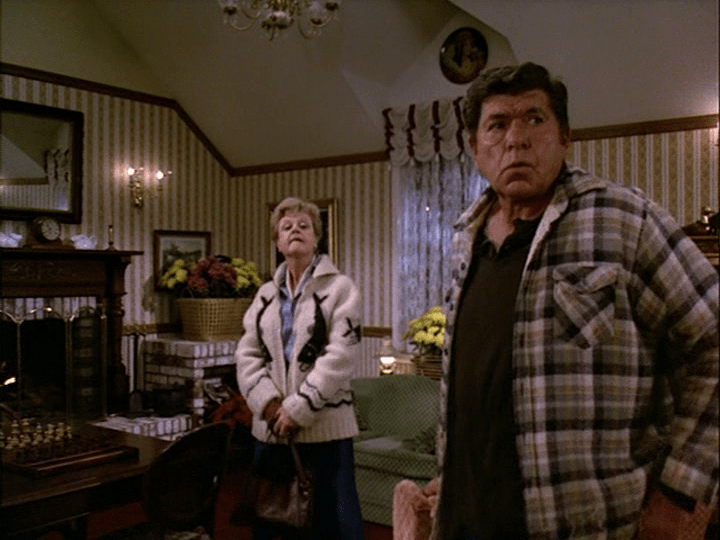
Brian copters into Cabot Cove and is greeted by Lisa.
Jessica makes a “boiled scrod” dinner for two. I think this may be a west coast mistranslation of traditional New England broiled scrod. Ralph smokes Frank’s pipe. Regarding children, Ralph says “blessed, ha,” by which he means “how sharper than a serpent’s tooth it is to have an ungrateful child.” Ralph departs.

Soon after, at 7:10 p.m., Jessica stares at the soapy vortex in her kitchen sink and realizes the Earl sisters couldn’t possibly have known their exact location in the middle of the hurricane. Jessica meets Ethan on his boat to do map and compass stuff to confirm her suspicions.
At some point between 7:10 and 10:45 p.m., Stephen Earl is killed by two shots to the chest.
Nan meets Terry Jones at the Portland airport at 7:30 p.m. They check into an airport motel at 9 p.m. Thoroughly modern Jessica clutches no pearls over this.
At the Hill House hotel, the clock reads 10:45. Maggie confesses to killing her father the night before the storm (Wednesday). Maggie is taken into custody. In a continuity error that is fortunately immaterial to the plot, the same clock then reads 10:40.


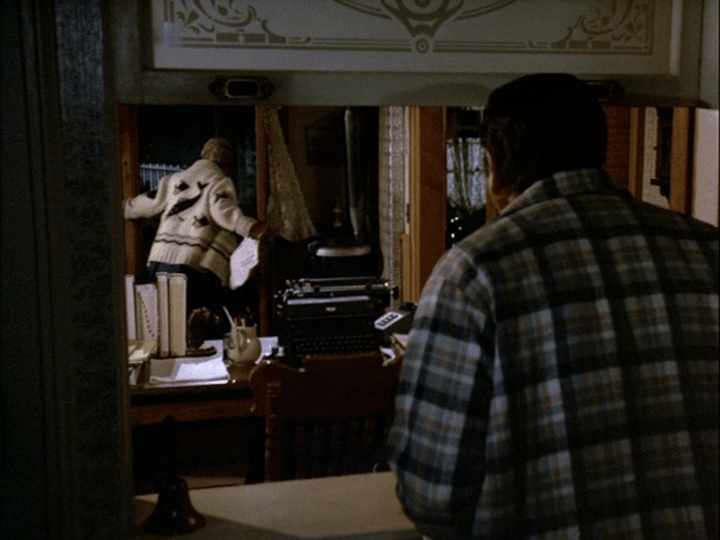
Jessica sees an early edition of the Cabot Cove Tribune and realizes Ralph is Stephen Earl. He is not at her house when she and Ethan return there. Comedic music plays during the search, because lol, Jessica’s got a man in her house, but also, we’ll soon learn he was murdered, so the tone feels off to me.
At 4 a.m. Nan leaves Portland to return to Cabot Cove.
The show briefly takes a very Stephen King turn, when, at 7 a.m., children discover Stephen Earl’s body on Cotter’s Beach. Leave the traumatized children out of my cozy, please. If I want to see children find a body, I’ll watch Stand By Me. Why 7 a.m.? Because the coroner later concludes that the body could not have been in the water more than 12 hours and places the earliest possible time of death as 7 p.m. Friday.
At 11 a.m. Terry hears about the actual death of Stephen Earl on the local television news in his Portland motel room.
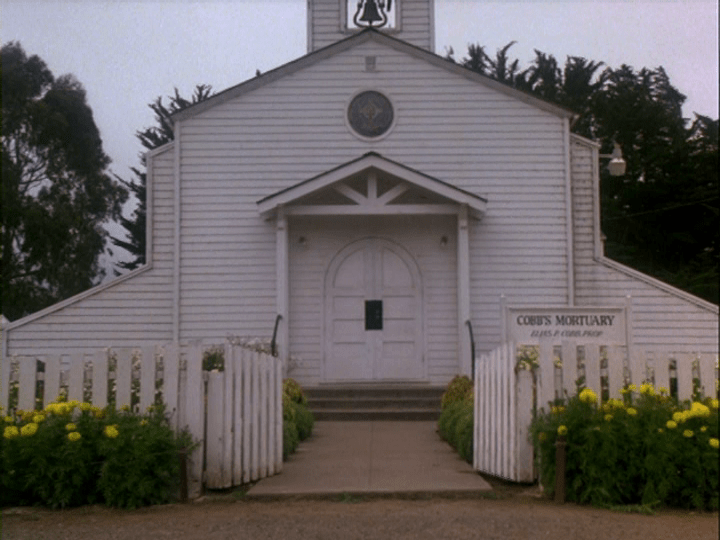
Nan and Lisa identify their father’s (still blinking) body. (Where is Grace?) Jessica also identifies the body.
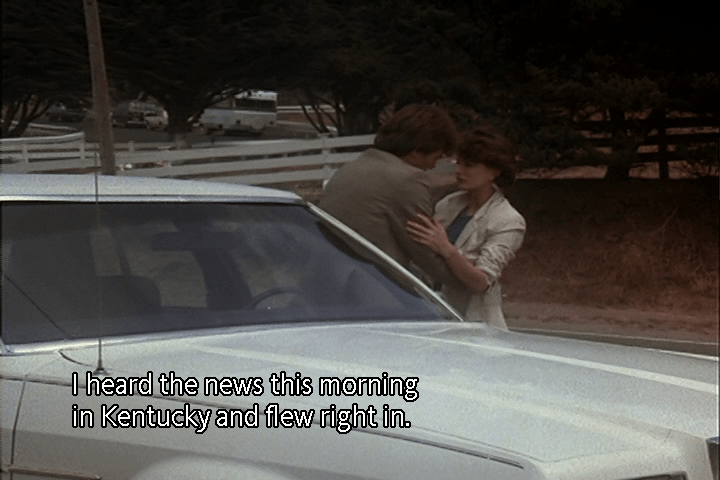
Outside the mortuary, Terry arrives and tells Nan that he flew in from Kentucky that morning, which is bullshit, and she knows it, even though the audience doesn’t yet. Continuity, people. Suggested alternative line: “As soon as I heard the news this morning, I had to come see you.” Less bogus as far as Nan is concerned, but enough of a dissemblance that Jessica can still nail his ass later.
Back at Hill House, Brian and Lisa have a drink and a scene about Lisa’s family loyalty versus maximizing the Shelby portion of the estate.
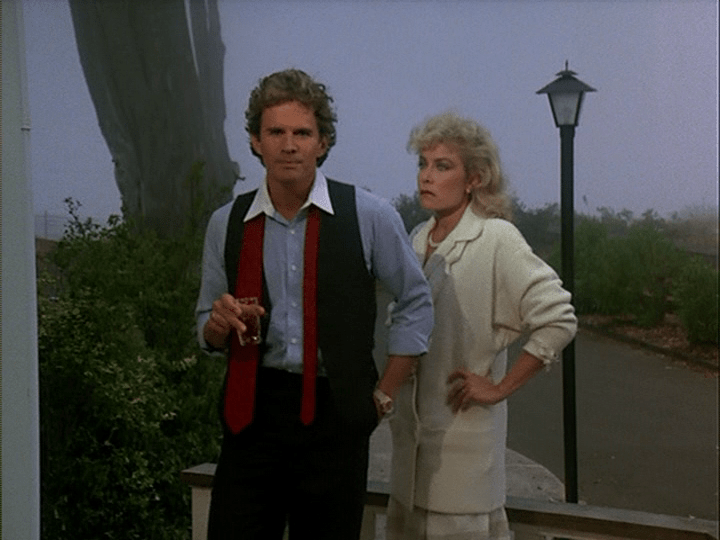
Meanwhile, at the Cabot Cove Sheriff Station, Maggie explains the fake death scheme she and Stephen planned to expose Terry Jones as a fortune hunter. Jessica says she gave Frank’s pipe to Stephen Earl the night before last, but continuity again, please, it was simply the night before.
Exonerated by the coroner’s evidence about the gun and time of death, Maggie is released from custody and returns to Hill House with Lisa and Brian. (Again, where is Grace?)
Nan and Terry have a romantic walk through the cemetery, but Nan still has her doubts. Agreed. While I wouldn’t necessarily call romantic interludes at airport motels, mortuaries, and cemeteries red flags, they are certainly sad, gray flags.

Jessica then has a comparatively less romantic walk through the cemetery with Terry, during which they discuss Anglo Saxon words, and that Terry is a liar liar pants on fire.
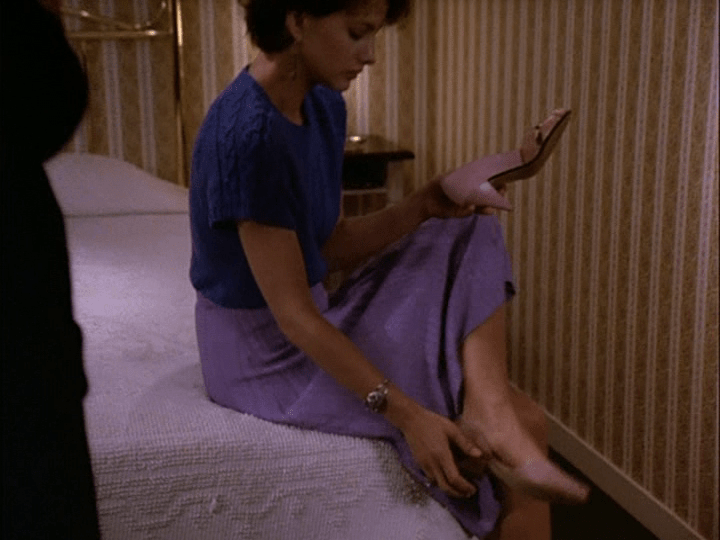
Jessica follows Amos to Cotter’s Beach so she can read the suspicious anonymous note left for the Sheriff. At the beach, they find Stephen’s raft, and a pair of pink shoes, plus a broken heel, in the rocks by the hotel. Jessica says that the shoes belong to Nan.
Back at Hill House, Nan agrees that the pink shoes are hers. In an inverted Cinderella moment, Nan puts one of the shoes on her lovely foot to prove it fits, and, at Jessica’s suggestion, agrees to be taken into custody, even though she is innocent.
Later, at the Sheriff’s station, Terry and Amos discuss possible timelines for the murder, but, to my frustration, do not come to any meaningful conclusions. Worried he, too, may fall under suspicion, Terry abandons Nan.
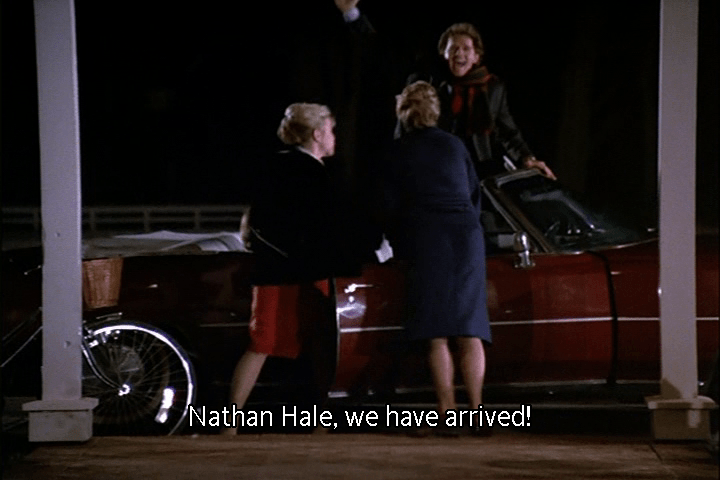
Later that night, Maggie, Lisa, Bart, oops, I mean Brian, and Grace return to Hill House after celebrating Maggie’s exoneration. In another mistranslation of New England culture, Brian seems to think Nathan Hale has something to do with Maine. Clearly, Mr. Shelby is not a Yalie.
Jessica is waiting in the lobby with a rather sinister looking paper bag and bad news about Nan’s arrest, which puts an end to the Earl family’s Saturday night fun.
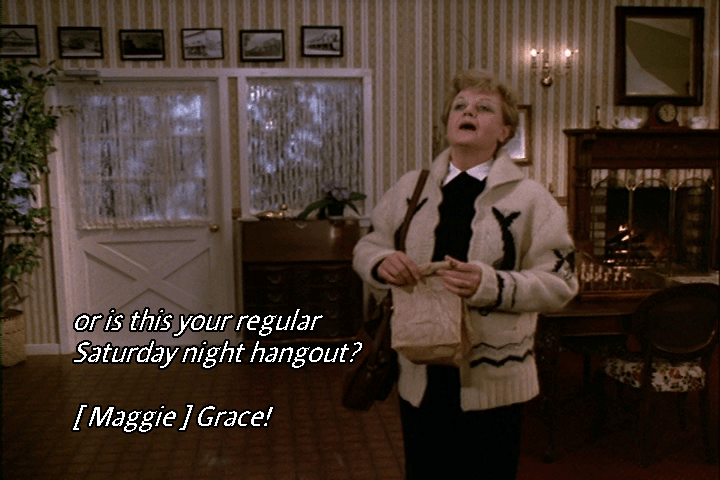
Grace and Maggie agree to allow Jessica to search their rooms for suspicious heelless shoes. Maggie makes what I’m going to call a pink slip, and Jessica goes home for the night.
A shadowy figure breaks and enters through Jessica’s backdoor. Eek, oh no, it’s the killer!
Jessica and Nan concur that Stephen Earl was “a man more sinn’d against than sinning.” True, since he was murdered. However, if you have poor relationships with three out of four children, I think that rests with you. Jessica puts Nan in a cab, and she sets off to, presumably, pursue her fashion career dreams.
The audience does not know that Jessica has solved the crime until she is sitting calmly in her darkened parlor, waiting for the intruder to reveal herself. Because of this, we get one more clue than Jessica said she needed to solve the case. Jessica actually solved the crime earlier, at the point when they find the shoes on Cotter’s Beach. And, in this case, the writers have played very fair with us. We can choose either point, on the beach or in the parlor, and solve the crime with the evidence presented to us. The only trick is that we need to figure out which suspect had motive, means, and opportunity to both (1) murder Stephen Earl and (2) attempt to frame Nan Earl.
We begin with all members of the main cast under suspicion:
None of the Cabot Cove townsfolk, Jessica, Ethan, and Amos, have motives. The four Earl sisters, Brian Shelby, and Terry Jones all stand to potentially benefit financially from Stephen’s death. Additionally, Stephen Earl’s daughters may have had personal motives to kill their father.
One could debate Stephen Earl’s frame of mind during his time in Cabot Cove. He was willing to fake his own death, after all, and seems dissatisfied in retirement. He also discusses his grief as a widower, and has strained relationships with his children.
The murderer also attempted to frame Nan for the crime. Neither Nan herself nor Terry would have a reason to do this, so we can eliminate them. While Stephen could arguably have been in a suicidal mindset, he would have had no desire to frame the child he loved best, so we can eliminate him, as well.
We can also eliminate Brian Shelby here. Brian is strictly motivated by power and greed. He tells Lisa that he does not see Nan as an obstacle to his designs on the Earl cosmetics company, because Nan is planning a design career in New York. If anything, he sees Grace, and presumably, an exonerated Maggie, as threats.
Therefore, the only suspects who may have motives for both aspects of the crime are the three older Earl sisters: Maggie, Lisa and Grace.
Maggie, Lisa, and Grace all had opportunity to commit the murder, based on the coroner’s timeframe: as early as 7 p.m. on Friday until the body was found at 7 a.m. Saturday morning. Even though the anonymous note implied the murder occurred at 10 p.m., the note doesn’t prove anything, nor does it matter, since none of the three have alibis until the Friday night meeting at Hill House, at about 10:45 p.m.
Framing Nan for the murder was a two-step process: (1) tell Nan to go to Portland to meet Terry on Friday night, so she won’t have an alibi for the murder and (2) plant Nan’s shoes at the crime scene. Maggie, Lisa, and Grace all had time to tell Nan about Terry’s flight to Portland on Friday. The shoes could have been planted on the beach at the same time as the murder was committed.
We can’t use opportunity to eliminate any of the remaining three suspects, because all of them had opportunity to both kill Stephen and frame Nan.
The means to kill Stephen is a straightforward matter: a .32 caliber gun. It’s never found, nor is the owner identified. So, to our knowledge, all the suspects had means in terms of access to the weapon used.
The means to frame Nan is two-part. First, a pair of Nan’s shoes, which would be a simple matter for anyone on the yacht or at the hotel, including all three remaining suspects. Second, knowledge of Terry’s flight to Portland on Friday evening, which is more crucial.
Based on their individual conversations with Jessica, it seems likely that Lisa did not know much about Nan and Terry’s relationship, but that Grace may have known more about Stephen’s interference. Either way, tough to eliminate either Lisa or Grace on this point. Also, Grace is, to my mind, conspicuously absent throughout the day on Saturday, which, if intentional to the plot, turns out to be a red herring.
According to Terry, Maggie told Nan about his arrival in Portland. Terry isn’t very trustworthy, but he had no reason to lie about this. In isolation, the fact that Maggie told Nan about Terry’s flight is not incriminating, because at this point in the story, we don’t know that it’s part of a larger plan to frame Nan. (It is suspicious that Maggie omitted this fact from her confession of the fake death scheme to Amos, however.)
The matter of the flight to Portland becomes more significant once Jessica discovers the shoes left conspicuously half uncovered on the beach. At that point, it’s clear that Nan was intentionally framed, and we know that Maggie is responsible.
In terms of fair play, this episode delivers. We have all the information we need to solve the crime at the same time as Jessica does. And, in case we’re a little slow, this episode gives us a last extra clue before the killer is revealed, Maggie’s pink slip.
What is the point of the blue heel trap? Jessica already knew Maggie did it. Was the evidence too weak to arrest and/or convict her? As I often wonder after watching Jessica coax out a confession, if Maggie had just kept her mouth shut, would she have gotten away with it?
Although it was a tidy way to tie up the episode, I’m glad Maggie’s guilt didn’t hang on the fact that she knew Nan’s shoes were pink. Why? Well, there’s this thing about Nan’s shoes. They’re all pink, every pair.

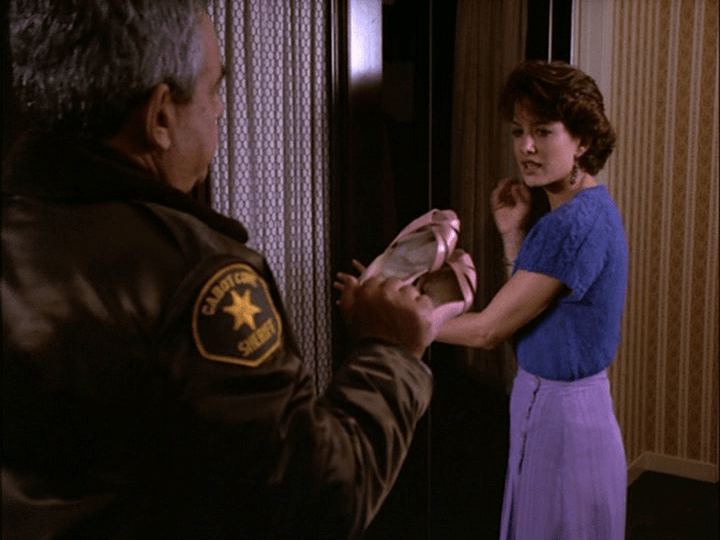

I give “Deadly Lady” 3 out of 4 stars. Not perfect, but quite good and definitely worth a watch.
*Pseudocide is not technically a crime, but it’s almost impossible to fake your own death without also committing fraud, etc.
What if Jessica is a very accomplished serial killer? This time, it’s easy to see how she might have done it. Ralph unwittingly stirs up Jessica’s deep feelings of grief over the loss of her husband, Frank. Jessica’s emotions get the better of her, and she follows Ralph to the beach and shoots him. Maggie, who had planned to meet her father at the beach, witnesses his murder. Maggie’s shock and grief cause her to confuse her role in the fake death scheme with culpability for her father’s actual murder, and so it is a simple matter for Jessica to lure Maggie into a confession.
“Deadly Lady” uses one of the most common cozy mystery tropes; a wealthy and disliked patriarch gives all his adult children reason to commit patricide. Cozy mysteries with this premise abound, but they don’t all aspire to King Lear.
This is the second episode, so all the MSW tropes and conventions still seem fresh and new, even the ones that will quickly become cliché. I’ve given them all names, and I’ll tag the ones that aren’t so ubiquitous as to happen almost every episode. Yep, I’ve given them Shakespearean names, because I’m pretentious. Take me as I am.
Often, Jessica will (falsely) claim to have a piece of evidence to lure the murderer into making a confession. This first time, there’s a little bit of a variation, because Jessica intentionally plants a piece of evidence that she knows the murderer will find to be false.
“Deadly Lady” is the first episode in which Jessica intentionally poses as alone and defenseless, to lure the murderer into a confession. This ploy will become so frequent that it will be more remarkable when it’s not used to wrap up an episode.
Many times, the one thing Jessica needs to put it all together is a seemingly unrelated comment or occurrence. This time, it’s a soapy sink vortex that makes her think of the eye of a hurricane.
There’s a stock character that turns up in many MSW episodes, and I’ll call him (it’s usually a man) the Jerk Who Isn’t The Murderer. In “Deadly Lady” that jerk is Brian Shelby, although I’ll admit I’d take Brian over Terry any day.
Speaking of remarkable when it’s not used, the final freezeframe of this episode is Ethan’s pickup truck, rather than Jessica mugging for a final laugh.
We get some classic Jessica pushbacks this episode:
A great way to make sure you have the last word is to have a bicycle ready for a quick getaway, like Jessica. Otherwise, I feel like her exchange with Brian might have escalated in an undesirable way. By contrast, Terry, a coward, was well and truly under her thumb.
I would have loved, loved, loved a Shakespearean reference from Mrs. Fletcher the English teacher this episode. Well, what’s done is done. As good luck would have it, it’s more than cold comfort to see Shakespeare himself making an appearance in her parlor.
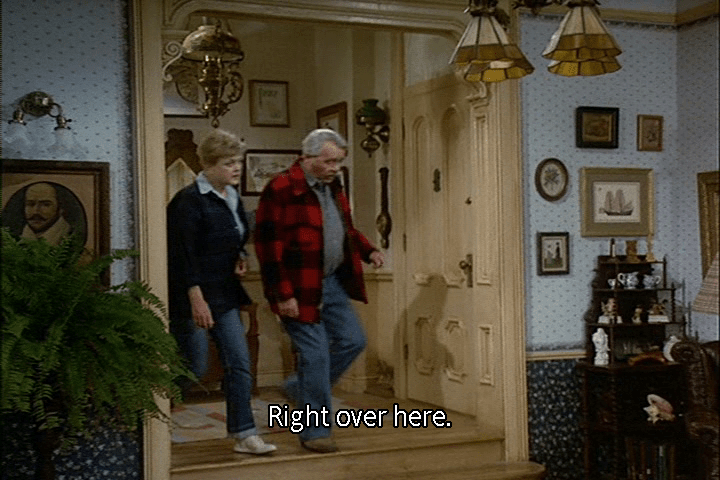
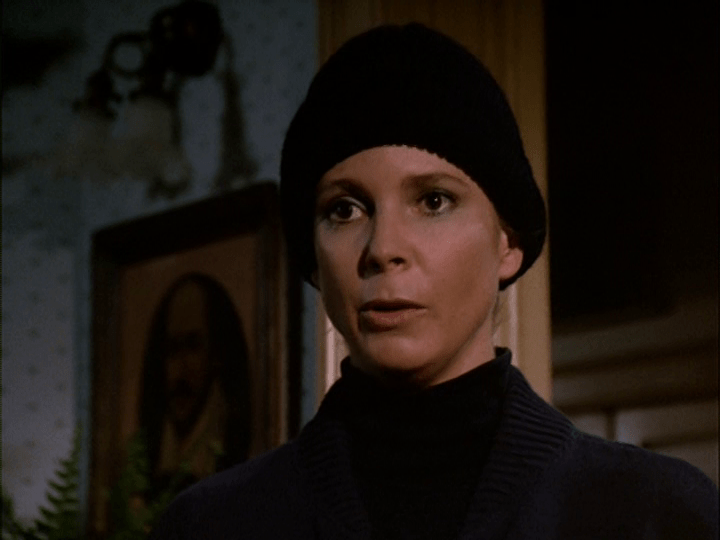
Owning and displaying a portrait of Shakespeare might be the most English teacher-y thing ever. I wonder what The Bard thought of this episode.
As I’ve noted already, “Deadly Lady” makes many clear allusions to King Lear. In that vein, the writers make one very notable departure from Lear by giving Stephen Earl four daughters instead of three. I’m still pondering whether this choice makes the episode work more effectively.
We can pretty easily match three of the Earl sisters with their Lear counterparts. Nan is Cordelia, the youngest daughter with the only good relationship with her father. Lisa and Grace, the two married sisters, are Goneril and Regan. That singles out Maggie from the start, which I can’t think was the writers’ intention.
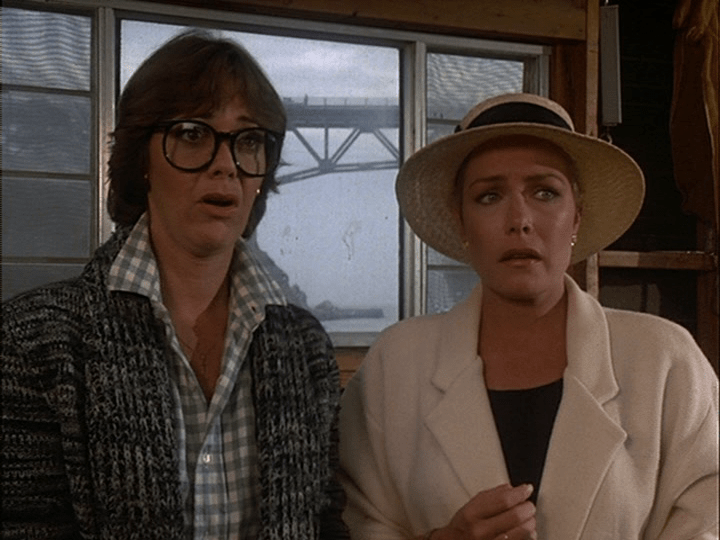
Assuming they weren’t wedded to the title “Deadly Lady,” if the writers felt the need for an additional suspect to add complexity to the narrative, why didn’t they simply include Grace’s husband, Mr. Lamont? In case you’re foggy about Lear, both Goneril and Regan’s husbands strut and fret their hour upon the stage. Further, Grace has precious little to do in “Deadly Lady.” It almost feels as if there are more daughters than the writers know what to do with.
Dear readers, it would be absolute heaven if you weighed in on this. Do four daughters make a better episode than three?
We’re back home in Cabot Cove, and Jessica is a bit more dressed down than she will be in later episodes. Still, she gives us a little L.L.Bean chic a couple of times.
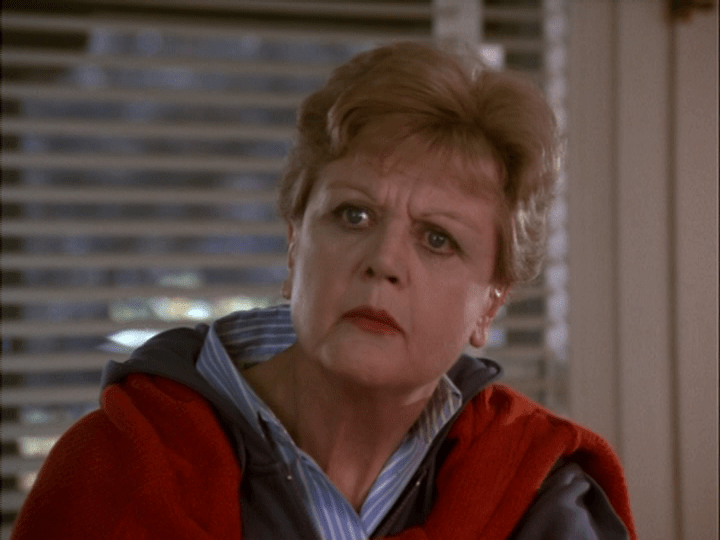
The whale sweater is my favorite thing she wears this episode.
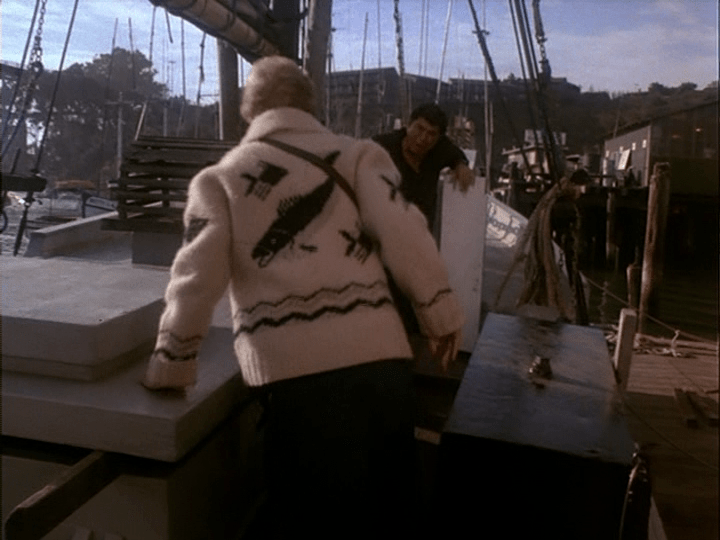
Nan lives up to her fashion designer aspirations with her white blazer over blue and lavender here, and I love a good cuff bracelet. It’s very Miami Vice, but refined and timeless enough that it could be worn today.
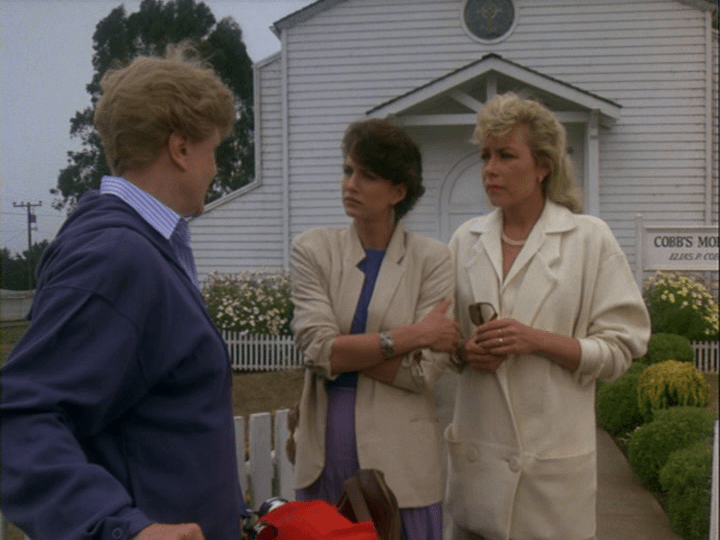
Grace wears competing plaids and a taupe sweater vest. I think her body language says what we’re all thinking about this look.
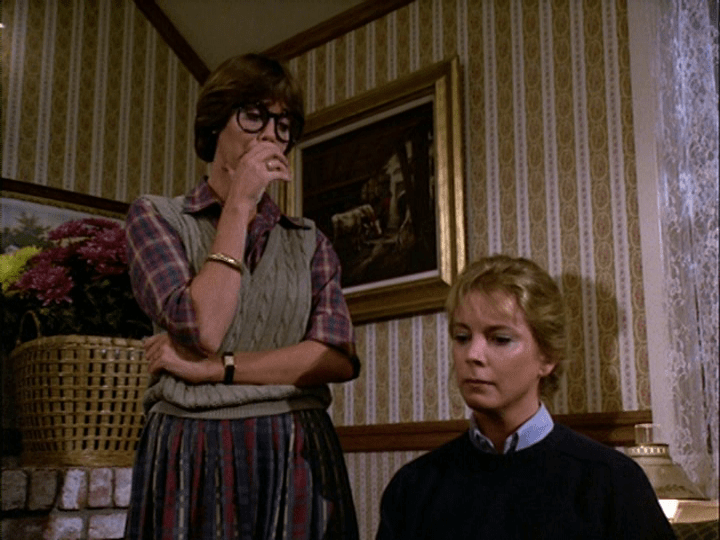
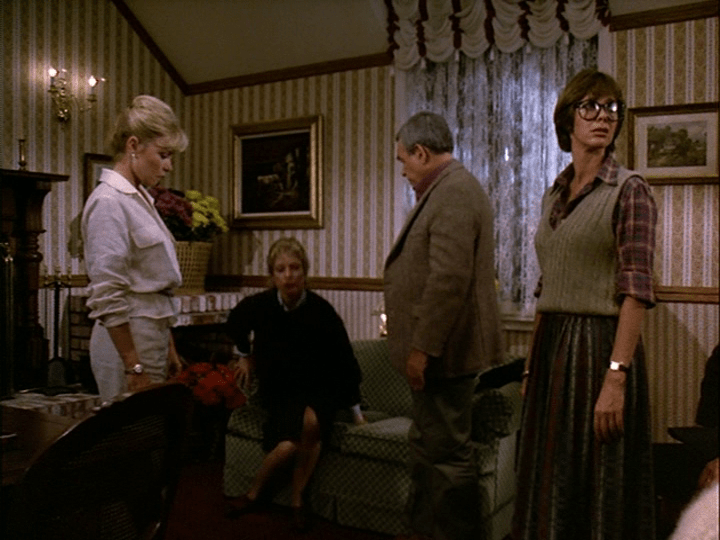
The Hill House is in the midst of an identity crisis; the wallpaper says “aggressively beige lobby” but the drapes say “Madame Alexander boudoir.”
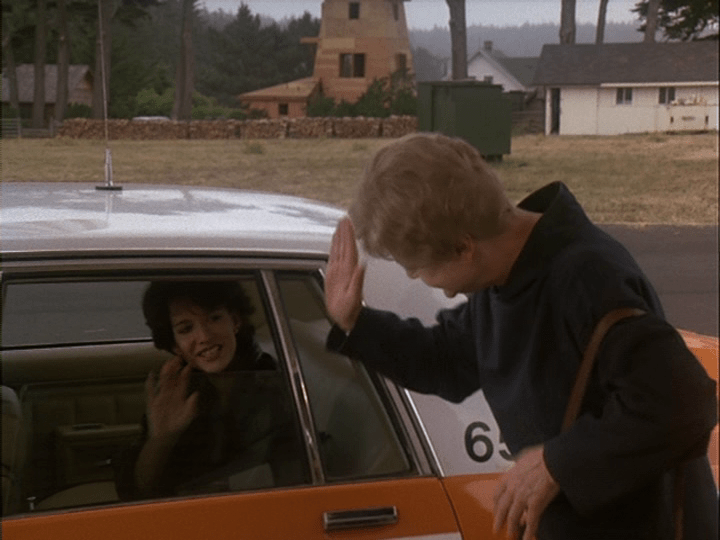
In the final scene, we watch Nan get into a cab to embark on the next chapter of her life. It’s a very long cab ride, all the way to Manhattan and Nan’s dreams of a career in fashion design.
While Nan is a skilled and talented designer, it’s her father’s reputation and wealth that open doors for her. Whenever she experiences some success in her career, she can never be sure if it’s because of her talent and hard work, or her status and privilege.
Nan is overwhelmed and disheartened by the notoriety surrounding her family and the scandal of her father’s murder. She feels isolated by her wealth and unsought celebrity. Understandably, Nan also feels alienated from her sisters. She never fully recovers from Terry’s betrayal, and struggles with trust issues in her romantic relationships.
After a few years of trying to numb her pain with excess, partying, and substance abuse, Nan decides to make some changes in her life. She finds a good therapist. She gets sober. She meets someone in group, Linda, who can relate to the pain and isolation that come from belonging to an extremely wealthy and dysfunctional family. That Linda is also independently wealthy greatly eases the dynamic of their relationship, and Nan learns to trust again.
Seeking a quieter, more intentional lifestyle, Nan and Linda eventually leave the city for a very comfortable few acres in the Hamptons. In an effort to become more authentic as an artist, Nan learns knitting, sewing, and leatherworking, so she can make the physical objects she designs, and fully appreciate the craftsmanship and skill required. Neither Nan nor Linda feels equipped for parenthood, but they adopt what eventually grows into a small menagerie of rescue animals.
When Lisa and Brian’s marriage ends in a very acrimonious divorce, Nan and Linda’s home becomes a haven for Nan’s nephew, Brian Jr. Much to his parents’ dismay, Brian Jr. does not go into the family business, but instead studies theology and becomes an ordained minister. One of the highlights of the Reverend Brian Shelby Jr.’s life is the day he marries his Aunt Nancy and Auntie Linda. It’s a small, casual ceremony on a Montauk beach at sunrise. Nan and Linda’s dear friend, Ina, hosts the wedding brunch.
The Mark of the Earl Cosmetics Company is eventually bought by Unilever.
Loved “Deadly Lady” so much you’re craving more? Here are my recommendations:
Scrod is an unappealing word for something that can be very delicious. It’s whitefish, usually cod or haddock. However, for this menu I am going to choose broiled scrod, which is a popular New England dish, over boiled scrod, which, as far as I know, isn’t really a thing.

For Ralph
Clam Dip & Potato Chips
I’m pretty sure Jessica meant broiled, not boiled
Fresh from her vegetable garden, I’d imagine
Sauteed Zucchini and Summer Squash
Because it’s summertime in Maine

Move over, Sherlock. We’re in Jessica’s world now.
This is a discussion of a murder mystery. It will contain many, many spoilers. If you have not yet had the pleasure of watching the entire episode, I suggest you make an evening of it and then return here to pick over the bones with me.
“The Murder of Sherlock Holmes” is the premiere episode of the Murder, She Wrote series. It is double length, which allows time to introduce Jessica Fletcher as she embarks on a new and unexpected chapter in her life.
We first meet Jessica as she innocently unravels the plot of a new murder mystery play, Something Terrible (indeed), just before its’ pre-Broadway premiere. The director is flummoxed. How could a PTA cookie lady outwit a New York playwright?
Because it’s the series premiere, we are treated to an extended opening sequence dedicated to picturesque scenes of Jessica’s hometown, Cabot Cove, Maine, and all of Jessica’s bracing outdoor exercise (Bicycling! Fishing! Jogging! Wind-swept cliff walks with young people!). This is punctuated with lots of presumably murder-writing on a typewriter that was already ancient in 1984.
We meet Grady! I love Grady and all his failed romances and revolving-door career decisions. I love the way Grady loves Jessica. He is the affable, loyal, slightly dim man of action. He is a Captain Hastings to our Miss Marple. He is generally prone to mishap, but his first act is a success. Grady discovers Jessica’s first book, The Corpse Danced at Midnight, and gets it published to wide acclaim.
We then watch Jessica transition from a small-town substitute English teacher to a bestselling novelist, by way of a very tried and true plot device, montage! In fact, montages, plural. There’s a quintessential (and tired) makeover montage, which proves both literally and figuratively ineffectual. Next, there’s a NYC book promotion montage, which I thought was clever and a lot of fun to watch.
The main plot of this episode gets rolling about fifteen minutes in, when Jessica is invited to spend a weekend at a luxurious estate in upstate New York.
Surprise! There’s going to be a fancy costume party! Since we’re watching a murder mystery, you know at least one of the costumed is coming to an untimely end. Or, more specifically, getting pushed over the Reichenbach Falls, because remember, it’s “The Murder of Sherlock Holmes.”
Don’t you admire the writers’ chutzpah? With their very first murder, they symbolically kill the world’s most famous fictional amateur detective. No sh*ts given for Sherlock, we’re in Jessica’s world now.
In the order we meet them:
Until recently, Jessica was a substitute English teacher at Cabot Cove High School and a core member of the PTA refreshment committee. She’s still all that, but now she’s also Coventry House’s newest bestselling mystery writer.

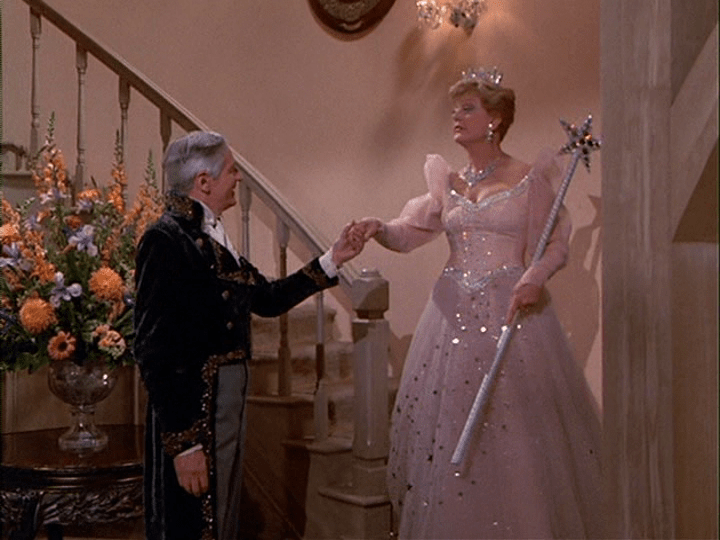
Jessica’s Costume: Cinderella’s Fairy Godmother, but with definite Glinda vibes. Also, Preston Giles, dressed as the Count of Monte Cristo.
It’s very early in the series, and so, unsurprisingly, Jessica’s character and personality are still evolving. In this first episode, she’s a very folksy “widow woman,” and has a home remedy for everything. A lot of time is dedicated to demonstrating her overwhelm and naivete about The Big City. While this Jessica is still whip-smart, energetic, warm, and caring, she is not yet the self-possessed and elegant woman of the world she becomes in later episodes.
Grady is Jessica’s devoted nephew, and, at least for the time being, employed as an accountant for Cap’n Caleb’s Chowder Houses.
Kitt is Grady’s fiancée, and it was she who helped get Jessica’s book published by Coventry House. But how did Kitt and Grady meet? It’s too much of a coincidence that their respective bosses also happen to be friends and neighbors, unless Kitt and Grady met through the Giles/McCallum connection at some other social event.
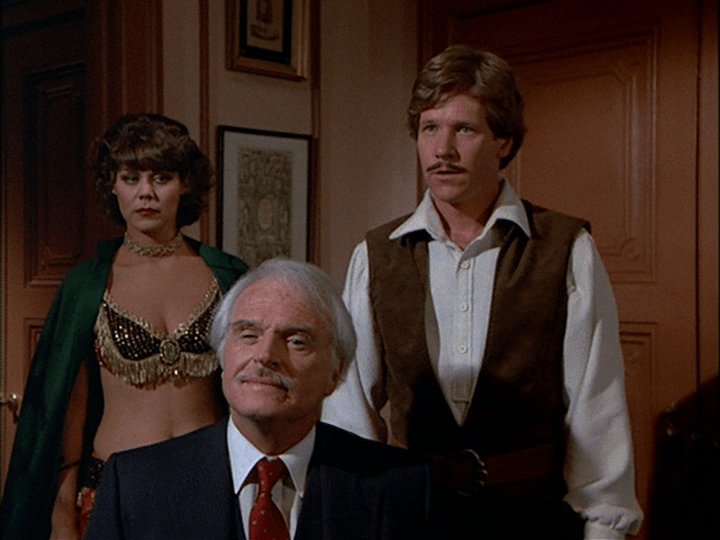
Giles is the erudite and genteel head of a successful publishing company, Coventry House. He is the gracious host of a very eventful costume party. Giles develops a romantic interest in Jessica.
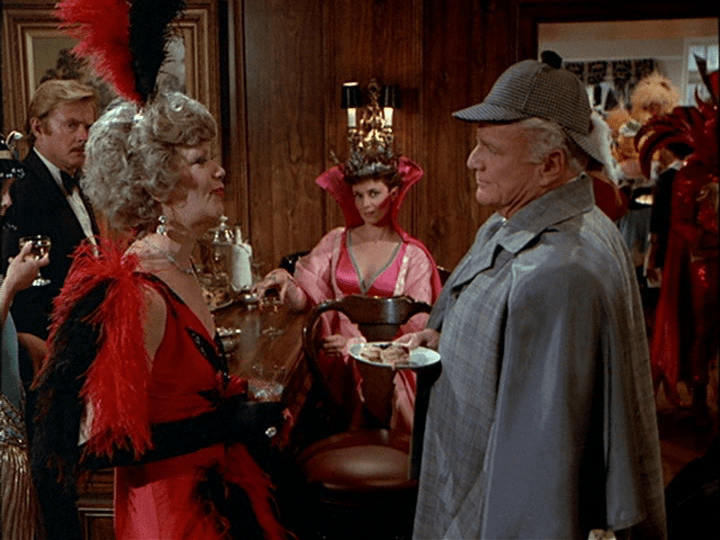
McCallum is a successful businessman. He owns of a chain of seafood restaurants, Cap’n Caleb’s Chowder Houses. Both wealthy and easy to dislike, McCallum is the conventional victim of a cozy murder mystery. When he joins the party dressed as the titular Sherlock Holmes, the case seems to be solved almost before it’s begun.
The glamorous Louise does not care for skeet shooting and is a bit of a day (and night) drinker. She is tired of her husband Caleb’s philandering.
Peter is a pompous, pretentious, down on his luck theater producer. He is also a talented piano man, and deserves points for being a good sport and playing all night to entertain a detestable Peter Pan.
Ashley is an executive at the Chowder Houses. She “has a slinky walk” and is Caleb’s former lover.
There is one very subtly done misdirect concerning Ashley. When Louise suggests that Caleb has invited Ashley to the party, Giles simply says that inviting her was not his (Giles’) idea. This allows both Louise and the audience to believe Caleb invited Ashley. However, later we learn that it must have been Peter Brill who invited Ashley, a fact that would have given too much away if disclosed early in the story.
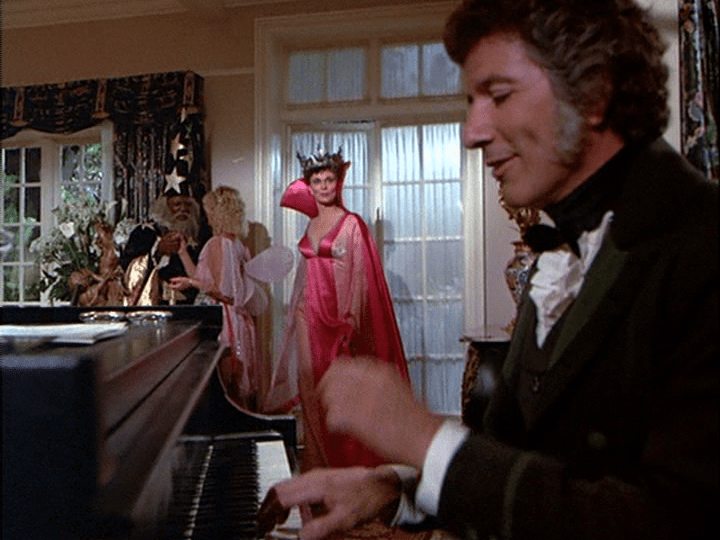
A gentleman PI, Baxendale nevertheless lends truth to the moniker “gumshoe.” He is an uninvited party guest who ends up as a fancy dress pool float.
Roy is the New Holvang Chief of Police. He is a church goer, a football watcher, and dislikes working on Sundays. Roy initially negs Jessica on her book, but he quickly warms up to her assistance with the case. Their subsequent rapport is such that he later accepts her offer of lobster stew if ever he’s in Cabot Cove.

If you’re a MSW fan (and if you’ve read this far, you are) I’m sure you’ve recognized a few actors who appear multiple times throughout the series, but in different roles. Check out The Rogues’ Gallery for more details. The following actors play supporting roles this episode. We’ll see them again, as part of the main cast of future episodes:
New Holvang is a completely fictional upstate enclave for wealthy New Yorkers. However, if you wanted to place it on a map, the sonic booms from the “airport a few miles down the road” are likely coming from the Stewart Air National Guard Base in Newburgh, NY.
Wait? What’s that? You DO want to place it on a map? Me too!
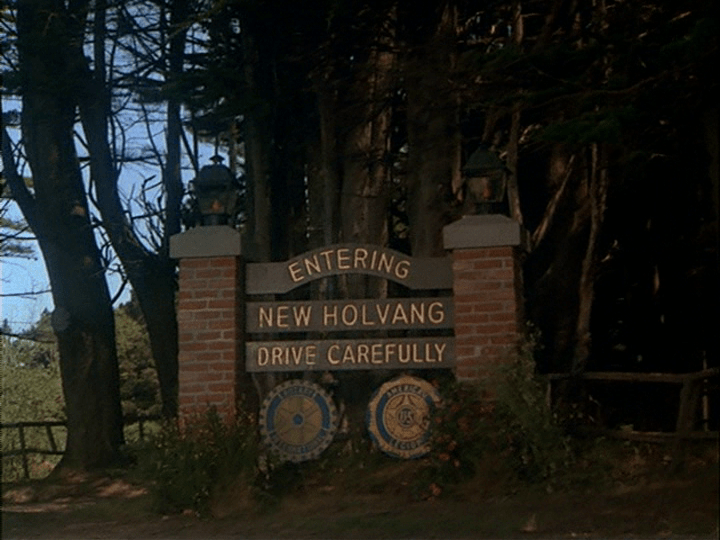
“The Murder of Sherlock Holmes” first aired in September 1984. At the costume party, Ashley Vickers says that it’s April. In the absence of in-episode information to the contrary, I assume that the events in question occur prior, but as close as possible to, the initial air date of the episode. Why? To establish a canon MSW timeline, that’s why. So, I place “The Murder of Sherlock Holmes” in April 1984.
A fun little easter egg can be found in the scene where Jessica, Kitt, and Grady are combing newspapers for information about Peter Brill’s new show. At 1:06:42 (or 19:50 in part 2) of the episode, Jessica holds open an issue of the ILGWU (International Ladies’ Garment Workers Union) Publication Justice with a back page ad for an upcoming ABC television broadcast of the 1979 film Norma Rae. Norma Rae was featured as the ABC Sunday Night Movie on Easter Sunday, April 22, 1984. This prop detail was not meant to be noticed by the audience, or be meaningful to the plot of the episode, but it certainly places filming in or around April 1984.

At the end of the episode, Jessica tells Grady she’s not coming back to New York, not next month (May 1984), not next year (1985). Will this hold true? Stay tuned!
At her final, successful departure from the NYC railway station, Jessica describes “the past seven days” as “the most miserable week of my entire life.” Here’s my breakdown of Jessica’s no good, very bad week:
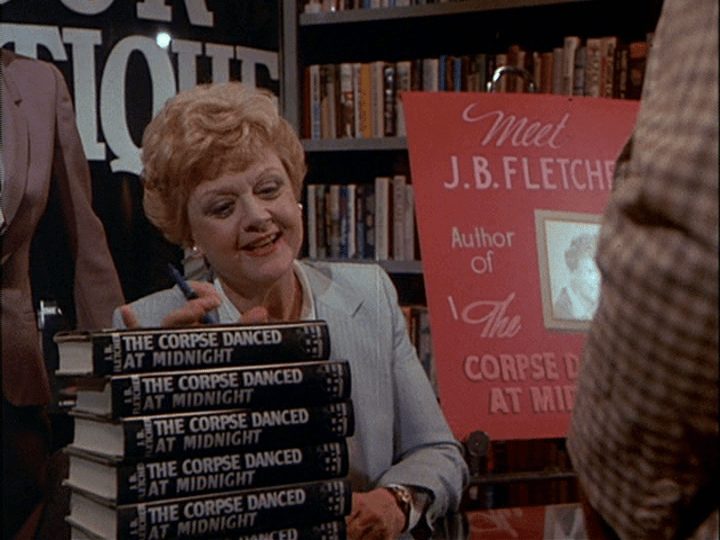
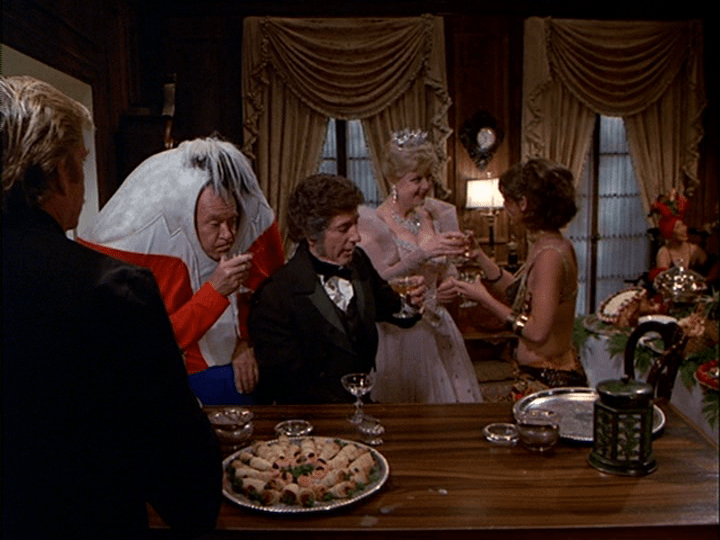
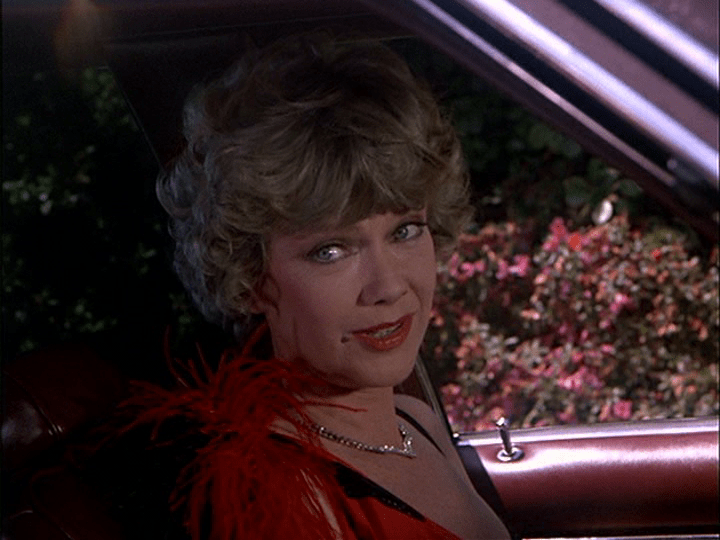

After her miserable seven days in New York, Jessica finally leaves for good on Wednesday morning. But not before Kitt tries to waylay her with another puzzling murder, lol!
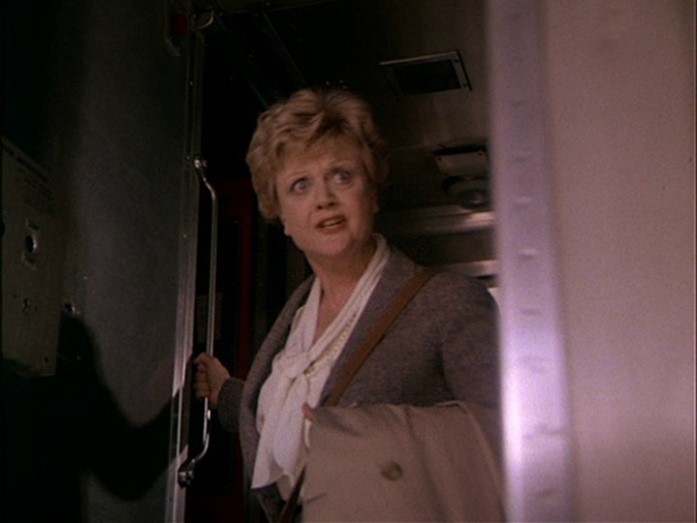
A crucial consideration for any cozy mystery is whether it is “fair play.” Are there enough clues for the audience to solve it? Does the evidence eliminate everyone but the guilty party? Does our sleuth know something we don’t?
One rule that always applies to cozy mysteries: The culprit must always have means, motive, and opportunity.
Another rule: The murderer is one of the main characters of the piece. As you watch “The Murder of Sherlock Holmes,” you know that the murderer will not be Humpty Dumpty, or Peter Pan, or even the good doctor. However, narrators, detectives, and law enforcement are all fair game.
So, for my own, and perhaps, dear reader, your enjoyment, here is my proof for “The Murder of Sherlock Holmes.” All main characters will be assessed as suspects. Those who do not have means, motive, or opportunity, will be eliminated. By the time Jessica has solved it, can we?
This is the point in the plot or narrative when our sleuth has all the clues necessary to solve the crime. It is the point at which Ellery Queen might break the fourth wall and issue a “Challenge to the Reader.” In this episode, Jessica solves the crime just before 4:30 pm on Tuesday, when she sees Book Beat columnist Chris Landon’s photo in the paper. We can use all the information presented up until this point to determine fair play.
The means for both murders are too widely available to eliminate anyone. Anyone and everyone had access to the unlocked gun cabinet by the pool where Baxendale was found. The gun that was used to shoot McCallum is never described in detail, so to our knowledge, all the suspects also had the means to murder McCallum.
Because of the relationship between Baxendale and McCallum, the motives are very similar for both murders.
We can eliminate:
That leaves four suspects with possible motives:
Of the four suspects with motives, Vickers and Brill have alibis for both murders. Louise does not have an alibi for the first murder, and it is not stated whether she has an alibi for the second murder. No alibi is given for Giles for either murder.
Jessica’s last clue is the gender of the NYT “Book Beat” columnist, Chris Landon. When she sees Chris’ photo in the paper, Jessica knows Giles lied about the phone call on Saturday night. While this makes Giles look very suspicious, it does not do anything to dispel the mistaken identity theory for the first murder.
Jessica has connected the idea of Giles’ automated lights to a well-lit murder scene, eliminating the possibility of mistaken identity, but she doesn’t share that with the audience until later, when she’s face to face with the murderer.
So, at the fair play pause point, based on the evidence presented to the audience, either Louise McCallum or Preston Giles is the murderer. It depends on whether the intended victim was Baxendale or McCallum.
Overall, I give this episode 2 out of 3 stars in terms of fair play. The plot is logically presented, and most of the other main characters are eliminated, but the evidence against Giles is very light. The audience really only knows to suspect him because of the conventions of the genre.
As the audience, if we have been very, very observant, once Jessica sees that the NYT journalist is a “she” and not a “he,” we know that Giles was lying his beribboned pants off about the Suspicious Phone Call he had during the costume party. However, in the actual “Pago Pago” exchange, the use of pronouns is very, very subtle. I wonder if the writers initially intended to make use of the gender-neutral name, “Chris”, as part of the misdirection earlier in the plot. As it is, the name of the journalist is not mentioned until just before Jessica sees her photo.
To wander a bit into the weeds, I find it difficult to believe that the shrewd, prosperous head of a New York publishing house would not know his business well enough to know exactly whom from The New York Times was scheduled to interview his newest bestselling author. (He knew all about the litigious Agnes Peabody.) Even if he hadn’t met Landon in person, as a publisher, he would have certainly read her column, and seen her picture, regularly. The clue of the phony phone call would have been more palatable to me if the journalist in question was from a more obscure publication (The Yale Daily News, for instance), or if we learned that the journalist herself couldn’t have made that call because she was in the South Pacific for the weekend.
Telling Jessica that automated lights were a part of his effete lifestyle was Giles’ other misstep, because those lights made it impossible to mistake Baxendale for Caleb at 11:15 pm. However, I’m willing to believe that, at least until the night of the party, Giles had only a dim awareness (pun intended) of the automated lighting on the premises of his weekend house. I think it’s plausible that an innocent Giles could have thought it dark enough by the pool at nighttime to mistake someone’s identity.
If the audience suspects Giles, it’s because of the conventions of the genre. If a main character has a Suspicious Phone Call, they are guilty of something. Ashley had one (and a half), and she is guilty of the thefts. Giles’ phone call during the party is suspicious, even if you didn’t notice the pronouns, and, up until the fair play pause point, remains unexplained. Also, when Baxendale sees the statue of blind justice and identifies Giles’ costume as the Count of Monte Cristo, we know that it’s more than just idle party chat, because we are watching the murder mystery costume party trope play out. Further, we know that Giles and Jessica’s relationship is going to be doomed somehow, because it’s the series premiere and Jessica is our protagonist, and it’s going to be better for the series if she’s single and has a romantic intrigue every so often.
The final scene between Jessica and Preston Giles is my favorite of the entire episode, and quite possibly, the entire series. This is the first time Jessica encounters and solves a real-life murder. It is the first time she confronts a murderer. Later in the series, most episodes will end in a pattern so predictable, it becomes cliché: Jessica will confront her suspect alone, elicit a confession, be threatened, and then be saved by law enforcement waiting in the wings. However, in this first episode, Jessica did not plan to meet Giles at the pool, and there’s no indication that she wanted to. Instead of the safety of police hiding nearby, Jessica is very alone, and in very real danger of her life. There’s also a brilliant, very theatrical visual element to the resolution of this episode. Jessica, standing in the dark with Giles, isn’t truly sure of his guilt until the lights literally come on. But the thing that really elevates this scene for me is that we don’t know what Giles will decide to do. He has isolated Jessica, and he has a plan for a quick escape. In the final moments of the scene, Giles stands behind Jessica with his hands on her shoulders. We can see both their faces. It’s clear that she doesn’t know what he’s going to do, and, for a moment, he doesn’t know either. It’s suspense worthy of Hitchcock.
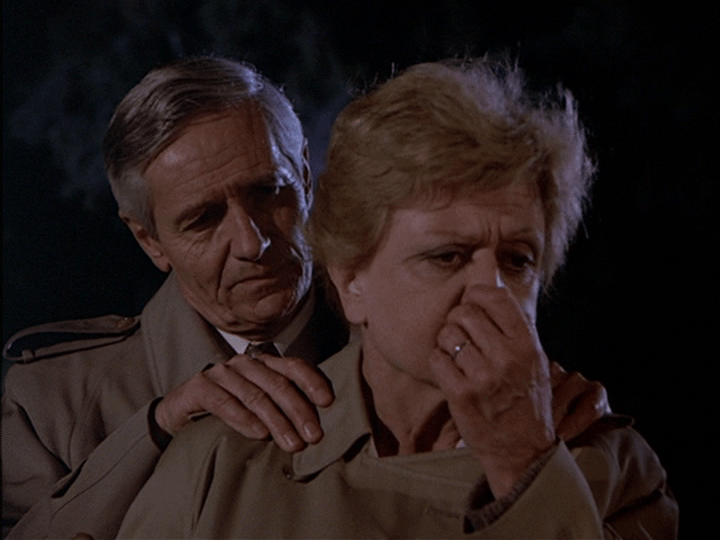

I give this episode four stars, it’s one of my favorites.
Dear readers, there are those among us who are certain that Jessica Fletcher is the world’s most successful serial killer. It’s not a pet theory of mine, but if you are interested, here is an excellent explanation as to how she did it this time.
Like other types of genre fiction, murder mysteries often rely on tropes and other conventions to set the desired tone or convey the story more effectively. Over its 12-season run, I think MSW probably makes use of almost every cozy mystery convention. The series is also well known for its own set of tropes and clichés.
I’ve discussed most of these earlier in the post, so I’ll be brief.
One or more costumes are used to obfuscate the identity of the murderer and/or the victim.
In cozy murder mysteries, the corpse is often found somewhere unusual. This helps keep the tone of the story light, and lets the audience focus on the puzzle, rather than on the disturbing and grim realities of violent death.
We overhear only part of a main character’s phone call, and what we do hear is usually either vague, suggestive, or both.
An innocent person – Grady – is wrongfully arrested. This is a favorite MSW trope/plot device, but it’s also ubiquitous to the genre. This plot twist can be used simply to keep the audience guessing, or to trick the culprit into giving himself away. It can also be used to illustrate the ineptitude of law enforcement, and thus the necessary involvement of our amateur detective.
Who doesn’t love a good montage, or love to hate a bad one? I’ve already discussed the two montages included in this episode, the makeover (meh) and the book promotion (enjoyable). However, I feel like there was a missed opportunity for a third montage, wherein our hero tries on all of Louise McCallum’s costumes before borrowing one. In fact, my theory is that Kitt and Grady probably also had to borrow costumes from Louise, so it could have been a really fun montage of all three of them playing dress up.
This is the first episode, so all the MSW tropes and conventions still seem fresh and new, even the ones that will quickly become cliché. I’ve given them all names, and I’ll tag the ones that aren’t so ubiquitous as to happen almost every episode.
Jessica tries to leave, but an innocent person is suspected, so she has to stay and solve the case. Often this involves getting off a train or missing a flight. This time, it’s Grady who’s arrested, foiling Jessica’s second attempt to leave town.
The characters are confounded or undone by some newfangled technology. This time, potentially incriminating real estate reports are “in the computer.” Poor Grady must have hit the wrong button, because “Instead of the real estate reports, it started spitting out last year’s wholesale fish prices!”

Jessica confronts the killer alone and persuades them to confess. I cannot think of an episode of MSW that doesn’t use this plot device, so it’s in cliché territory, but it’s also one of the things that made the series so beloved.
To end the episode on an up note, there’s almost always a cheesy freezeframe of Jessica laughing or otherwise mugging in response to the last, generally pretty lame, joke of the episode. Again, it’s used so much it’s cliché, but also something that made the show. Yes, of course I have a final freezeframe page.
Jessica Fletcher has the most satisfying ability to tell odious people where they get off without ever being discourteous or vulgar. She has a couple good repartees this episode:
I often find myself wishing I had Jessica’s knack for saying exactly the right thing. Of course, I don’t have a team of writers creating my dialogue… at least, I’m pretty sure I don’t. Free will is a topic for another day…
Returning to our muttons, the exchange with the book critic was probably the wittiest scene of the episode, but the man set himself up in a very specific way, and so Jessica’s response doesn’t lend itself to reuse. However, I can imagine many occasions where “It was an experience I’ll never forget” would come in handy.
About halfway through the episode, Preston Giles refers to what I always call “the train station” as “the railway station.” Initially, I thought it must be an old-fashioned gentleman using an old-fashioned term, how quaint, or maybe vaguely transatlantic, of him. But readers, I was wrong. According to the Google Books Ngram Viewer, in 1984 it was actually more common to say railway station than train station, although it sounds very old fashioned to me now.
The New York railway station is an important element of this episode. There are five scenes that take place there:
Solving the case by way of train schedules is a common murder mystery trope. One that isn’t used in this episode. However, the plot would have benefited from a quick glance at the Amtrak schedules. Why does the Yalie who wants to interview Jessica get on at New London, when Yale is in New Haven? On his way back from Mystic Pizza?

Does it matter? Yes. New York to New Haven by train is about 1.5 or 1.75 hours, putting the 4:30 pm New York train in New Haven by about 6:00 or 6:15. That same train would not reach New London until about 7:00 pm. The Yalie then needs at least a few minutes to discover Jessica is not on the train, talk to Daniel about where she is, and place a call (remember, no cell phones) to Giles’ New York office. Giles then has to make very good, probably impossible, time to meet Jessica poolside in New Holvang before the 8:00 pm lights come on. It’s about a 1.5-hour drive from Manhattan to the sonic booms of Stewart Air Base. So, what have we learned? Fictional facts matter. Also, 10:1 there were no Yalies in the MSW writers’ room that day.
Is there still something stuck in your craw? I got you. Why does Daniel the conductor tell this Yalie where Jessica went anyway, rather than just telling him she’s not on the train? My theory: Remember Daniel’s son’s university scholarship? It’s to Yale, so he’s partial.
Am I splitting hairs? Maybe. However, let the record show that Daniel’s son starts school “next September 4th.” Tuesday, September 4th, 1984, was the day after Labor Day, an extremely plausible first day of school. If we can be precise about dates, we can be precise about Connecticut railway stations.
Unlike future episodes, this one wasn’t a sartorial standout for me. While Louise McCallum and Ashley Vickers have some varied and chic ensembles throughout the episode, everyone else wears a lot of tweed and trench coats, which is accurate to 1984 New York, but isn’t especially interesting to look at.
The very significant exception to this is, of course, the costumes in the party scenes, which were far and away the most remarkable and memorable looks this episode.
Jessica’s best look is meant to be, and is, the fairy godmother costume, which foreshadows the camp and glamour, but not necessarily the elegance, we’ll see later in the series. Jessica’s worst look is, and is meant to be, the makeover montage visual gag dress that Jessica refers to as a “barber pole” on her arrival in New York.
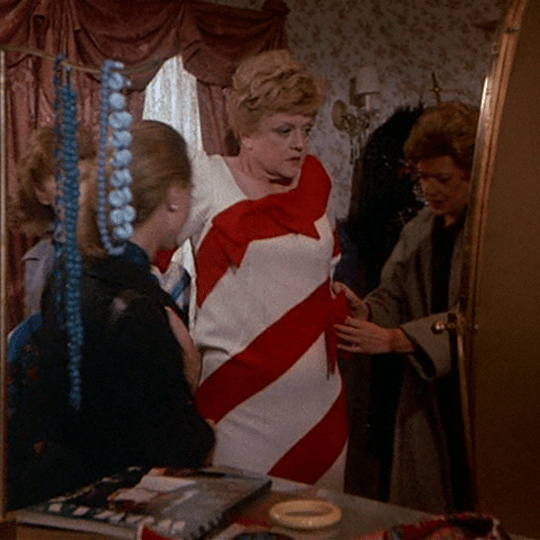
The highs and lows of campy glam this episode.
And the award for worst dressed/best visual gag goes to Cap’n Caleb’s Chowder Houses HQ.
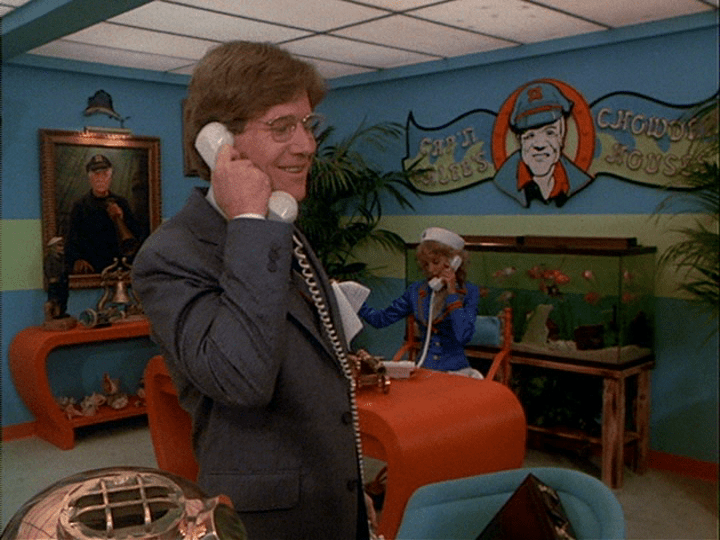
Before Jessica’s penultimate attempt to depart New York by train, Kitt discloses that The Corpse Danced at Midnight is being considered for a movie deal, foreshadowing a later MSW episode, “Hooray for Homicide.”
As the series unfolds, we will learn more about the future of a few characters. Sadly, there will be no doing of deeds in Jessica’s parlor – Grady and Kitt are not meant to be. Though we bid adieu to the lovely Kitt, we will see Preston Giles again, after he is released from prison.
But what becomes of, IMHO, the most underserved character of this episode, the warm, glamorous, costume-sharing mensch, Louise? As we know, Preston Giles chooses to do the right thing and confess to the murders of Baxendale and McCallum. Because of their prenup, Louise inherits “next to nothing” from the Chowder King’s estate. However, as Caleb’s widow, Louise would have had grounds to sue Giles in civil court for the wrongful death of her husband.
Fortunately, it doesn’t come to that. Giles, inspired by his deep and abiding love for Jessica, chooses to be noble, and settles with Louise out of court, generously. With her newfound wealth, Louise decides to make a fresh start, leaves New Holvang behind, and pursues her dream of opening a bespoke costume boutique for New York City’s elite. Her motto: “No Duplicates!” She becomes a lauded and beloved fixture in NYC fashion circles. When Iris Apfel declares “More is more,” it’s her good friend Louise who adds “and less is a bore.” In the 90’s, it’s Louise who convinces a young SJP to embrace feathers as a daytime look. …Or is it a young Carrie Bradshaw? Do MSW and SATC exist in the same fictional universe? Yes. Let’s make it yes.


Loved this episode so much you’re craving more? Here are my recommendations:

To Mrs. Fletcher’s rare gift for murder, and to her continued success
Fit for New York’s Chowder King
Featuring the only claws in Cabot Cove
Steamed Lobster with Drawn Butter
For our gracious host
Provided by the PTA Refreshment Committee
 Murder, She Wrote, She Wrote